

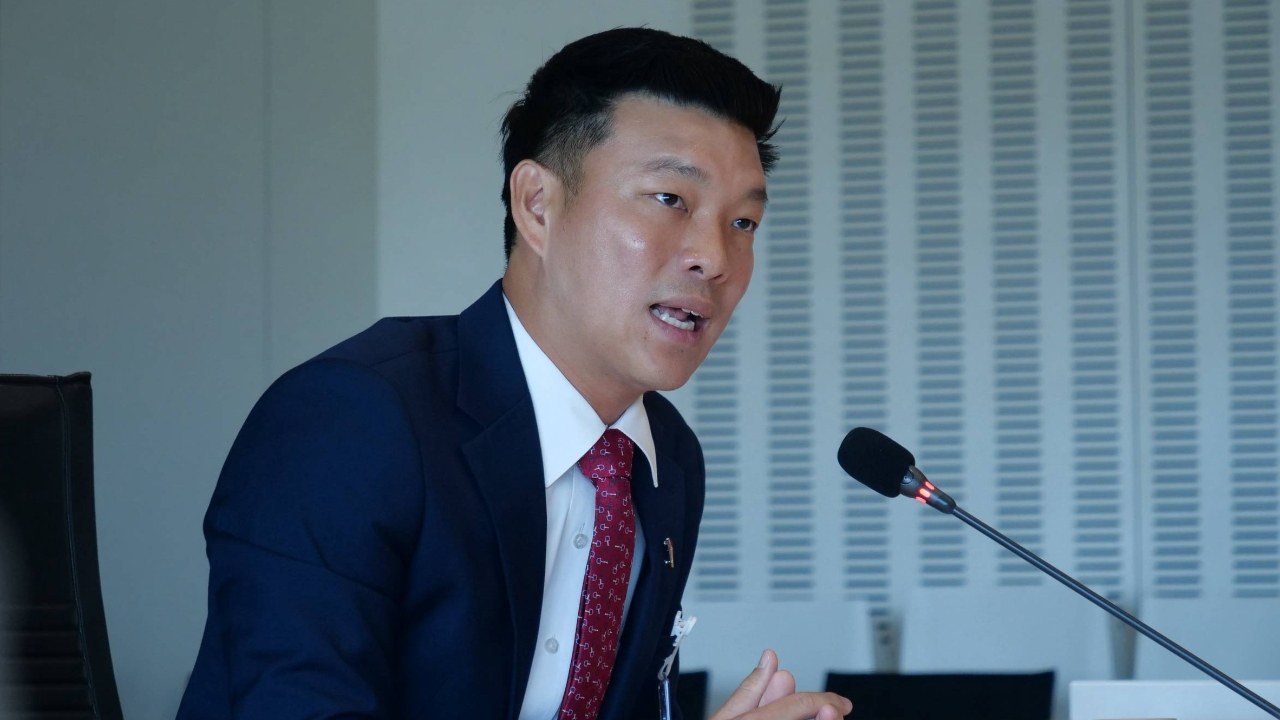
"Teng Natthapong," leader of the Prachachon Party, urged the government to stop rushing the no-confidence debate, emphasizing that the 18 ministers must be given appropriate time. He expressed concern about scheduling conflicts with the 2571 budget forum and said he is ready to postpone the debate by 1-2 weeks to November if needed.,
At 10:00 a.m. on 22 October 2026 at the parliament, Natthapong Ruangpanyawut, party-list MP and leader of the Prachachon Party as opposition leader in the House of Representatives, gave an interview regarding the meeting of the three-party parliamentary whips on 21 October. The meeting aimed to set the schedule for the no-confidence debate. He said the negotiations are still unresolved and likely to continue today. He believes the main issue is the amount of time allocated for the debate. He understands that the Prime Minister and the government side likely have other commitments.
"However, I believe the Prime Minister and the Cabinet’s schedules can be flexible or adjusted. Therefore, I hope today’s joint whip meeting will reach a conclusion on the allocation of time and dates for the debate. We should establish the principle that the no-confidence debate is a key parliamentary function, and the government should grant the opposition appropriate and sufficient time," said Natthapong.
Natthapong added that although he did not attend the 21 October meeting, everyone is well informed that this time 18 ministers face no-confidence motions. Compared to previous occasions with fewer ministers, which still had four days of debate and voting on the fifth day, the 18 ministers should likewise be allocated suitable debate time.
When asked to confirm a five-day debate period, possibly not at the end of October but in November, Natthapong said the opposition is ready at any time. The exact timing depends on the government’s schedule. The opposition is flexible and willing to postpone by 1-2 weeks because the key issue is that the debate must provide the opposition with full time. Since the no-confidence debate occurs once a year, he is also concerned that if the government pushes for the debate by late October, citing early November commitments of the Prime Minister and Cabinet, this could be moved. The government’s 2571 budget calendar, already released by the Cabinet, must be considered.
Natthapong continued that the Budget Office has released a calendar indicating that at the end of October, there will be an intensified process this year before the budget proposal is drafted. The government must hold a forum in parliament to hear opinions on the 2571 budget from representatives before agencies submit their requests. Therefore, if the government pressures the opposition’s debate to late October citing early November duties, the debate and the 2571 budget hearing could clash. The government must clarify this clearly.
When asked about the government possibly extending the debate time as a bargaining point, Natthapong said he does not want the debate schedule and duration to become a media battleground. Everyone should agree because the no-confidence debate is a parliamentary forum where the executive must respond to the opposition, and it happens only once a year. Principles must be set to allow the opposition to perform their duties fully. He does not want disputes over this matter and believes the government can manage the scheduling.
Asked whether reducing government time in favor of the opposition might affect the government’s ability to fully explain, Natthapong said that for fairness, the opposition also wants to hear the government’s explanations regarding the issues raised. He does not want to see a debate where only the opposition speaks and the government remains silent. That would not be an appropriate parliamentary process.