

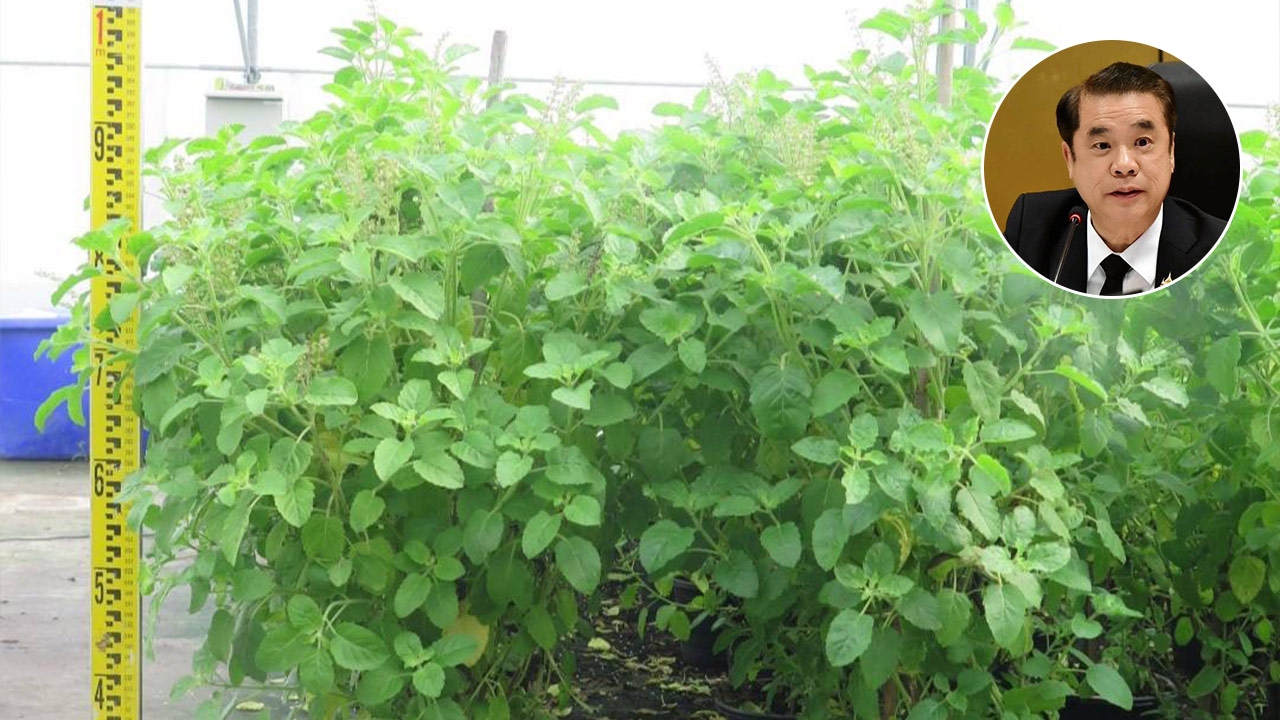
Suriyas clarified that registering protection for basil varieties does not impact the general public; growing the plants for household consumption is permitted, but propagating the four new basil varieties for commercial sale is prohibited.
On 22 October 2026, Mr. Suriyas Jungrungreangkit, Minister of Agriculture and Cooperatives, addressed concerns about a private company registering protection for basil varieties. He explained that the law allows private sectors conducting research and developing new plant varieties to apply for protection rights, similar to intellectual property rights for pharmaceutical research. He confirmed that this registration does not affect the general public; households may grow the protected basil varieties for consumption as usual, but propagation for sale without authorization is not allowed.
Mr. Suriyas added that the Department of Agriculture continues research and development of plant varieties to enable farmers to benefit from improved seeds for cultivation.
The concerns arose after BioThai Foundation disclosed that CP RAM Co., Ltd. had registered protection for four new basil varieties: Kaewjuree 01 on 12 March 2024, and Kaewjuree 02, 03, and 04 on 24 May 2024, with a protection period of 12 years ending in 2036, under the Plant Variety Protection Act B.E. 2542 (1999).
According to documents from the Department of Agriculture, the four basil varieties were developed from the native basil strain CPR1 by chemically inducing an increase in chromosome sets combined with tissue culture techniques. Development began in April 2020, with planting trials at Kasetsart University Kamphaeng Saen Campus in Nakhon Pathom Province and CP RAM Company in Pathum Thani to select varieties suitable as culinary raw materials.
BioThai raised concerns that if Thailand amends its plant variety protection laws to comply with the UPOV 1991 Convention, it may restrict farmers' and the public's rights to save and share protected seeds for non-commercial use, potentially limiting seed sharing and hindering further breeding and development of plant varieties.