

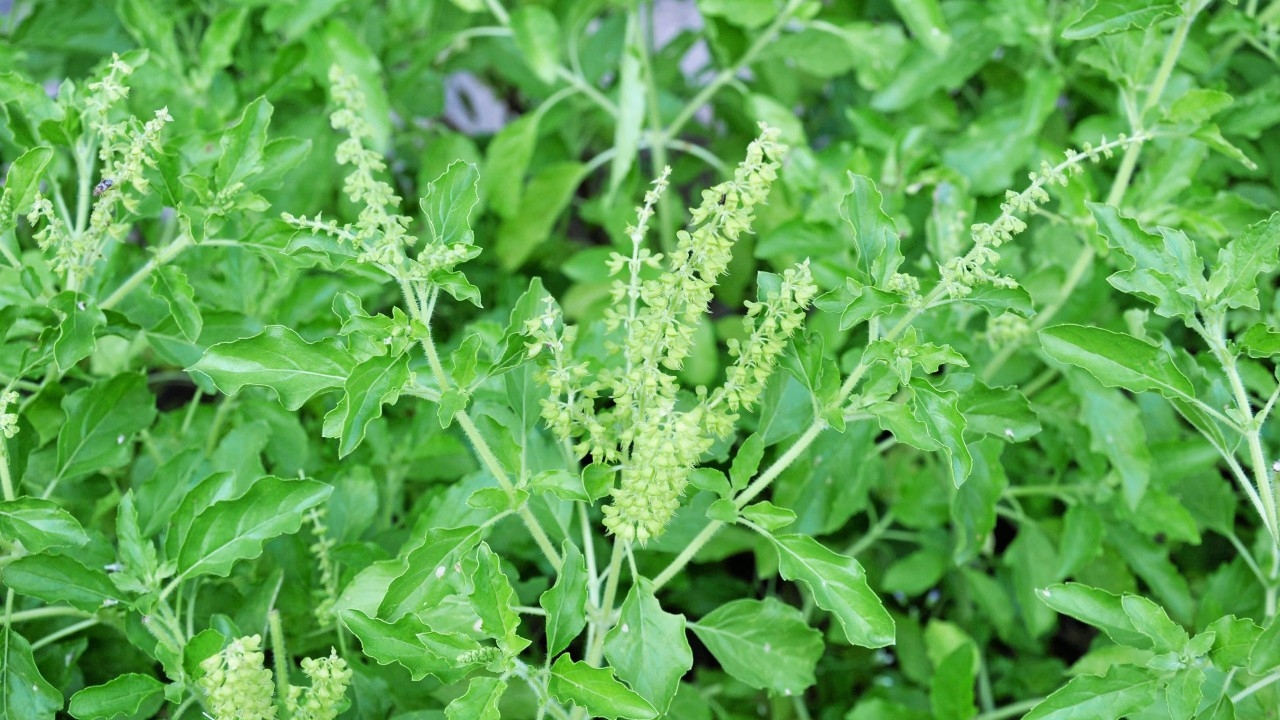
The Deputy Government Spokesperson explained that registering protection for four new holy basil varieties does not grant private companies exclusive rights. Citizens may save seeds for personal cultivation and consumption without any violation, but commercial propagation for sale is prohibited.
On 22 October 2026, Second Lieutenant Phatdarasmi Thongsaluaykorn, Deputy Spokesperson of the Prime Minister's Office, clarified concerns about the registration protecting four new holy basil varieties called “Kaewjuree 01 - 04” by a private company. She stated that the registration does not give the private company exclusive rights over all holy basil varieties in Thailand. Protection applies only to the newly registered varieties under the law. People can still cultivate local and common holy basil varieties that are not protected as usual.
The Deputy Spokesperson of the Prime Minister's Office said that the Ministry of Agriculture and Cooperatives, represented by Mr. Kris Uttamawetin, Deputy Permanent Secretary and spokesperson for the ministry, explained on 22 October 2026 that people can still grow holy basil for personal use, harvest leaves for sale, cook food to sell, and sell holy basil products for consumption normally. There is no need to buy seeds from any private company if they wish to grow local or common varieties not under protection.
Regarding legal rights granted to developers of new holy basil varieties, these relate to producing and selling propagation materials such as seeds, seedlings, and cuttings of the protected varieties. Commercial propagation and sale may require permission from the rights holders under legal conditions. Therefore, it is important to distinguish clearly between selling holy basil as food and producing plants for propagation and commercial sale.
However, Section 33 of the Plant Variety Protection Act B.E. 2542 (1999) provides certain exceptions, such as using plant varieties for study, research, or breeding, non-commercial use, and farmers replanting propagation materials they have produced under legal conditions. Thus, saving seeds for replanting is not always a violation. It depends on whether the variety is protected and if the usage fits within legal exceptions.
Regarding concerns from the Biothai Foundation and the public about farmers’ rights, access to plant varieties, and origins of research, the government believes it should openly receive feedback and provide verified information. This will ensure that research promotion proceeds alongside protecting farmers’ rights, biodiversity, and the country's food security.
Meanwhile, the Department of Agriculture is gathering public input to amend the Plant Variety Protection Act B.E. 2542. Farmers, breeders, academics, civil society, and the public are invited to submit opinions, including concerns about protection under the UPOV 1991 Convention. The impacts on farmers’ rights, production costs, and access to plant varieties will be carefully considered. Receiving feedback does not mean all proposals will become law immediately.
The Deputy Government Spokesperson added that the government, through the Ministry of Agriculture and Cooperatives, prioritizes promoting research and plant breeding alongside safeguarding citizens’ rights and livelihoods. This ensures farmers maintain access to necessary plant varieties and the public can use common holy basil varieties as usual. The government welcomes participation from all sectors in revising the law for fairness and national benefit.
Citizens and farmers wishing to check information about protected plant varieties or inquire about cultivation, sale, and propagation can contact the Plant Variety Protection Division, Department of Agriculture, at 02-940-7214 for further advice.
