

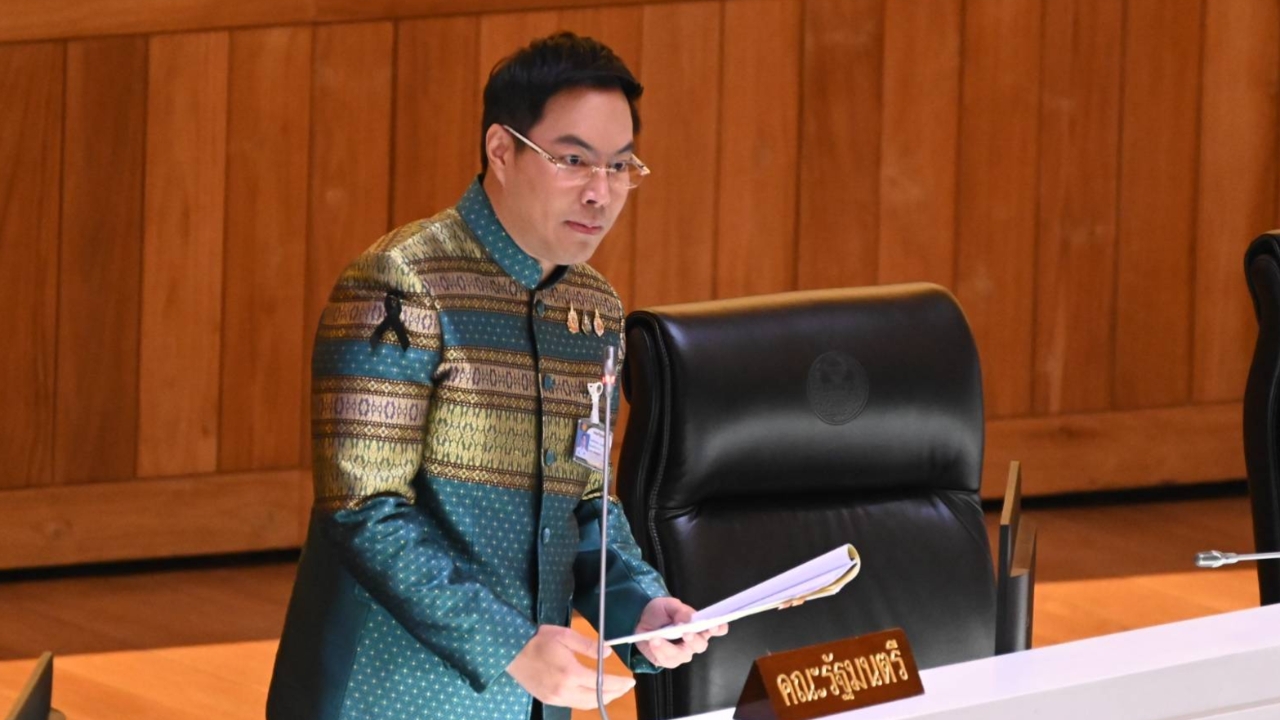
"Akkharanat" responded to a question from the People’s Party, explaining that the new curriculum adjustment focuses on age-appropriate competencies, with a three-year evaluation period before nationwide implementation.
On 22 Oct 2026 GMT+7, at the Parliament, Mr. Akkharanat Kankittinan, Deputy Minister of Education, was assigned by Minister Prasert Chandraruangthong to answer a question from Mr. Theerasak Jiratratru, a party-list MP from the People’s Party, regarding the government’s seriousness about changes to the core basic education curriculum.
Mr. Akkharanat explained that the curriculum adjustment represents a transition from the 2008 core basic education curriculum, which emphasized learning standards, to a Competency-Based Education (CBE) curriculum that prioritizes applying knowledge and skills in real situations through Active Learning. A working group comprising stakeholders from all relevant sectors is implementing this.
In the 2025 academic year, the new curriculum will be piloted in two levels: the 2025 Early Childhood Education Curriculum for children aged 3–6, and lower primary education for grades 1–3. In 2026, it will expand to three levels by adding grades 4–6, covering 4,221 schools. By 2027, the plan is to cover all five levels, including lower and upper secondary education, with the curriculum framework currently under development.
Mr. Akkharanat stated that a nationwide implementation deadline has not been finalized. The government will evaluate the program thoroughly during the 2025–2027 academic years before deciding the next steps. They are also developing Learning Progression tools to ensure continuity between educational stages.
To support teachers, the Office of Basic Education Commission (OBEC) is developing tools to reduce workload in assessment result processing and promoting the use of artificial intelligence (AI) in school curriculum development, lesson planning, and assessment tool creation. Additionally, participating schools can flexibly manage their per-student subsidy budgets for learning materials as needed.
"Initial feedback shows a shift from rote memorization to more hands-on learning, with students happier and more confident to express themselves. The reading ability assessment of Grade 1 students in pilot schools shows an average score of 82.10, higher than the national average of 78.57. OBEC plans the first formal evaluation to align with curriculum goals in the second semester of the 2026 academic year," said Mr. Akkharanat.