

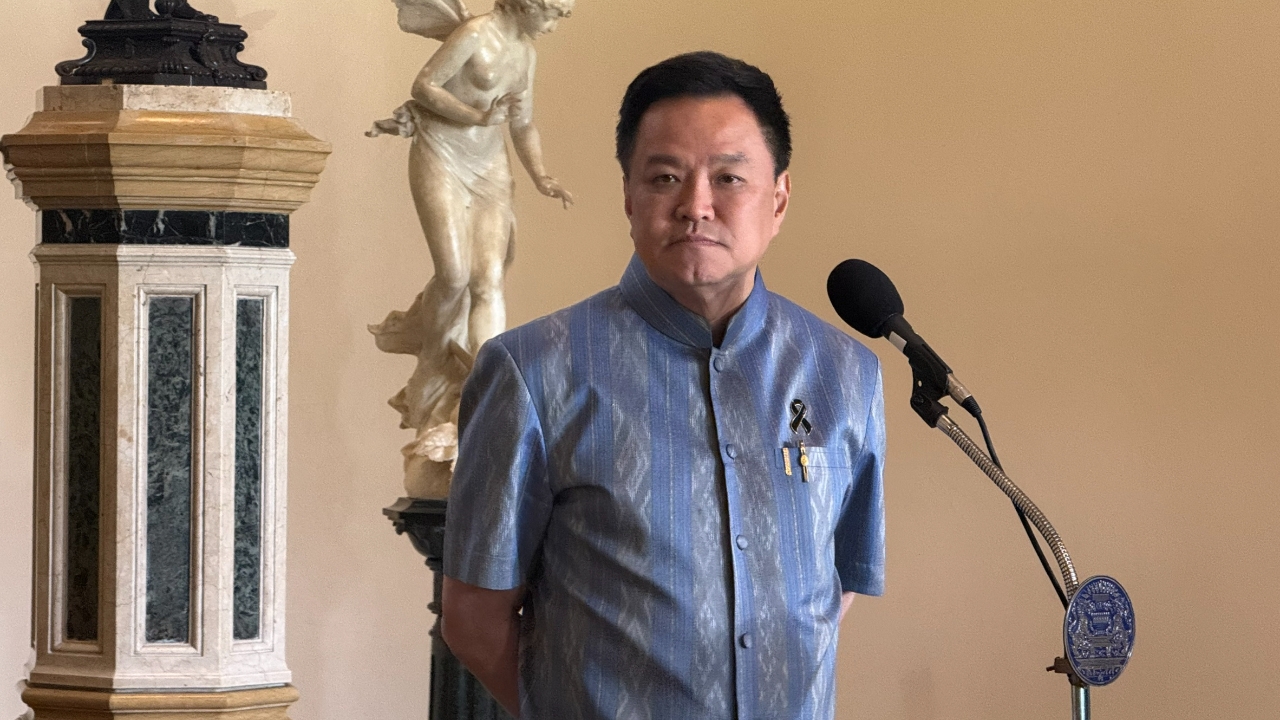
The Prime Minister ordered the Customs Department to intensify inspections of exports after discovering drug smuggling cases. He emphasized that cannabis flower remains a controlled drug and pointed out that CBD is for medical use, not recreational.
On 22 Oct 2026 at the Thai Khu Fah Building, Government House, Mr. Anutin Charnvirakul, Prime Minister and Minister of Interior, spoke after chairing the 3rd/2569 meeting of the Narcotics Control Board. He said the meeting discussed prevention and suppression measures for fiscal year 2570, requiring integrated cooperation among all agencies—civilian, administrative, police, military—and Cabinet support on budgets. They reviewed a draft amendment to the Narcotics Act, which includes increased penalties and controls on cannabis. Details of the draft law would be provided by the Secretary-General of the Narcotics Control Board.
When asked about the use of transport companies to smuggle drugs abroad, the Prime Minister said he instructed the Customs Director-General to strictly monitor this illegal export, likening it to smuggling contraband. He stressed the need for strict inspection of product types, good intelligence, and random checks. While not every container can be inspected, improved experience and efficiency mean that shipments to Europe or elsewhere originating from Thailand are illegal if they contain any cannabis parts—stems, leaves, or flowers—because they are illegal from the start.
Asked whether cannabis would be reclassified as a controlled drug, the Prime Minister said the status remains unchanged. CBD is legal for use in medical and cosmetic products under FDA regulations, strictly for health purposes. Recreational use and cannabis flowers remain illegal.
"People often say cannabis is no longer a drug, but the important part—the flowers—are still fully controlled drugs under the law and enforcement. Shops can only sell medical products without flowers. They cannot sell rolled cannabis or cigarettes containing flowers. If such shops still operate, their licenses can be revoked immediately. I instructed the Ministry of Public Health, which handles this, to revoke licenses and conduct inspections. Licenses must be renewed annually, and renewal is not automatic; inspections must intensify," the Prime Minister said.
Mr. Anutin added that the drug law draft submitted by the Bhumjaithai Party to Parliament yesterday includes stricter penalties. Possession of even one pill would be charged as drug use. At the meeting, he asked about concerns that this might overwhelm prisons and treatment facilities. The Permanent Secretaries of Health and Justice and the Narcotics Control Board Secretary-General assured that management is feasible and enforcement officers have confirmed capability.
The Prime Minister said he was unaware of past policies but noted that during his tenure as Health Minister, drug control was strict. He mentioned that three years after his departure, he questioned why medical cannabis clinics were well-established then, but now there are calls to revert policies. He questioned the rationale behind such moves.
"Roots, stems, leaves, and CBD were removed from the drug list when I was minister, but after I left, there were attempts to reverse this. What is the basis for these changes? Policies cannot be made based on ministers' personal preferences; principles must guide policy, not politics. There have been political struggles over these issues, but ultimately the Narcotics Control Board did not approve changes, so the original draft remains: only flowers and the whole plant remain controlled drugs, as do other narcotics," the Prime Minister said.