

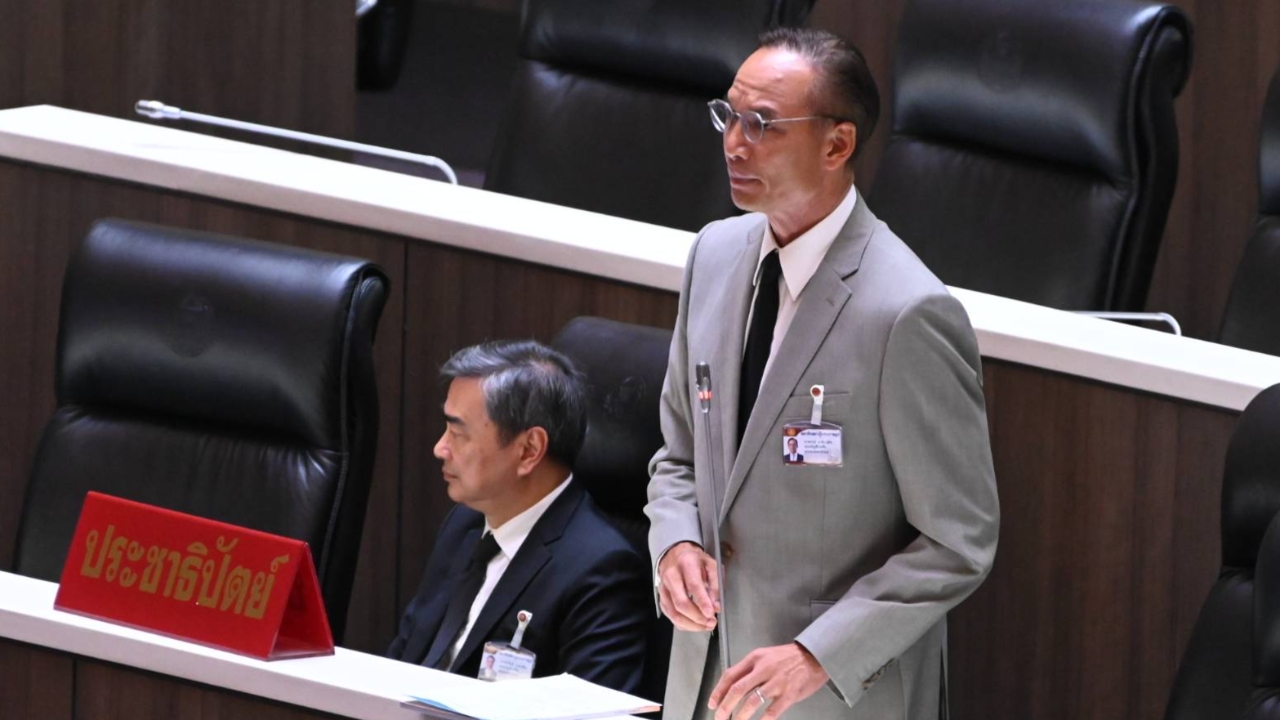
Korn criticized the government’s failure in managing the Oil Fund, with debt surpassing 100 billion baht. He warned that proposals to transfer money across funds and use dividend income violate fiscal discipline.
On 22 Oct 2026 GMT+7 at the Parliament Building, Korn Chatikavanich, party-list MP and Deputy Leader of the Democrat Party, spoke during the House of Representatives session reviewing the 2024 annual report of the Oil Fuel Fund. He raised three main issues regarding the fund's debt burden, legal aspects, and solutions to oil price problems.
1. Oil Fund debt exceeds 100 billion baht, raising questions about authority to extend borrowing limits.
Korn pointed out that the Oil Fund currently carries accumulated debt exceeding 100 billion baht, which ultimately will translate into higher oil costs borne by the public long-term. In 2022, the government issued a royal decree extending the borrowing limit to 170 billion baht, but the decree was valid for only one year. He questioned the government and Ministry of Finance on what legal authority the fund is borrowing beyond the original 20 billion baht limit now, since no new royal decree has been announced.
2. Urges explanation for continuing bioenergy support despite expiration of special provisions.
Korn expressed concern about Section 55 (transitional provisions) of the 2019 Oil Fuel Fund Act, which stipulates ending compensation payments to tobacco and bioenergy within 7 years after the law’s enforcement—this deadline passed on 24 September. Yet, the fund still pays compensation for bioenergy-mixed fuel. He asked the government to clarify the criteria used and whether this breaches the fund’s founding law.
3. Points out that ideas to transfer Energy Conservation Fund money and use refinery dividends violate fiscal discipline.
Furthermore, Korn addressed the Energy Minister’s proposal to transfer leftover funds from the Energy Conservation Fund and use refinery dividends held by the Ministry of Finance to help pay down the Oil Fund’s debt. He warned these approaches contradict the Energy Conservation Fund’s purpose and violate fiscal discipline and budget law, since state dividends must become government revenue and their use must be approved by the House of Representatives. Arbitrary cross-fund transfers are not allowed.
Korn called on the government to reconsider its oil price solutions, reaffirming the Democrat Party’s proposal to reduce excise and VAT taxes on fuel. This approach directly tackles cost of living and product price issues at the source, rather than relying on the Oil Fund and incurring unsustainable debt, then proposing measures that risk violating fiscal laws.