

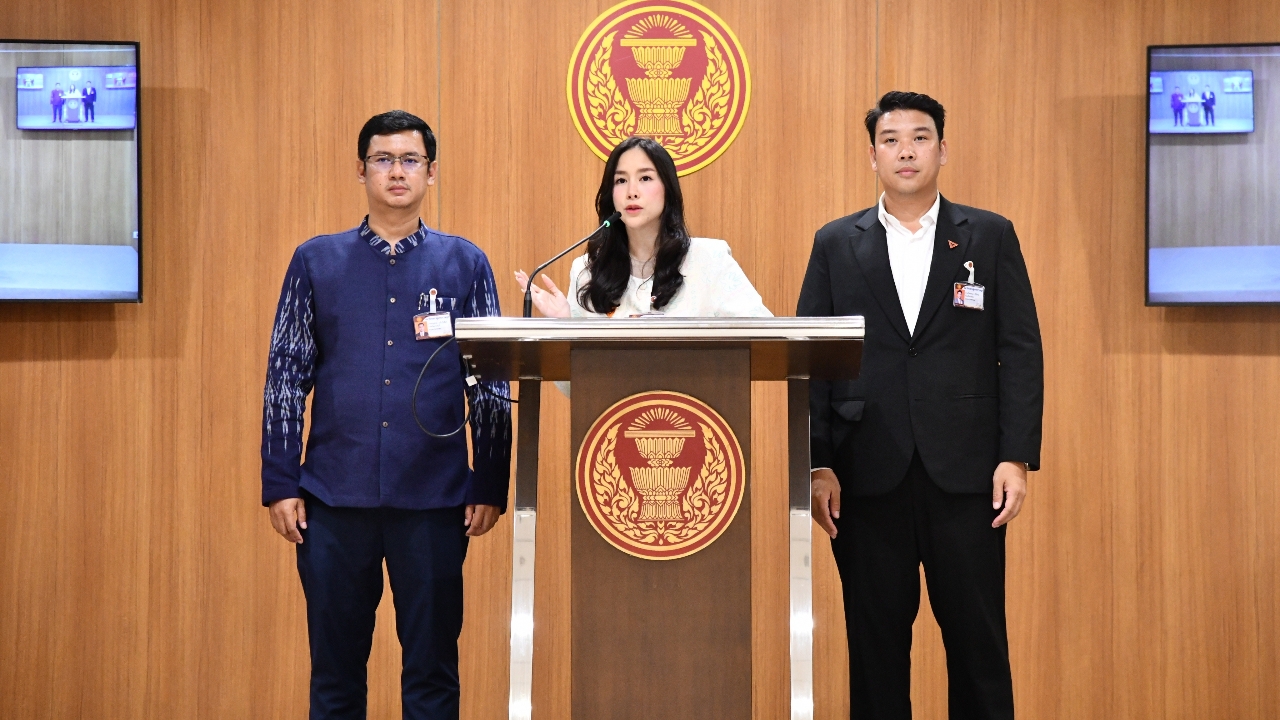
Chonlatat, a Bangkok MP from the Puea Chat Party, points out that reforming Thai PBS must be transparent and subject to scrutiny. He warns that switching to an annual budget risks affecting the independence of public media and emphasizes that political parties must not gain authority over media operations.
On 23 Oct 2026 GMT+7, Ms. Chonlatat Koykul, Member of Parliament for Bangkok's 28th district from the Puea Chat Party, revealed after the Parliamentary Committee on Political Development, Mass Communication, and Public Participation meeting on 22 Oct 2026 GMT+7 that they reviewed a draft amendment to the Public Broadcasting Organization of Thailand Act (Thai PBS). The proposal involves changing Thai PBS's revenue source from a maintenance fund collected as a 1.5% tax on liquor and tobacco, capped at 2 billion baht annually, to receiving an annual government budget allocation.
Ms. Chonlatat stated that the key issue in reviewing this bill is finding a balance between transparent, accountable use of public funds and maintaining the guarantees for public media independence. She emphasized that these goals can be pursued simultaneously without diminishing Thai PBS's independence in exchange for budget oversight.
During the meeting, financial agencies including the Fiscal Policy Office, Excise Department, and Budget Bureau explained the advantages of integrating revenue into the national budget system. Meanwhile, the Office of the Council of State noted that Section 82 of the State Financial Discipline Act includes exceptions for agencies established by prior laws, allowing Thai PBS to continue receiving the maintenance fund from liquor and tobacco taxes as stipulated by law. Thus, switching to an annual budget is a legislative option, not a mandatory requirement.
The Excise Department reported that over the past decade, Thailand has collected more than 200 billion baht annually in liquor and tobacco taxes, enabling Thai PBS to receive the full 2 billion baht maintenance fund each year. However, the Budget Bureau admitted that under an annual budget system, it cannot guarantee Thai PBS would receive the same or sufficient funding annually, as allocations depend on government budget burdens and policies at given times.
This raised committee concerns that if public media's operating budget depends on annual government and parliamentary approval, it could open the door to pressure that undermines the media's role in scrutinizing those in power. There was also an observation that other state agencies also have off-budget revenues but are not facing similar proposals for funding system changes.
Thai PBS management expressed disagreement with changing the revenue source, noting the organization has received the 2 billion baht maintenance fund cap consistently for 18 years and already has financial oversight from the Office of the Auditor General, the Policy Committee, the Viewer and Listener Council, as well as reporting to Parliament.
Thai PBS executives highlighted the public media's distinct mission compared to commercial media, including investigative journalism, children’s and educational programming like ALTV, support for independent producers, disaster reporting, and developing national viewing platforms to reduce reliance on foreign platforms. They proposed legal improvements to enhance revenue flexibility, such as monetizing produced content, selling documentaries and news footage overseas, joint investments with other agencies, and collecting digital platform subscription fees—all without compromising the organization's independence.
Ms. Chonlatat cited media communication scholars’ concerns about funding system changes. Dr. Jermsak Pintong said revenue sources should remain independent from state power to prevent political interference or pressure leading to self-censorship. He suggested setting a budget ceiling adjusted by inflation and online viewership to ensure spending accountability.
Associate Professor Dr. Pirongrong Ramsut emphasized that stable budget guarantees serve as a safeguard against interference, essential for building a trustworthy media ecosystem and enabling Thai PBS to plan long-term development of a National Streaming Platform.
Meanwhile, Assistant Professor Dr. Phatsasiri Kulab warned that government budget allocations risk state capture of news direction and could force media self-censorship, undermining public media functions that commercial outlets may not fully perform, such as providing space for civil society, fact-checking, and handling public complaints.
Additionally, the meeting raised concerns about suspicious spikes in support for the draft law on the parliamentary website after midnight, despite the comment period supposedly being closed. This issue requires fact-checking. Pakamon Noon Anan, MP from the Puea Chat Party and chair of the committee, plans to invite the parliamentary IT department for clarification in the next meeting.
Going forward, the committee will begin reviewing the draft law clause by clause next week and invite the bill's proponents for further explanation. The Puea Chat Party intends to propose an alternative amendment draft for concurrent consideration, allowing Thai PBS and civil society to participate in designing reform directions.
Ms. Chonlatat reiterated that Thai PBS reform should focus on making the organization’s spending transparent, accountable, agile, and more responsive to the public while safeguarding the independence of public media. The reform’s goal should be to enable Thai PBS to better serve the public interest, not to create opportunities for political parties to exert control over media operations.