

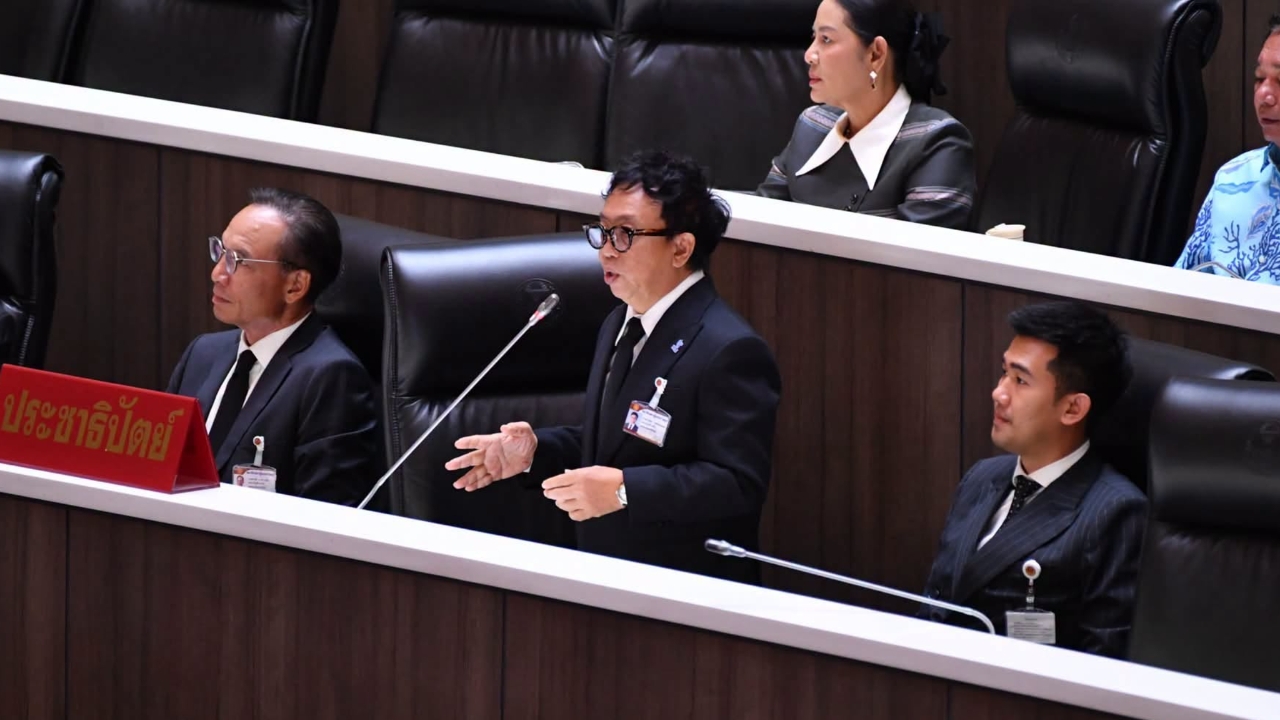
Satit posted an explanation about the collapse of the three-party whip meeting to set the no-confidence debate date. He thanked Speaker Sophon for upholding parliamentary dignity and for scheduling an opposition meeting on 28 October before the third round of negotiations.
On 23 October 2026, Satit Wongnongtoey, party-list MP and deputy leader of the Democrat Party, posted on Facebook regarding the three-party whip discussion on setting the no-confidence debate date and time allocation. Under the topic “Why is the no-confidence debate an issue?”, he summarized that the no-confidence debate is a constitutional channel under Article 151 allowing the legislature—specifically the opposition—to scrutinize the government once a year as a democratic check and balance.
The opposition must gather information and prepare debaters, concluding that debating 18 ministers requires 5 days, roughly 60 hours, more than during the 'Uncle Tu' era when debating 9-10 ministers took 40 hours. Previously, informal talks were held to find agreeable times before setting debate dates. This time, Cabinet representatives insisted on only 3 days—27-29 October—and said November to December was unavailable. The opposition suggested adding weekends, but the government rejected this. Reducing the debate to 4 days was manageable but required postponing dates to consult the many debaters. Ultimately, the government insisted on 27-29 October, offering extra time from the afternoon of 26 October but ending by 2:30 a.m., excluding protest time. This led to the question, “Is the legislature truly allowed to scrutinize the government under the constitution if there is no time at all?” and thus the three-party whip meeting collapsed.
“Thanks must go to Speaker Sophon Sarum, who was fully informed including by the opposition leaders—Leader of the Opposition, Abhisit Vejjajiva, and the opposition whip chairman—with me and Mr. Rom coordinating the opposition information. On the evening of 22 October, he issued a meeting agenda excluding the no-confidence debate next week, allowing the government to find suitable time for the debate motion. I consider this a commendable act preserving the legislature’s dignity in this case,” Satit said.
Satit added that after the failed three-party whip meeting, opposition coalition representatives, as he posted, met the Speaker who understood the opposition’s oversight role. The Speaker asked if the opposition could reduce the debate to 4 days plus 1 day for voting, approximately 50 hours of speaking time. The opposition must internally discuss managing time and reducing debaters, as the lineup is already set. An opposition-only meeting was scheduled for the afternoon of 28 October at the parliament to reach a conclusion before informing the Speaker. The Speaker would then arrange a third three-party whip meeting with government and Cabinet representatives to set the date. If the debate cannot occur in October, it will move to November; the Speaker must check the Cabinet’s availability. The no-confidence debate cannot be canceled as it would violate the constitution—a serious matter—and Satit believes the government would not allow such a precedent given past practice.