

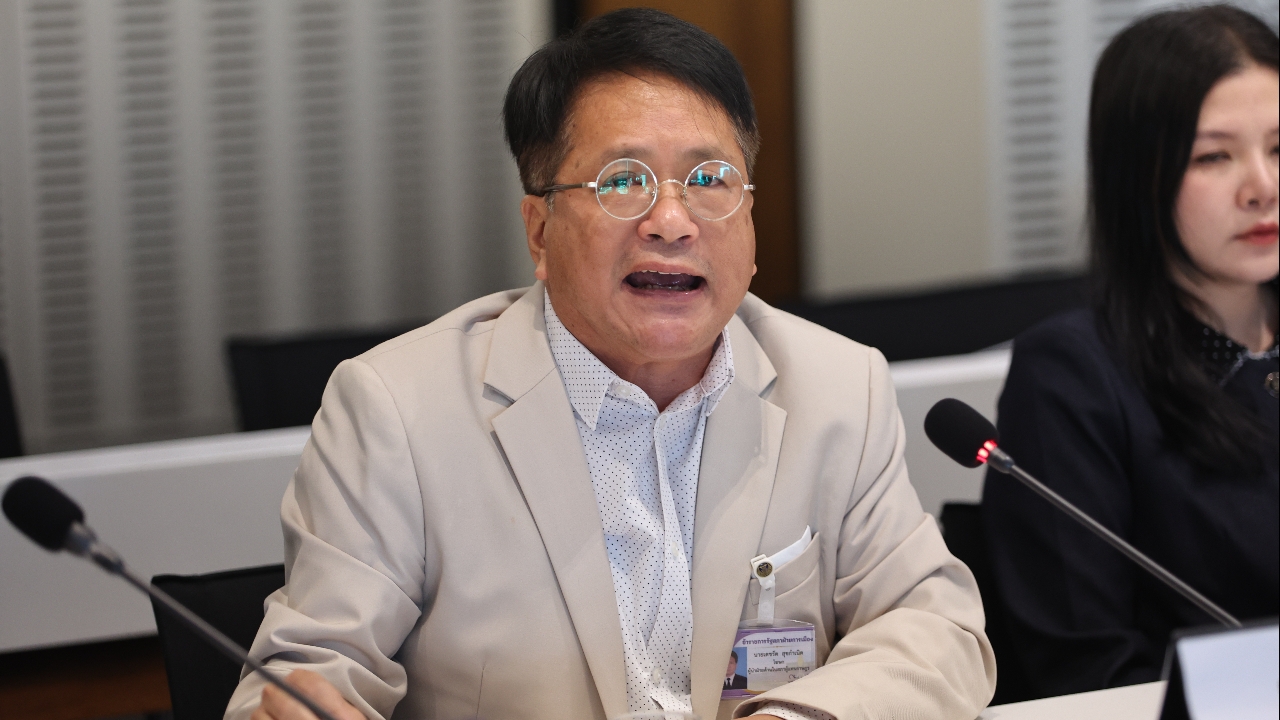
Decharat urges Suriya to address the registration issue of “Kaew Juree Holy Basil,” pressing for transparency on the benefit-sharing fund and recommending the creation of a database to preserve variety diversity with clear distinctions shown.
On 26 October 2026, Decharat Sukkamnert, director of the Think Forward Center and head of the Shadow Cabinet’s Quality of Life team for the People’s Party, raised concerns over the registration of protection for four varieties of “Kaew Juree Holy Basil” under the 1999 Plant Variety Protection Act, registered by CP RAM Co., Ltd. in partnership with Kasetsart University.
Decharat affirmed that the People’s Party supports research and development of plant varieties to enhance production efficiency but stressed the need for clear protection of farmers’ rights and use of traditional genetic resources. Since holy basil is commonly grown, sold, bought, and used by the public without clear differentiation—unlike rice or corn seeds—there is public concern and confusion over the registered varieties.
Although recently Suriya Jungrungreangkit, Minister of Agriculture and Cooperatives, ordered the Department of Agriculture to investigate the registration process, Decharat said legal scrutiny alone is insufficient to ease public doubts. He therefore calls on the ministry to answer key questions.
1. Clarify how to observe and distinguish the varieties. The ministry must clearly explain how the four protected holy basil varieties physically differ from common varieties and the original CPR1 variety, so that the public and farmers can easily identify, distinguish, and avoid infringing rights.
2. Disclose transparency regarding benefit-sharing. The development used wild holy basil as a base, and under Section 52 of the Plant Variety Protection Act, benefit-sharing agreements must be made with the Plant Variety Protection Fund. Decharat noted that claims of confidentiality on this data are misunderstandings, as the law only restricts disclosure of “breeding methods.”
It was found that from 2018 to 2025, 207 benefit-sharing agreements were made, but the fund received only about 467,000 baht from this source, with just 366,668 baht in 2024. He questions the fairness in how revenue is allocated back to the state and society.
Decharat further said that the pattern of breeding and registering varieties by major market buyers tends to promote only developed varieties, which may affect biodiversity. He proposes the ministry accelerate the creation of a database for over 200-300 Thai holy basil varieties and support communities in registering as “local native plant varieties.” Under Section 45, local administrative organizations, cooperatives, and farmer groups can protect these varieties under Section 47 and negotiate benefit-sharing agreements directly with developers, instead of dealing with the Plant Variety Protection Committee’s working group, as in the case of the four holy basil varieties developed.
Decharat concluded by emphasizing that if the government establishes strong mechanisms to protect farmers, the public, and traditional genetic resources, it would reduce societal doubts and create a sustainable balance between developing new plant varieties and protecting the public interest.