

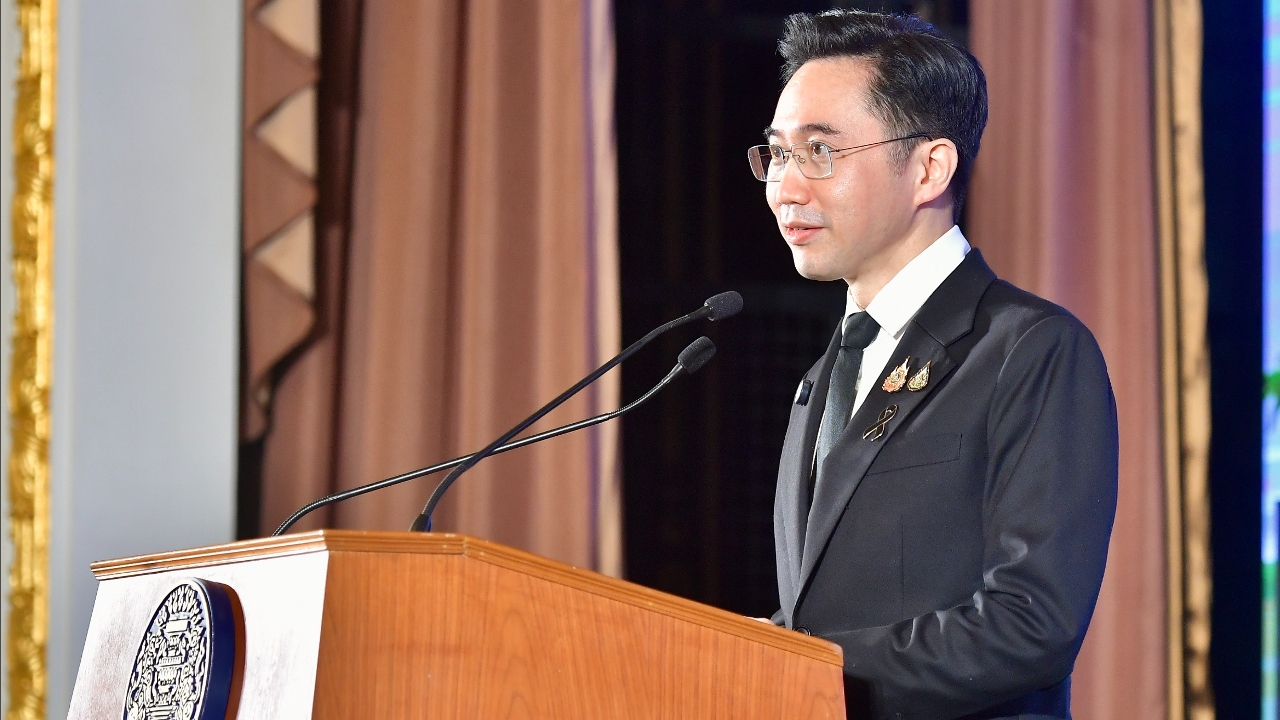
Yotsanan welcomes Thailand’s receipt of the Outstanding Community Housing Award in Asia, noting its contribution to poverty reduction, lowering inequality, and resolving conflicts. He aims to combine innovative efforts to extend the success from “Baan Mankong” to “Mueang Mankong”.
On 26 Oct 2026 GMT+7, Mr. Yotsanan Wongsawat, Deputy Prime Minister and Minister of Higher Education, Science, Research and Innovation, presided over the opening ceremony of the international seminar and presented awards for outstanding community-managed housing projects in Asia at the Collective Housing Best Practices Forum & Collective Housing Award 2026.
This event was held to celebrate World Habitat Day and to recognize 87 exemplary projects from various Asian countries that demonstrate the effective management of collective housing by communities.
The event included Mr. Nikorn Somkalang, Minister of Social Development and Human Security, along with ministry executives, government representatives, civil society members, academics, and community organization leaders from 15 Asian countries, totaling over 250 participants.
On this occasion, Yotsanan delivered a keynote speech titled “Collective Housing Innovation for Asia's Future: Community Housing Innovation and Driving Asia’s Future,” congratulating all award recipients. He noted that this ongoing project has proven its ability to sustainably solve various problems.
Yotsanan stated that over one billion people worldwide still live in slums and informal settlements amid Asia's urban crises in economic, social, and environmental aspects. The lack of secure housing and insufficient multi-sector cooperation are key causes of poverty. Therefore, traditional solutions are inadequate, requiring structural innovation and paradigm shifts.
He added that it is a great honor that several Asian countries, including India, Bangladesh, the Philippines, Indonesia, Sri Lanka, Malaysia, Japan, and Thailand, received awards. It is a source of pride that the United Nations, through UN-Habitat, has recognized Thailand as a leader and Regional Learning Hub to advance pilot projects into mainstream public policies across Asia.
The Deputy Prime Minister and Minister emphasized that the government is very pleased to collaborate with the UN on this initiative, which changes the government’s role from a housing provider to an enabler, empowering local communities to own the process and participate in housing design alongside community architects and experts (Participatory Design), while also designing livelihood opportunities.
“Housing development and livelihood creation must proceed together, with citizens as the main driving force, supported by tripartite cooperation among government, community organizations, and academia. Appropriate science, technology, and innovation from university and research networks will help elevate local enterprises to increase productivity and secure household incomes,” Yotsanan said.
Another key mechanism is social financial innovation, focusing on blended finance and revolving funds by combining small savings from community savings groups with larger funds from government budgets, donor funds, and the private sector, alongside digital technology management. This ensures fair access to capital, treating residents as co-owners rather than debtors.
With residents having livelihoods and strong savings systems through the “Baan Mankong” microscale project, communities build financial strength and stable foundations, enabling expansion to the macroscale “Mueang Mankong,” linking community networks with local governments and civil society to jointly develop cities aligned with the United Nations Sustainable Development Goals (SDGs).
This self-managed community model not only helps eradicate poverty but also concretely reduces inequality and resolves conflicts. The government is ready to collaborate with all sectors to further develop social innovations that address various vulnerabilities comprehensively.
Mr. Nikorn said that Thailand’s experience in addressing poverty and inequality has shown that the most sustainable approach is to place communities at the center, with people owning the process and managing themselves. The government views housing not merely as welfare but as a strategic tool to restore human dignity, secure land rights, and establish a foundation for grassroots economic and social development.
The Ministry of Social Development and Human Security and related agencies will use this data and successful models to expand support for vulnerable groups including children, youth, women, and the elderly. They will also open opportunities for younger generations and women to become community leaders alongside current leaders, and adopt green technologies and low-carbon materials in housing design to prepare for disasters and climate change with security and sustainability.