

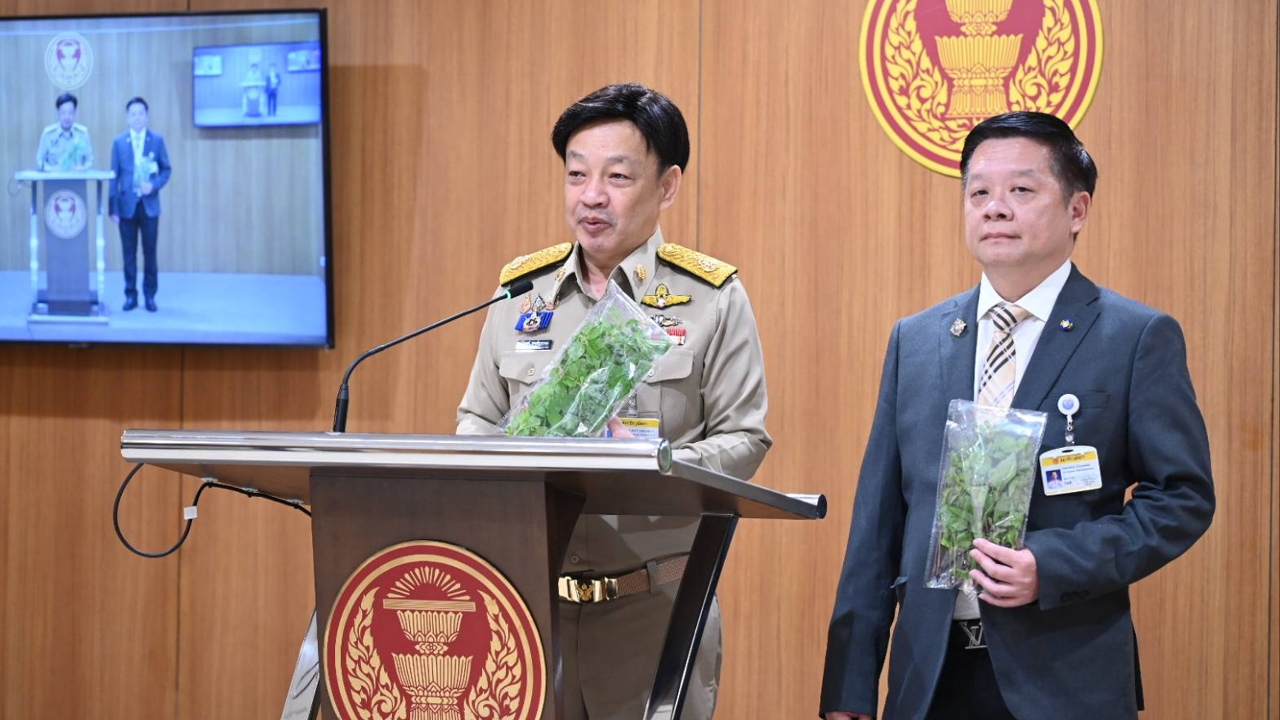
Senators have strongly opposed a major company's registration of four holy basil varieties, emphasizing that all Thai citizens should have rights to this plant, likened to national heritage. They argue that research should not be used to obtain patents and warn of potential future monopolies, urging the government to expedite a review.
At 14:05 on 26 Oct 2026 GMT+7, at the Parliament, Lieutenant Commander Wutthipong Pongsuwan and Senator Sahaphan Rungrojpanich jointly held a press conference regarding four holy basil varieties registered by a major corporation as plant varieties or under copyright. They noted that many senators are concerned because the private giant company is attempting to monopolize holy basil varieties, which are considered a staple ingredient, sometimes called a "comfort food" or even a national dish, as everyone has eaten it. This plant is deeply connected to Thai society. While research and development are important, such development should not lead to monopolies or allow the knowledge and skills of Thai researchers and civil servants, using state university laboratories funded by the Thai public, to be monopolized by just a few companies.
Lieutenant Commander Wutthipong added that there are problems in this process, citing corn as a clear example where native varieties have disappeared. Thailand has no fewer than 200 holy basil varieties, but today only two are commonly seen: white holy basil and red holy basil. Thailand's rich biodiversity and agricultural academic expertise are significant. King Rama IX established Kasetsart University, and many respected figures have contributed to agricultural research and development. The King granted the Nile tilapia fish variety to all Thai people to farm freely as an important protein source, without charge, as a sincere act of loyalty. Therefore, holy basil should also be considered a national asset, as it has been consumed by generations of Thais.
"Thai academics, especially at Kasetsart University which has invested billions, have developed upstream agricultural research creating jobs and income. When problems arise with these plants, research is conducted to resolve them and then open licenses are issued so Thai farmers can grow and distribute seeds freely. Rice is another example, overseen by the Rice Department. Likewise, vegetables should have research units to distribute them as public assets. I earnestly appeal to Deputy Prime Minister and Minister of Higher Education, Science, Research and Innovation Yotsanan Wongsawat, who oversees universities, to address these issues—especially regarding plant varieties and vegetables, which are Thailand's food sources. Academics using Kasetsart University's labs should ensure these results become the property of the Thai people, with rights belonging to all. I urge university administrators to clarify what benefits have been gained from this research. If possible, these rights should be returned to honest Thai practitioners so they can continue cultivating seeds. I ask the Ministry of Agriculture and the Ministry of Higher Education, Science, Research and Innovation to review and resolve these problems to prevent recurrence," he said. Lieutenant Commander Wutthipong stated.
Senator Sahaphan, coming from the business sector, said this is a sensitive matter. Holy basil leaves have been consumed since childhood and everyone is familiar with them, using them in cooking throughout life. It can be said to be Thailand's national food. If research development did not involve patents, it would be better. However, if patents are used to control and regulate, it may extend to other plants and various related animal breeds. If all research and development are controlled this way, eventually the entire food chain could be regulated. Registering patents on plants regularly consumed by Thais restricts certain rights and could cause social conflict. Therefore, he urged the government and relevant agencies to reconsider this matter.