

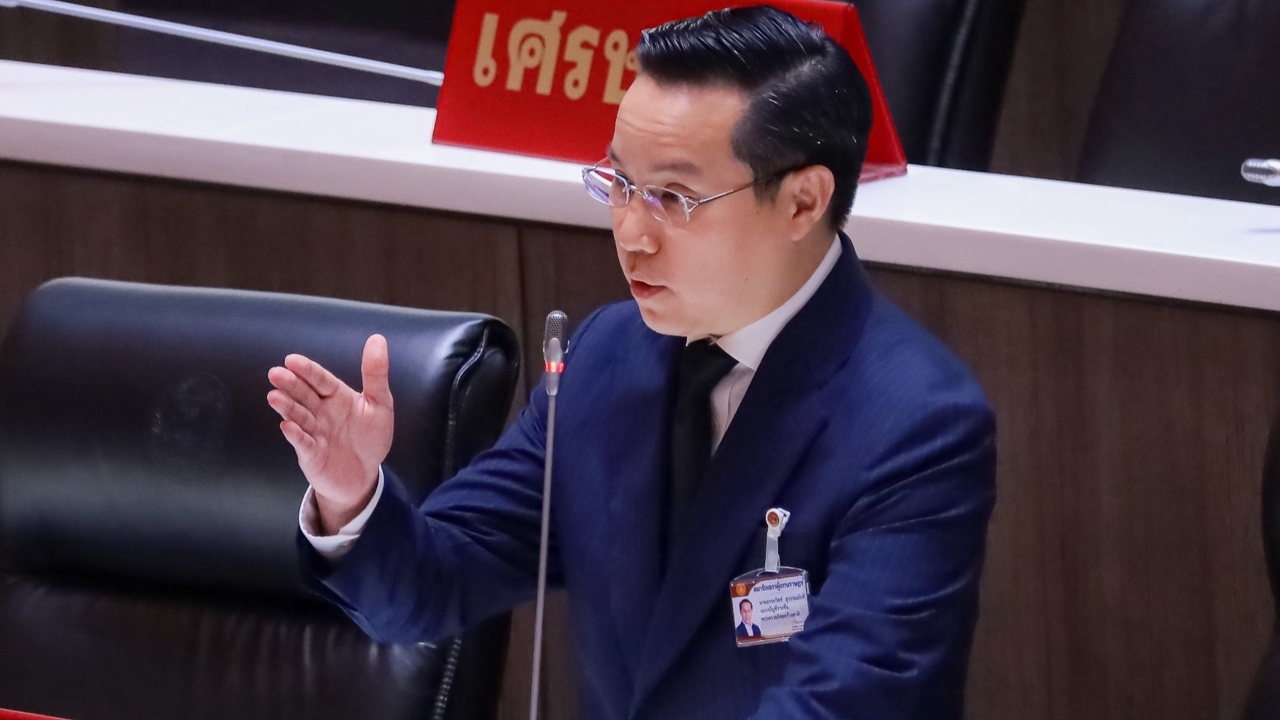
Atthawit warns the government that cutting oil taxes while still allowing refineries to reference Singapore market prices is not a sustainable solution. He proposes an urgent restructuring of Thailand's oil pricing system with price ceilings applied.
On 26 Oct 2026 GMT+7, Atthawit Suwanpakdee, party-list MP for the United Thai Nation Party, commented on the accumulating oil fund debt surpassing 100 billion baht. He proposed the government urgently review Thailand's oil price structure before the planned excise tax reduction meeting on 27 Oct. He explained that using the oil fund or tax money to subsidize oil prices may ease public burden temporarily but cannot solve the problem sustainably if refineries continue pricing oil based on Singapore's refined oil market instead of Thailand's actual production costs.
He compared oil price situations during the 2022 Russia-Ukraine war and the 2026 Iran-US conflict. In 2022, Dubai crude was $94 per barrel while Singapore's refined diesel (MOPS) was $126 per barrel, a spread of $32. As of 21 Oct 2026 GMT+7, Dubai crude is $108 per barrel but Singapore diesel prices surged to $170 per barrel, a spread of about $63—nearly double—reflecting significantly increased profits for refineries from the Singapore price referencing system.
Atthawit added that Thailand's crude refining capacity is about one million barrels daily, similar to Singapore's, but market structures differ. Singapore, a small country focused on refining for export, uses pricing mechanisms aimed at foreign market revenues, like Malaysia, which supports domestic consumers through the BUDI program offering diesel at about 16 baht per liter with a 300-liter monthly quota per ID cardholder. Thailand, with significant domestic oil consumption and sales, should have a pricing structure suited to its context rather than following Singapore's approach.
He therefore proposed the Ministry of Commerce invoke the 1999 Price of Goods and Services Act to set price ceilings on gasoline and diesel. Although fuel has long been a controlled commodity, no price ceilings have been set, mainly due to a 1991 Cabinet resolution favoring free market pricing for oil.
He clarified that setting price ceilings does not mean abolishing the free market system but uses price control mechanisms similar to those for other consumer goods to ensure fairness for buyers.
"Using the oil fund or tax money to subsidize fuel prices will never suffice if refineries continue profiting from selling oil priced by referencing Singapore’s market. It is time for the Thai government to seriously resolve the oil price structure problem rather than relying solely on tax cuts or ongoing subsidies from the oil fund," Atthawit said. Atthawit concluded.