

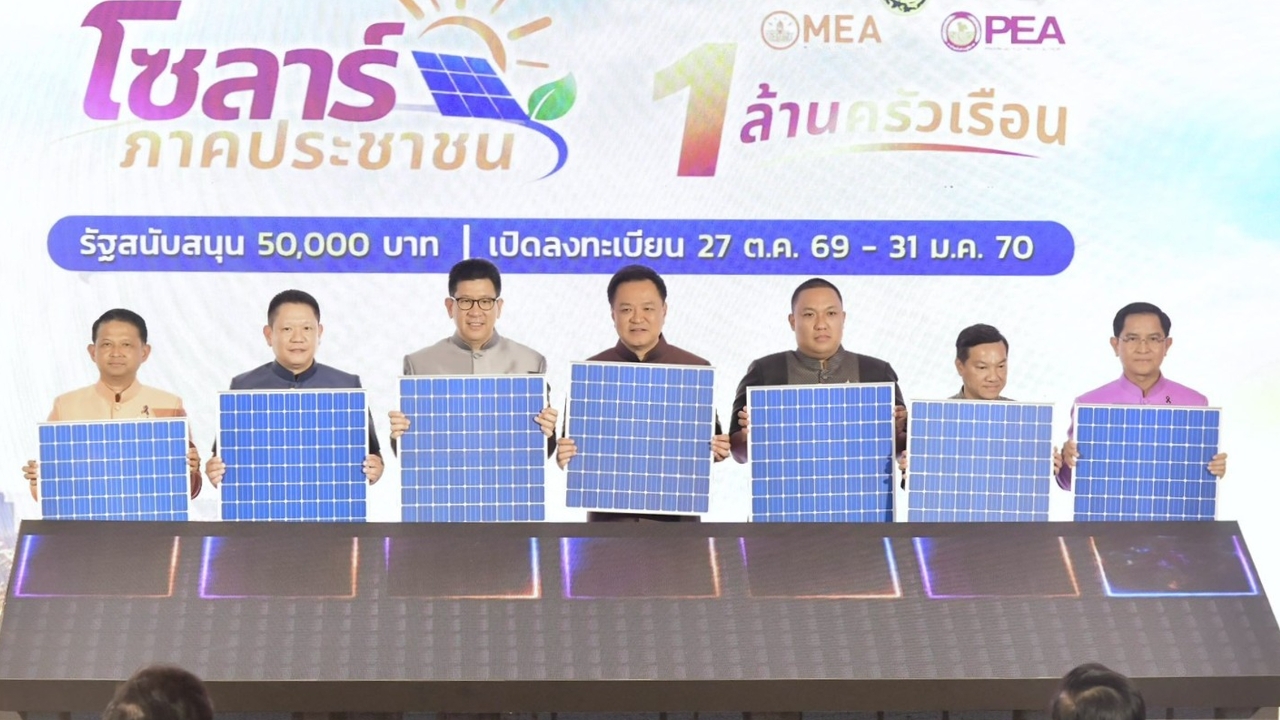
The Prime Minister launched the "People's Solar Project" aiming to support 1 million households, reduce electricity costs by over 24.5 billion baht annually, and open avenues for selling surplus electricity to generate income.
At 1:00 p.m. on 27 October 2026, at the Santi Maitri Building (Inner Building) of the Government House, Mr. Ekaphop Phianpiset, spokesperson for the Prime Minister's Office, announced that Prime Minister and Minister of Interior Anutin Charnvirakul presided over the inauguration ceremony of the "People's Solar Project," attended by cabinet members and officials from relevant agencies.
The Prime Minister said in his opening remarks that promoting clean and alternative energy is a key government policy and a global priority to strengthen the country's energy security. The People's Solar Project is not merely about installing solar panels on rooftops but transforming sunlight into opportunities for citizens—turning roofs into energy producers, changing electricity expenses into family savings, and transforming energy consumers into active contributors to national power production.
The government aims to support 1 million households nationwide to independently generate electricity from solar energy, providing a subsidy of 50,000 baht per household to collectively drive Thailand toward a sustainable clean energy society.
Besides reducing energy expenses, citizens can sell surplus electricity back to the national grid, generating additional household income. Thus, the project is not only an energy initiative but also an economic and social measure to increase income, reduce costs, build savings, and substantially improve citizens' quality of life.
Preliminary estimates suggest the project can collectively reduce citizens' electricity costs by more than 24.5 billion baht per year. This amount will circulate back into the grassroots economy, stimulating employment, creating jobs, and enhancing economic opportunities for communities nationwide.
The project is implemented through cooperation between the Metropolitan Electricity Authority and the Provincial Electricity Authority under the supervision of the Ministry of Interior, integrating efforts with the Ministry of Finance, Ministry of Energy, and Ministry of Labor to ensure the project achieves its goals and maximizes benefits for citizens.
The Prime Minister instructed all relevant agencies to prioritize citizens, facilitate processes, reduce unnecessary steps, increase speed and transparency in services, and strictly maintain electrical system safety standards to ensure citizens access their benefits and maximize advantages from the project.
The Prime Minister emphasized that reducing carbon dioxide emissions is part of Thailand's commitment to new global agreements, helping the country remain competitive internationally, especially in exporting goods and products where buyers may require products to be made using renewable, green, or environmentally friendly energy. Promoting clean energy thus expands Thailand's trade opportunities, reduces export constraints, and enhances its capacity to generate carbon credits.
Additionally, implementing clean energy policies is part of Thailand's preparations for joining the Organisation for Economic Co-operation and Development (OECD). Successful implementation will open numerous new opportunities in the country's economy, trade, and investment sectors.
In closing, the Prime Minister thanked all sectors involved in driving the project forward and reiterated the commitment to advancing the country’s energy transition so citizens can access clean energy at fair prices with sustainable energy security.
After the opening remarks, the Prime Minister joined the Deputy Prime Minister and Minister of Finance, the Deputy Minister of Interior, Permanent Secretaries of the Ministry of Interior and Ministry of Finance, the Governors of the Provincial Electricity Authority and the Metropolitan Electricity Authority in officially launching the project by placing a model solar panel on a mock house rooftop at the ceremony stage.