

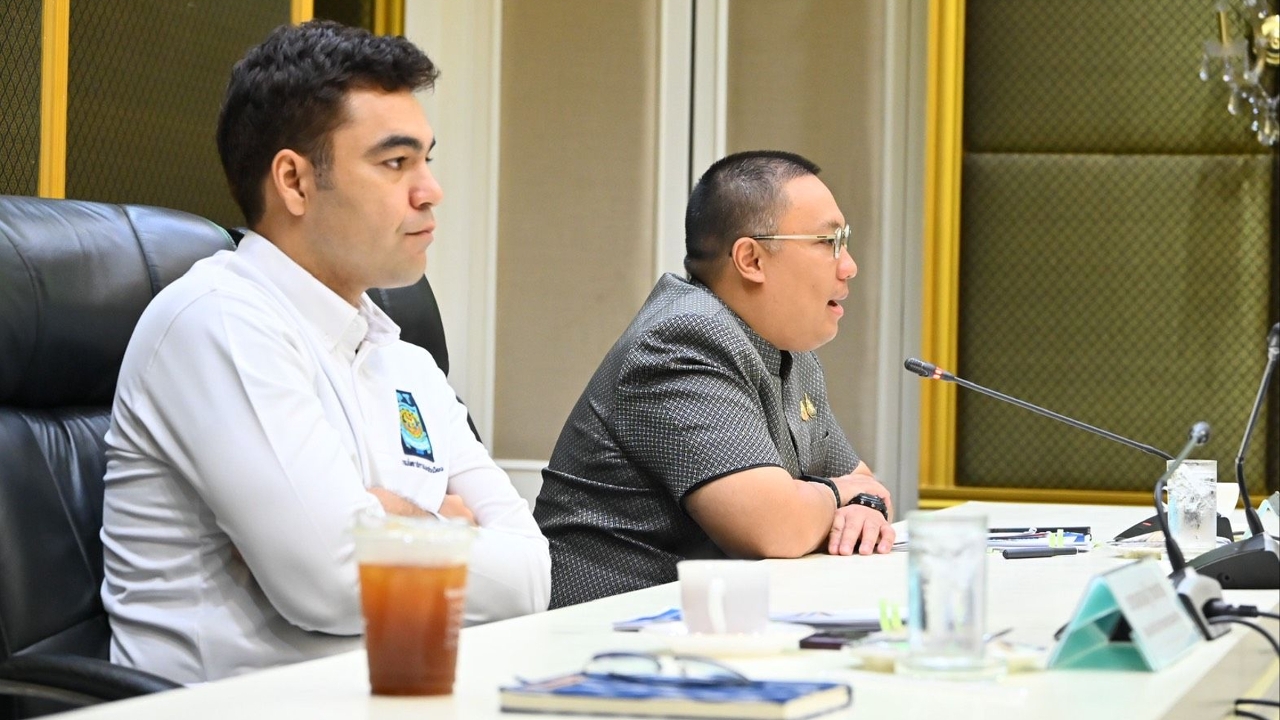
Phonphir and Jeset convened the Ministry of Interior's special task force to regulate society, advancing enhanced measures to crack down on nationality fraud rings and illegal nominee businesses, and stressed local mechanisms to continuously monitor the behavior of repeat offenders.
At 09:30 on 28 Oct 2026 GMT+7, at the Rajasi meeting room, Ministry of Interior, Mr. Phonphir Suwanchavee and Mr. Jeset Thaiset, Deputy Ministers of Interior, chaired the 4/2569 meeting of the Ministry's social regulation task force. Attendees included Mr. Anupong Suksamanit, Deputy Permanent Secretary of the Ministry and head of internal security affairs; Mr. Wilur Sitthiwong, Deputy Director-General of the Department of Provincial Administration; Police Lieutenant Singkham Kamyod, Director of the Investigation and Legal Affairs Bureau; Mr. Anucha Ruangamornwiwat, Director of the Local Administration Bureau; Mr. Patcharapatch Srithanyanont, President of the College of Local Administration; along with directors and relevant officials.
Mr. Phonphir expressed gratitude on behalf of management for the continuous work of the task force, thanking all officials sincerely for their efforts despite obstacles, difficulties, and personal time sacrificed to gather information—whether undercover in the field or in operations with the Department of Provincial Administration's special task force (DOPA N.I.C.E.) that apprehended and prosecuted registration fraud. He noted that the Deputy Ministers’ direct involvement on-site created a domino effect, awakening regional and provincial administrative mechanisms to seriously investigate and arrest offenders. The work centers on public interest and follows the Prime Minister’s directive to “close the name, focus on behavior,” aiming to suppress violations straightforwardly without exemptions for any establishments or individuals.
"The key in every mission is to complete the full cycle. If benefits are received or officials are impersonated—regardless of ministry or department affiliation—investigations must identify those responsible and bring them to full legal accountability. Currently, the Office of the Public Sector Anti-Corruption Commission (PACC) is closely involved in investigations. Provinces must strictly control licensing for service venues, hotels, firearms, and nationality, with no excuses related to zoning or urban planning; improper applications must be rejected. Efforts also target foreign nominee businesses in all sectors, including entertainment venues, recycling operations, and inspections of constructions encroaching on forest or hillside areas. Problems involving fake parentage, nationality fraud, firearm licensing (types P.3 and P.4), and foreign networks such as the Chabad group violating laws are addressed. After prosecution, nationality revocation, or deportation, the Department of Provincial Administration will coordinate with relevant agencies to seize and return nominee-held land assets to Thai ownership as swiftly as possible," said Mr. Phonphir.
Mr. Phonphir added that the task force will continue operations within the Ministry of Interior’s authority, emphasizing that it does not encroach on other agencies. Any Ministry officials found guilty will face prosecution without protection. He explained that during field arrests, he often keeps speakerphone on to allow administrative staff to hear facts simultaneously, facilitating meticulous case files and expanded prosecutions. This approach has led many offenders to voluntarily provide evidence and financial trails to authorities.
"Administrative visits aim to encourage and support local officials to enforce laws courageously. Provincial governors act as the prime ministers at the provincial level and are the supreme leaders overseeing all agencies. Ministers’ presence in each province serves as a reminder to governors and all local leaders of the importance and collective effort to push policies combating influential figures, regulating society effectively and seriously," he said.
Mr. Jeset stated his full support for the task force’s operational approach, which has significantly raised awareness and momentum in suppressing gray-area businesses and illegal profiteering. He highlighted two key recommendations: first, acquiring modern technology equipment to support the Department of Provincial Administration’s investigations, enabling independent and agile operations without sole reliance on external agencies; second, providing tactical training for officers, including self-defense and specialized knowledge, to enhance readiness and meet increasing mission demands despite staffing limitations.
"Lastly, I want to emphasize the system for monitoring repeat offenders. Although offender lists have been sent to provinces and districts, there remains a lack of in-depth feedback on behavioral risk, especially among sexual offenders against dependents or children. Psychological experts confirm such offenders have a high likelihood to reoffend when given opportunity, and victims often hesitate to report. Therefore, local administration and officials should implement continuous intelligence and investigative measures to 'monitor behind the scenes,' not just assess superficial appearances. This will enable screening of high-risk individuals and timely prevention to stop repeated offenses in society," Mr. Jeset concluded.