

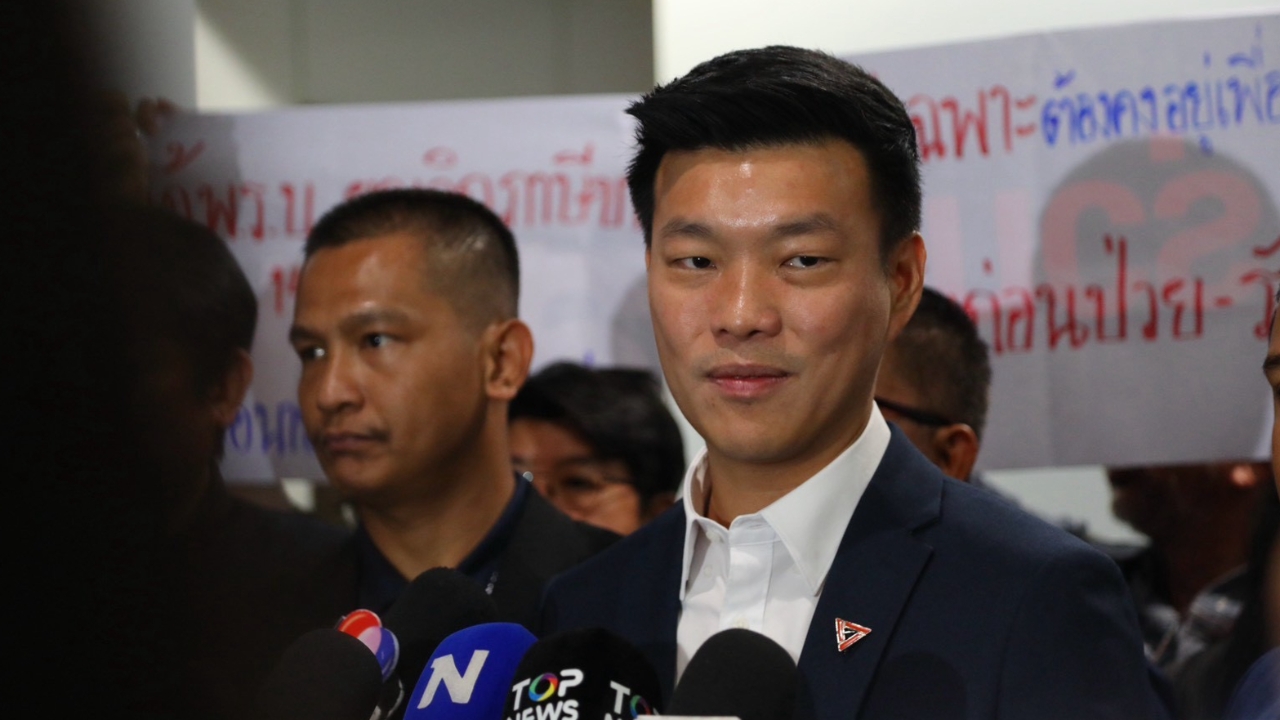
Nattapong "Teng" Ruangpanyawut presses Prime Minister Anutin over delay tactics to avoid the no-confidence debate, stresses the debate theme unveiling the Blue Regime's corruption, pledges a full investigation into the "People's Solar" project, and calls on the government to promote salt battery development in the Northeast region.
28 Oct 2026 GMT+7 Mr. Nattapong Ruangpanyawut a party-list Member of Parliament and leader of the Prachachon Party, spoke at the parliament about the negotiations concerning the upcoming no-confidence debate. He said the person least prepared is the Prime Minister himself, who is the most unready to face this no-confidence interrogation. When asked if the opposition would object if the debate started on 6 December or later, Nattapong said the longer it is delayed, the more society loses out. The Prime Minister has never attended parliament, only insisting that the opposition is ready anytime the Prime Minister does not avoid parliament. The sooner it happens, the better.
If the debate is moved to four days, the opposition has no problem, but after proposing this, the Prime Minister said he could only attend again in December, which seems like an attempt to delay and avoid the no-confidence battle. Regarding the November schedule where the Prime Minister must attend ASEAN and APEC summits, he said he has seen it, but if a 4+1 day schedule is adopted, including meetings on Saturday and Sunday, dates in November can be found. Nattapong commented on the arrest warrants for Ben Smith and associates, acknowledging that these gray capital networks might be linked to politicians, but the key question is whether they connect to major figures. The Prachachon Party has designated people to investigate this, with more details to emerge during the no-confidence debate. On whether the warrants were a reaction to the Godd Dam case, which the party's MPs shared posts about leading to a quick investigation, he denied any connection.
Asked about the Bhumjaithai Party filing an ethics complaint against Rakchanok Srinok, a party-list MP from Prachachon, as a move to eliminate key no-confidence debaters, Nattapong said those in power, led by the Bhumjaithai government along with independent organizations and justice agencies, have long used legal warfare to suppress those scrutinizing authorities, destroying opposition or popular power. This forms the core theme of the opposition’s no-confidence debate—that the Blue Regime is the enemy and a threat to democracy.
Meanwhile, Nattapong also spoke about the "People's Solar" project.
Regarding the registration process and the party's previous concerns about favoritism toward certain capital groups, he said the investigation into whether the project benefits contractors linked to influential interests will proceed fully. However, a key energy transition element is installing large-scale batteries in the grid system, not small home units. Currently, Khon Kaen University has developed knowledge and a factory producing salt batteries using Thai expertise. The Northeast has ample pure underground salt deposits suitable for salt battery production but lacks clear government policy. The supply chain for salt battery production to support energy transition requires an investment of about 20-30 billion baht, with almost all local content sourced domestically. While Thailand cannot produce lithium-ion batteries, it has salt mineral resources and can source nearly 100 percent local content. On whether low public participation in the project would mean failure or that the loan is not worthwhile, Nattapong said the People's Solar project aligns broadly with the party’s policies, though some operational details may have issues. The most crucial aspects are fairness and transparency, ensuring no conflicts of interest with contractors undertaking the project.