

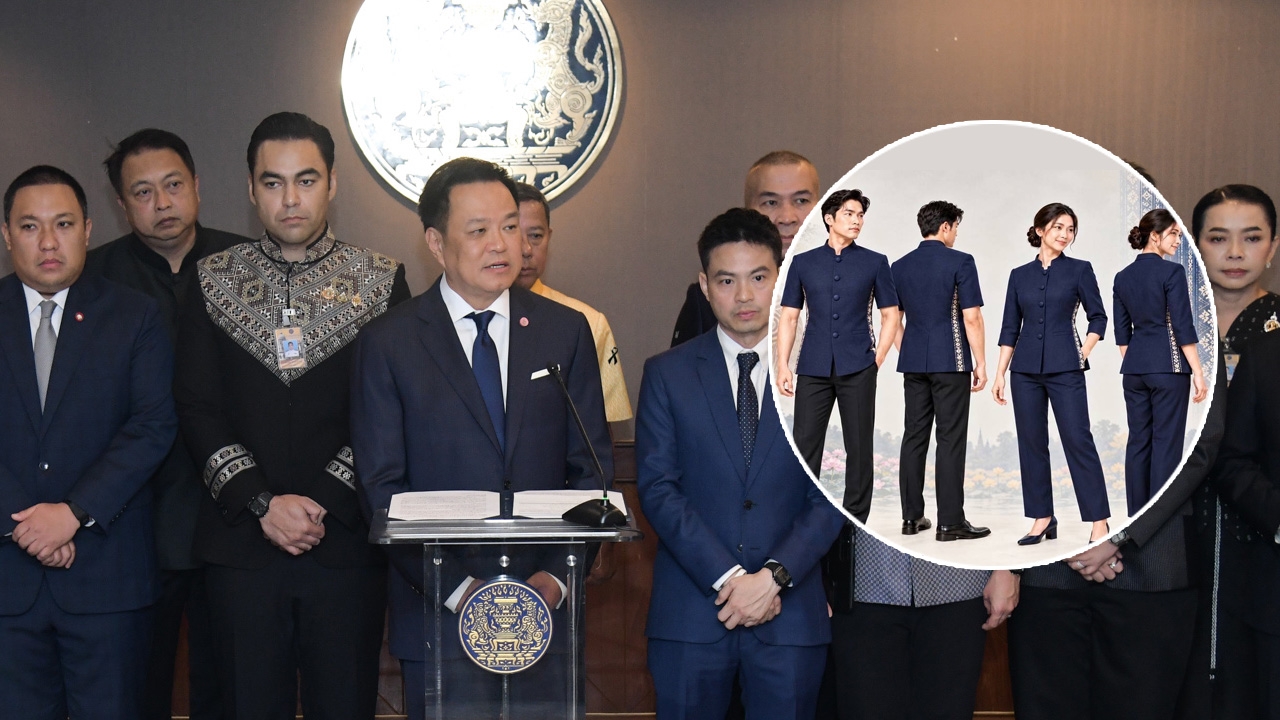
The Deputy Government Spokesperson unveiled the Mi Khit fabric clothing prepared for Cabinet members to wear during the traveling Cabinet meeting in Udon Thani Province on 2–3 November 2026, expressing identity through naturally indigo-dyed cloth, the World Heritage Ban Chiang jar pattern, and lotus flower motifs.
On 28 October 2026, Second Lieutenant Phatdarasmi Thongsaluaykorn, Deputy Spokesperson of the Prime Minister's Office, stated that for the traveling Cabinet meeting in Udon Thani from 2–3 November 2026, the Cabinet members will wear shirts made from Mi Khit fabric, a distinctive textile of Udon Thani. These garments convey local stories through fabric patterns, reflecting Thai wisdom that embodies not only beauty but also history, nature, and community life.
The shirts are made from deep blue base fabric naturally dyed with indigo, woven using a four-shuttle technique to create dimensional, distinctive bead-like patterns. The base fabric comes from the Dong Yang–Phonphibun Community Enterprise of women farmers in Phibun Rak District, a learning center for tie-dye weaving passed down through generations. The shirts are then adorned with Mi Khit fabric featuring significant provincial patterns with meaningful symbolism.
The first pattern is the 'Ban Chiang Jar,' linked to the Ban Chiang cultural World Heritage site, reflecting historical and cultural values that make Udon Thani well known. The 'Lotus Flower' pattern represents the province's abundance, natural beauty, and local identity, especially highlighting the Red Lotus Sea in Kumphawapi District, a major tourist destination connecting nature and community lifestyles.
The uniqueness of Mi Khit fabric lies in its intricate weaving process, using the 'Kep Khit' or 'flower gathering' technique with 58 wooden rods alternating with tie-dye weaving and natural indigo dye. It is produced by the Ban Non Kok Ancient Weaving Group in Nong Nakham Subdistrict, Mueang Udon Thani District, a learning center and producer of handwoven textiles on ancient looms, as well as a repository of local weavers’ works from across the province.
Combining the naturally indigo-dyed base fabric with the distinct Mi Khit patterns results in garments that reflect both the craftsmanship's finesse and hometown stories. The patterns symbolize prosperity, sustainability, peace, and beauty that can be passed down through generations.
The Deputy Spokesperson explained that Udon Thani has a long-standing tradition of handwoven textiles. The Ban Nakha community began seriously organizing Mi Khit and tie-dye weaving in 1974, becoming part of the province’s identity reflected in the motto 'Province of Mi Khit Fabric.' In 1991–1992, a historical Mi Khit fabric was woven to celebrate Udon Thani’s 99th anniversary, involving 150 weaving groups across the province to create a single piece measuring 1,199 meters long and 60 centimeters wide, featuring over 600 patterns. It is now exhibited at the Design and Textile Innovation Center, Udon Thani Rajabhat University.
The Mi Khit clothing design for this Cabinet traveling meeting is a collaboration between Udon Thani Province and the Design and Textile Innovation Center at Udon Thani Rajabhat University. They adapted cultural capital for contemporary use, providing broader exposure for local products and opportunities for the public to appreciate the craftsmanship of weaving groups in the province.
The Deputy Spokesperson added that incorporating Mi Khit fabric into the traveling Cabinet meeting not only showcases the host province’s identity but also offers a chance to highlight the value of local wisdom and Thai weaving skills widely. Sustaining indigenous textiles is not just preserving past patterns but building cultural capital that creates present value and opportunities for community products to grow alongside sustainable regional development.
For the traveling Cabinet meeting in Udon Thani, Prime Minister and Minister of Interior Anutin Charnvirakul instructed ministers to prioritize support for farmers in the Northeast and other regions by preparing development project proposals focused on five key issues: agriculture, food, drug prevention, border trade, and tourism.
