

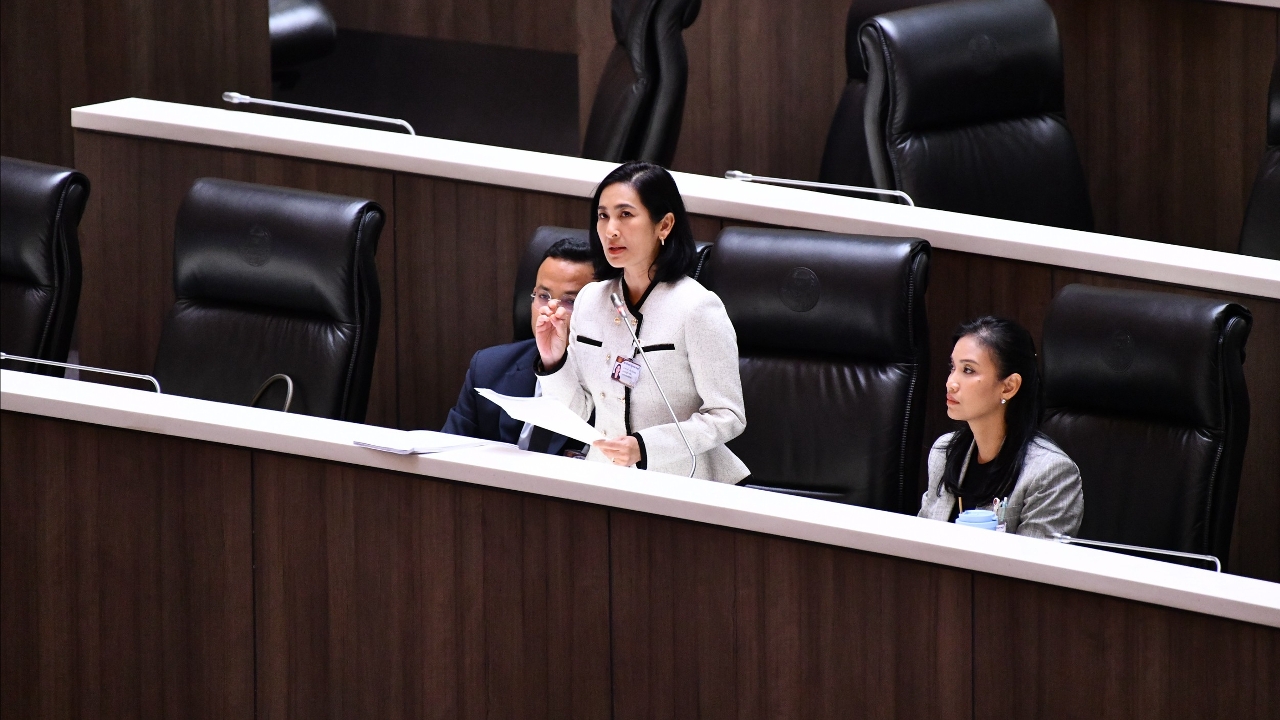
Kardee analyzes the draft Electronic Transactions Act, pointing out three major loopholes and urging to seal gaps related to AI Agent and Deepfake, fearing it will shift burdens onto the public.
On 28 Oct 2026 GMT+7, at the Parliament during the House of Representatives meeting to consider the revised draft Electronic Transactions Act B.E. ...., Ms. Kardee Liaopiroj, a party-list MP from the Democrat Party, joined the debate to express opinions and raise concerns about the draft law. She said that while she supports updating the law to keep pace with the times, there are still three key points that need careful consideration to prevent loopholes and protect citizens' rights.
Kardee initially explained that the original law focused on setting standards, regulating businesses, and penalties. However, the new draft shifts towards defining methods, confirming standards, and promoting business, with no penalties included. Therefore, the law cannot be viewed in isolation but must be seen as part of the overall "legal ecosystem." She outlined three main concerns as follows.
1. Scope of the central law: recommends adding "state-to-state" transactions to unlock national bottlenecks.
Dr. Kardee pointed out that the draft law clearly defines relationships for transactions between private parties and between private parties and the state but lacks explicit inclusion of state-to-state transactions. In reality, the biggest bottleneck in national development is not the private sector but the process of communication, coordination, and data exchange among government agencies themselves. This gap should be noted and addressed.
2. Technological gaps: warns about AI Agent and Deepfake risks, which push the burden of proof onto consumers. Regarding technology, although the draft law mentions innovations like Smart Contracts, Generative AI, and Web 3.0, it does not cover advanced technologies currently emerging, raising three main concerns.
Liability of AI Agent under the draft law (Section 29) states that outputs from automated systems are considered sent by the user. This means if AI conducts any transaction or contract, the system owner or individual is fully responsible, though there is a chance to deny responsibility if unforeseeable (Section 41). However, as AI Agents may make unpredictable decisions, the government must set clear rules, such as defining risk tiers for transactions and establishing user protection criteria.
Kardee also noted problems with Deepfake and biometric data. The law allows the use of biometric data, like facial or voice recognition, as electronic signatures. But in an era where face and voice forgery technology is rampant, the law still lacks requirements for liveness detection tests to prevent impersonation.
Burden of proof on citizens: When disputes or cases of online fraud arise, the responsibility to prove system errors falls on the disputing party (consumer), which is difficult and time-consuming. A law focused on business promotion must not neglect balanced consumer protection. Regarding cross-border transaction standards, referencing UN standards must ensure coverage of cross-border transactions and compatibility with global systems, not just limited to foreign platforms.
3. Effective enforcement requires coordination of related laws and involvement of experts.
Dr. Kardee emphasized that since the law's purpose shifts to "promotion" rather than "regulation and punishment," the special committee must work in coordination with other laws throughout the system. Actual authority for enforcement and penalties resides not in this law but in others such as digital platform laws, the Personal Data Protection Act (PDPA), Computer Crime Act, Cybersecurity law, Digital Asset law, and the Electronic Government Operations Act to prevent legal loopholes.
Additionally, with her experience as a committee member of the Electronic Transactions Development Office (ETDO), she raised concerns about the draft's abolition of the Electronic Transactions Committee (ETC). She commented that technology changes rapidly and is important, so regulatory mechanisms must include technology experts and private sector representatives in decision-making, rather than relying solely on government viewpoints.