

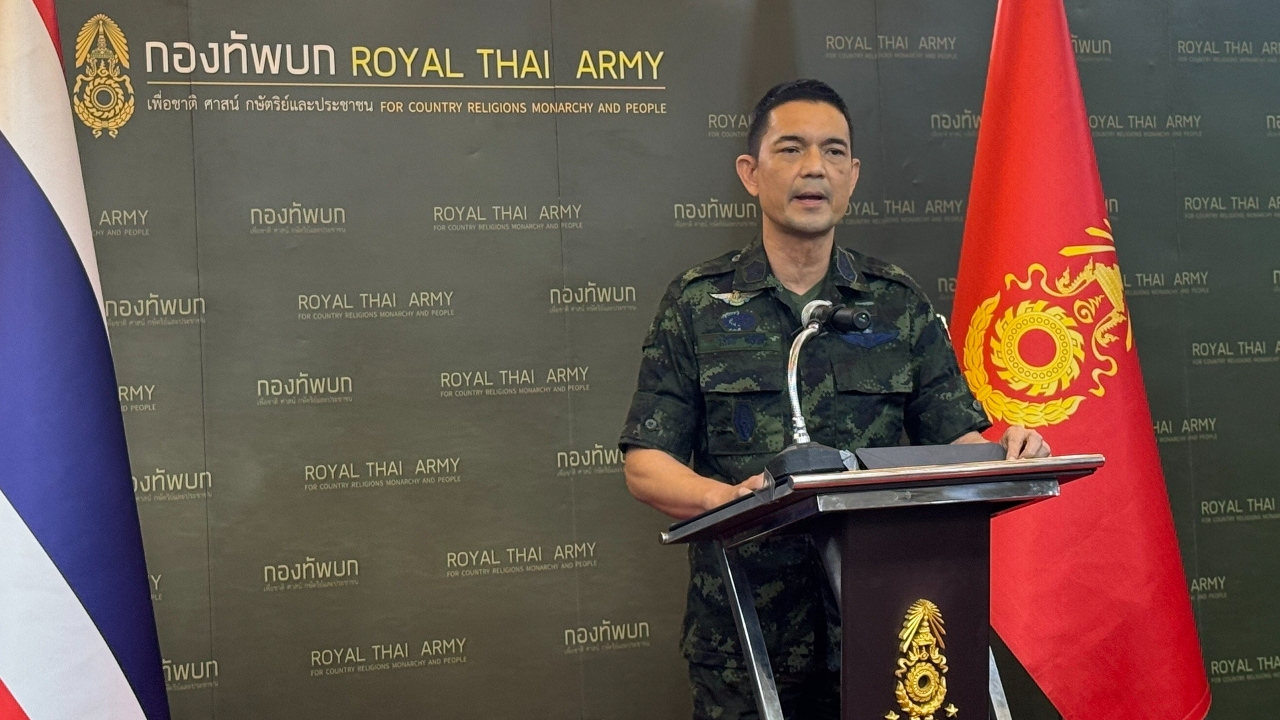
The Army spokesperson confirmed moving forward with law enforcement regarding Athip, husband of Boom Panadda, noting he was found to have recently entered the area. He emphasized that action against unauthorized users of state land will be considered on a case-by-case basis.
On 29 Oct 2026 GMT+7, Major General Winthai Suwaree, the Army spokesperson, spoke about progress in filing legal action against Athip Anantawan, husband of Boom Panadda Wongpudi, for unauthorized use of Army land in Sri Ka Ang Subdistrict, Ban Na District, Nakhon Nayok Province, where a resort and trail running course were built without permission. The survey found that Athip's use of the land was recent compared to other cases nearby, some of which have persisted longer and involve different types of land use. Regarding questions about land title documents, the type of land and responsible agencies must be clearly verified because state land falls under several categories managed by different agencies, including the Ministry of Natural Resources and Environment and the Ministry of Finance via the Treasury Department. Documents used to show rights to use or cultivate the land are not land ownership titles; ownership remains with the state. For the disputed area, the Army is responsible for management and use as assigned, including safeguarding state property. Unauthorized entry requires filing charges following legal procedures. Verification of relevant documents must consider the land category and supervising agency to ensure accurate fact-finding.
The Army spokesperson emphasized that unauthorized occupation of state land is not limited to this area but occurs in other locations under Army care. Therefore, systematic surveys and data compilation are necessary to understand the problem's scope and devise appropriate management plans. Addressing unauthorized use of state land does not rely solely on legal measures, given the large number of occupants and varying case details. Some groups occupy land for livelihood or subsistence, while others exploit it commercially or for business. Thus, consideration of usage type and behavior is essential. In some cases, agencies may start with warnings or discussions before deciding on suitable measures, depending on case specifics and the discretion of responsible authorities. The Army also stresses the importance of cooperating with local leaders, such as village chiefs, who have close ties to residents and may hold relevant information on land use. This cooperation will improve clarity in investigations and decision-making.
The Army will perform its duty in managing state land by assessing facts and land use characteristics on a case-by-case basis to ensure problem resolution aligns with the area's conditions and the behavior of each land user.