

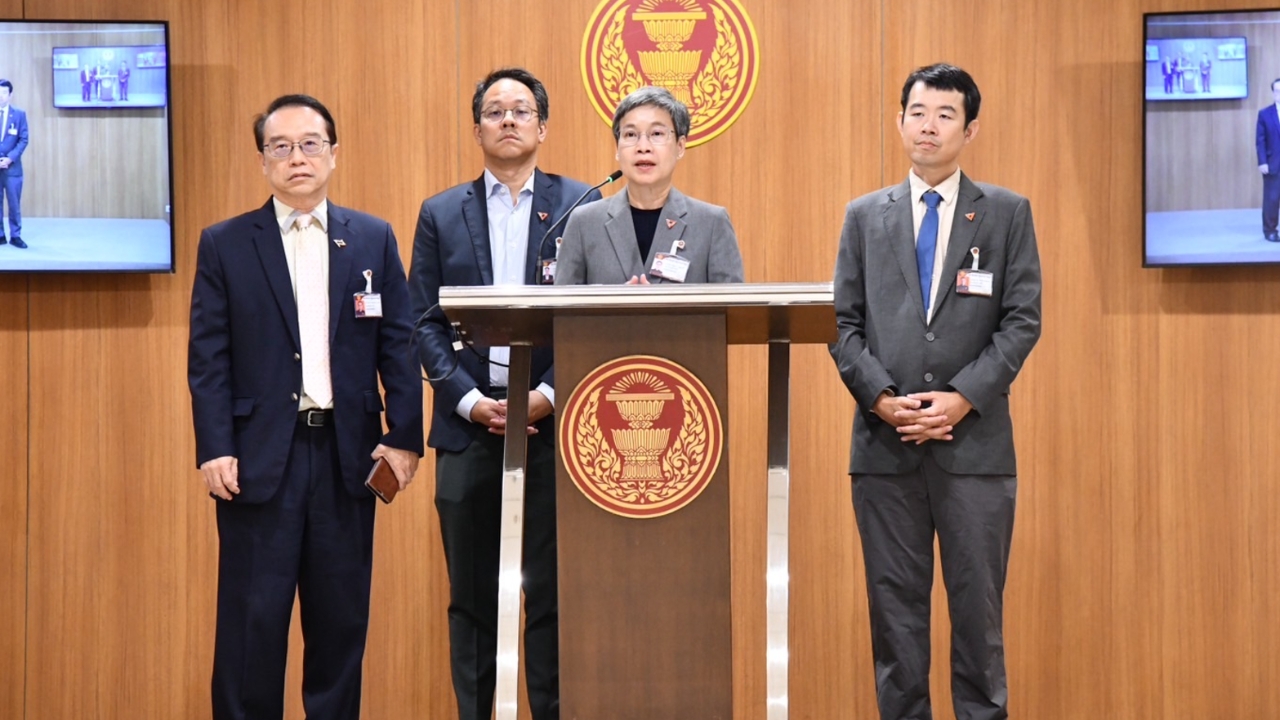
People’s Party MPs have urgently submitted a motion to form a special committee to study reform approaches for three funds and Thai PBS. They urged the government to listen broadly and avoid rash decisions that could harm vulnerable groups and open the door to public media interference.
On 29 Oct 2026 at the Parliament Building, People’s Party MPs led by Ms. Natthaya Boonpakdee, Mr. Anusorn Thamchai, Mr. Ekaphop Sitthiwannat, and Mr. Phandil Nuamjeem held a press conference to submit an urgent motion to the House Speaker. They requested the House of Representatives establish a special committee to study reform methods for three funds and one organization: the Thai Health Promotion Foundation (ThaiHealth), the Elderly Fund, the National Sports Development Fund, and the Public Broadcasting Service of Thailand (Thai PBS).
Ms. Natthaya said that over the past month, several bills have been proposed by MPs to amend the revenue sources of these three funds and one organization. They seek to change funding from surcharges on excise taxes for alcohol and tobacco (sin taxes) to annual budget appropriations, citing fiscal discipline in line with government policy. However, the People’s Party believes these four legal amendments would broadly impact the public in many ways.
First, it would affect continuity in supporting vulnerable groups. The Elderly Fund provides direct welfare to low-income seniors. ThaiHealth supports health access for over 10 vulnerable and specific groups. The National Sports Development Fund offers opportunities to underprivileged children and youth nationwide. Thai PBS plays a clear role in highlighting issues and demands of people affected by economic and social development.
Second, it would impact the independence of public media and the work of controlling health risk factors, which often face opposition from large business or industrial groups. Without stable and continuous budgets, protecting the public would suffer. It also risks long-term health fiscal burdens because ongoing behavior and environmental changes to reduce non-communicable diseases (NCDs) must be sustained. Changing funding sources without careful evaluation would increase state healthcare costs over time. There is uncertainty about whether the approximately 14 billion baht per year from sin tax surcharges would disappear without legal mechanisms during the transition.
Ms. Natthaya added that concerns about governance or transparency raised by various parties, including the Office of the Auditor General, will not automatically be solved by switching to annual budgets. Improving governance and transparency is an executive power responsibility. The Prime Minister, Deputy Prime Minister, and supervising ministers can directly manage these funds without legal amendments.
Public opinion gathered through the parliamentary online system shows over 200,000 people commented, with 60-80% opposing changes to budget sources. Recently, civil society networks have continued submitting letters of opposition. The People’s Party therefore urges legislators not to push laws through rashly without heeding objections, hence submitting an urgent motion to form a special committee to gather broad stakeholder input to finalize the most suitable reform approach.

Mr. Anusorn Thamchai emphasized the importance of sin taxes supporting all four organizations, especially Thai PBS. He said the government and bill proposers cannot use fiscal discipline as a pretext to conceal agendas to control and interfere with public media, a democratic foundation. Currently, Thai PBS operates free from influence by business groups or the government, enabling independent public oversight. He also noted ongoing efforts to damage the reputations of ThaiHealth and Thai PBS to justify legal changes, which he strongly condemned.
Mr. Anusorn added that from an economic viewpoint, earmarked taxes are not a violation of fiscal discipline. Governments worldwide use such tools if they benefit public missions. The roughly 14 billion baht per year from sin taxes is substantial, and if it helps these four organizations fulfill their missions, it is worthwhile. It is the opposition and the House’s duty to use this motion mechanism to debate genuine reform paths.
He also raised concerns about hidden conflicts of interest. Previously, sin tax surcharges for these funds were clearly specified by law—for example, Thai PBS’s surcharge is set at 1.5%, not exceeding 2 billion baht annually. If these laws are repealed and replaced by Ministry of Finance announcements, even if the government promises not to reduce collection, in practice there would be no stable guarantee. Everything would depend on political power and decisions, potentially allowing tax rates to be negotiated for the benefit of liquor or tobacco industry groups. He hopes the Finance Minister, a professional insider, will act straightforwardly and uphold principles prioritizing the nation’s interest.
Mr. Ekaphop Sitthiwannat spoke about issues to study further within the special committee, especially regarding reform of ThaiHealth in three main areas. First, studying the roles of the board and internal management that can be improved immediately without amending the law, to evaluate the cost-effectiveness of ThaiHealth’s grants and investments to date.
Second, reforming budgets for health promotion and disease prevention. Thailand’s budget for this is still very low, under 10% of total health spending, compared to OECD countries investing two to three times more. Therefore, the appropriate budget level should be studied. What is clear is that this budget must not decrease or be disrupted by changes in revenue sources.
Third, reform to empower the public and small network partners to access health promotion funding more effectively. Also, study why many government agencies prefer to seek ThaiHealth funding instead of regular parliamentary budgets, indicating ThaiHealth’s management system is flexible and attractive for collaboration. Currently, projects involving the Ministry of Public Health, provincial governors, and provincial administrative organizations work with ThaiHealth to develop shared indicators. These three points are key issues for improving the structure.
Ms. Natthaya said the People’s Party wants the House and legislature to amend laws based on genuine public and stakeholder participation per democratic principles, listening to each other rather than acting unilaterally. She hopes the urgent motion will be accepted quickly by the House Speaker so Parliament can be a refuge and safe space for the public to join discussions and find solutions on matters with broad social impact.
