

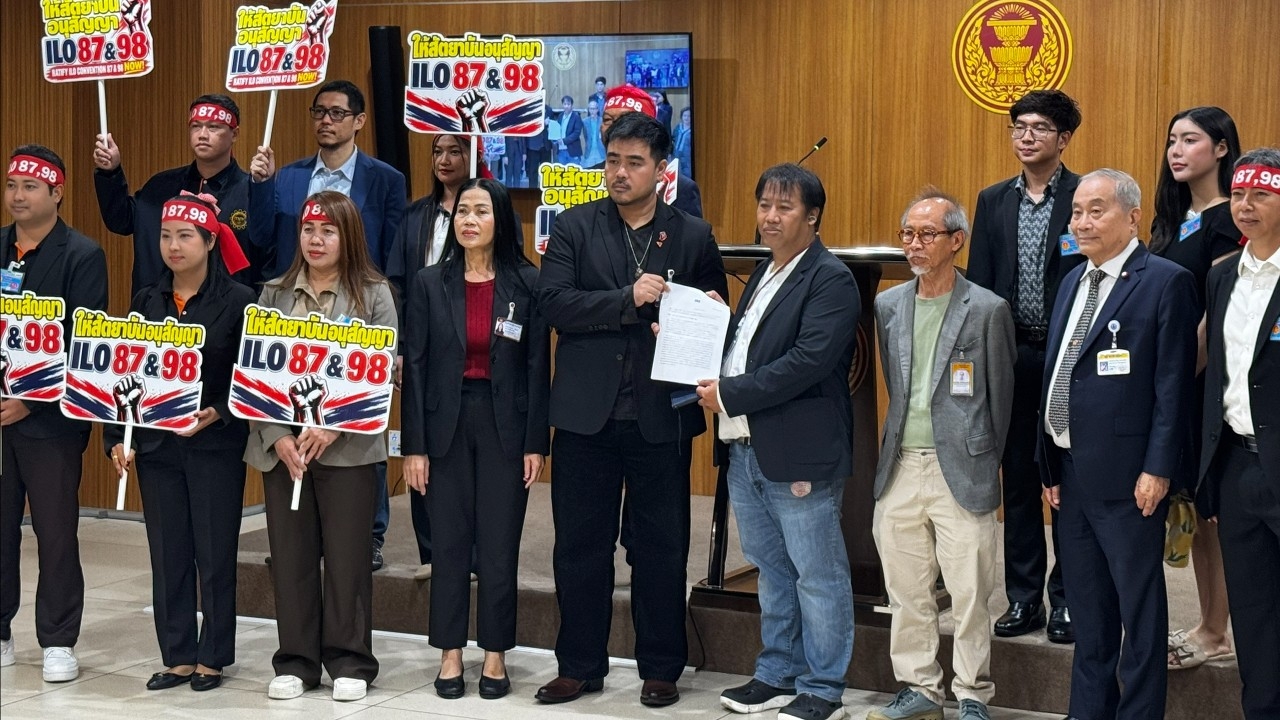
The Labor Committee received a letter from the migrant worker network demanding the government urgently ratify ILO Conventions 87 and 98, highlighting a persistent problem lasting over 30 years and the repetitive excuse of forming study committees to delay action without progress.
On 30 Oct 2026 GMT+7, the network of organizations working with migrant populations and the campaign network for ratifying International Labour Organization (ILO) Conventions 87 and 98 submitted a letter to the Chairman of the Labor Committee of the House of Representatives, urging the Thai government and Ministry of Labor to demonstrate seriousness in ratifying ILO Convention 87 on freedom of association and protection of the right to organize, and Convention 98 on the right to organize and collective bargaining.
A representative from the labor network stated that for over 30 years, the Thai labor movement has continuously petitioned the government to ratify Conventions 87 and 98 to protect workers' freedom of association and collective bargaining rights, which are fundamental rights and essential mechanisms for social justice.
However, workers have continued to face obstacles in forming labor unions, interference, and unjust dismissals without protection, leading to reduced job security and increased social inequality.
Meanwhile, successive governments have habitually responded by "forming study committees," a process lasting over 40 years without any real progress.
The labor network representative further said that the network and the Labor Committee have submitted three main proposals for the government and Ministry of Labor to act promptly: first, to set a definite timeline for when Thailand will ratify ILO Conventions 87 and 98 to stop delaying tactics; second, to amend the Labor Relations Act and related laws to align with the conventions and implement effective measures to protect against interference, unfair dismissals, and union destruction, ensuring all labor groups have the right to organize and bargain collectively; and third, to enforce strict compliance among all business owners and operators in the country to conduct operations respecting ethics, human rights, and environmental standards.
Sahaswat Khumkong, Member of Parliament from the Prachachon Party and Chairman of the Labor Committee, said ratifying these two ILO conventions is linked to international trade platforms such as the World Trade Organization (WTO), the Organisation for Economic Co-operation and Development (OECD), and free trade agreements (FTA) between Thailand and the European Union (EU), which often include conditions related to fundamental labor rights.
Regarding concerns that these laws might cause investors to relocate production bases, he affirmed that currently investors do not move due to labor rights issues, as labor rights are universal human rights. Allowing migrant workers to join unions under Thai law elevates the country’s legal standards to international levels.
Sahaswat added that the Labor Committee will discuss this matter and include it as a key agenda item. They will invite the Minister of Labor and relevant agencies to provide explanations and expedite the establishment of a subcommittee to study and promote ratification of ILO Conventions 87 and 98, including amendments to the Labor Relations Act, to achieve tangible results as soon as possible.
Similarly, Thanaporn Wijan, MP from the Prachachon Party and spokesperson for the Labor Committee, called on the government to ratify these two ILO conventions, noting they represent a long-standing struggle of civil society and labor for over 30 years. However, past efforts have never succeeded as the government has repeatedly used the same excuses to delay and obstruct the review process. Labor rights and labor dignity have been neglected and never seriously addressed in government negotiations. She believes this is a crucial opportunity for the Thai government to change its attitude and concretely incorporate labor rights, freedom of association, and collective bargaining rights into trade agreements and conditions, raising Thailand’s labor standards to be internationally accepted.
“The time for old excuses to delay decisions is over. It is time for the government to urgently restore ‘democracy in the workplace’ and return fundamental rights to all workers in the country by promptly ratifying ILO Conventions 87 and 98.”