

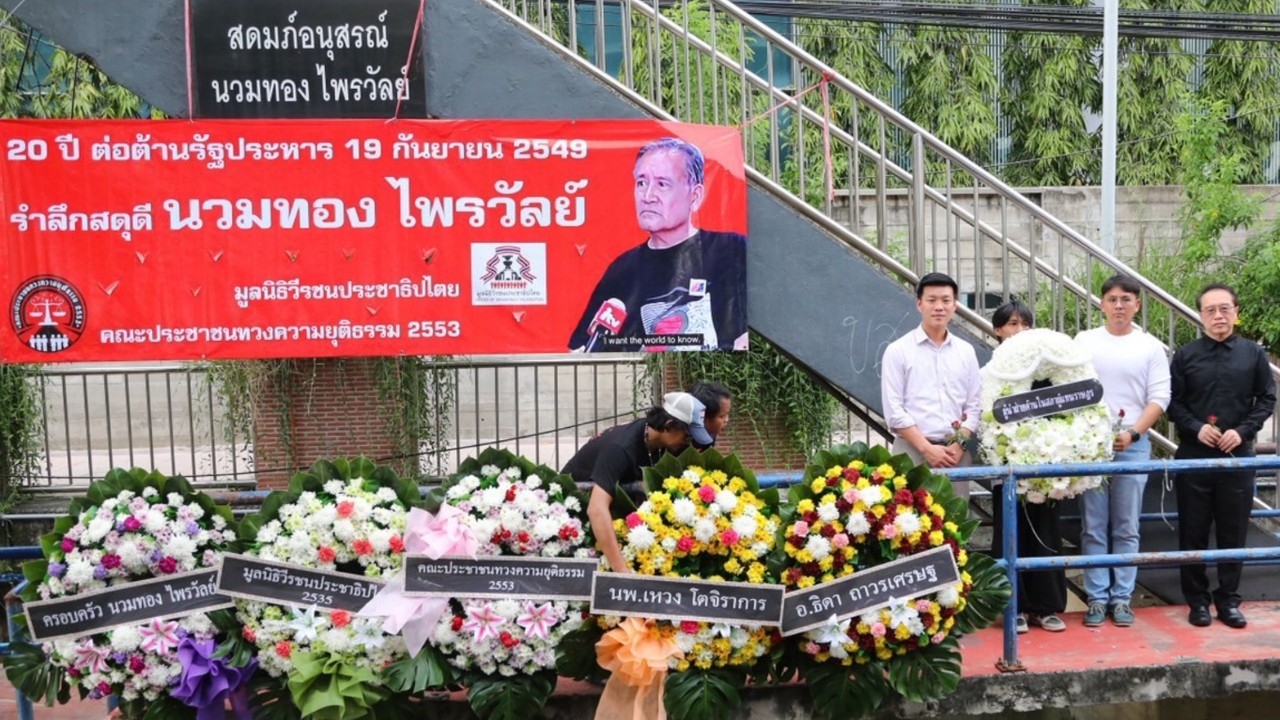
"Teng Natthapong," leader of the People’s Party, joined the 20th anniversary commemoration of "Nawamthong Phaiwan," the taxi driver who rammed a tank protesting the 19 September 2006 coup, calling for punishment of coup perpetrators and a genuine transition to democracy.
On 31 October 2026, Natthapong Ruangpanyawut, party-list MP and leader of the People’s Party, attended the memorial marking two decades since the death of Nawamthong Phaiwan, the taxi driver who drove into a tank to protest the 19 September 2006 coup before ending his own life on the pedestrian bridge in front of the Thairath newspaper building. The event was also attended by Wiroj Lakkhanadisorn, Anusorn Thamchai, Ekkarat Udom-amnuay, and Panyarath Nanthaphusitanon.


Part of the memorial at the commemorative monument near the site of Nawamthong’s death included screening an interview clip from 2006, shortly after he drove his taxi into the tank. Natthapong said that hearing Nawamthong’s words—"One life alone isn’t worth more than the democracy of the country"—was deeply moving. He believes that what unites different generations is the pursuit of something greater than themselves: democracy and a better future for their children.


Natthapong added that the people's demands are simple, though the forms of struggle have changed over time. In the past, it might have involved guns or tanks; today, it may take the form of the 2017 constitution.
He emphasized that over 21 million citizens who voted in the referendum have expressed a collective consensus to abolish the current constitution. This is a cause that must be fought for and pushed forward. He urged everyone to keep the memories and struggles of the past as strength to move forward together.
Natthapong also recounted a conversation with representatives from South Korea’s May 18 Foundation, which promotes awareness of the 1980 Gwangju incident that led to the establishment of a democratic constitution and direct presidential elections in 1987. The Korean representatives asked why Thailand’s 14 October event, which drew hundreds of thousands of people, has not resulted in a similar democratic transition.

Natthapong reflected that unless one enters politics, the deeper history is often unknown because Thai society attempts to erase its history. The education system does not teach it, and even symbols of regime change like the People’s Party plaque have been removed. This contrasts with South Korea, where there are monuments commemorating Gwangju and the event is incorporated into TV series and various media.
"Preserving memories prevents history from repeating itself, but equally important is punishing those who have led coups at least once in history. South Korea has held corrupt politicians and coup leaders accountable, but in Thailand, corrupt politicians remain free and coup perpetrators face no consequences," Natthapong said.
Natthapong concluded by saying that if he could ask for one thing as a politician, it would be for Thailand to one day transform into a democracy capable of reviewing cases and facts retrospectively and holding wrongdoers accountable, so that true democratic power resides with the people.
