

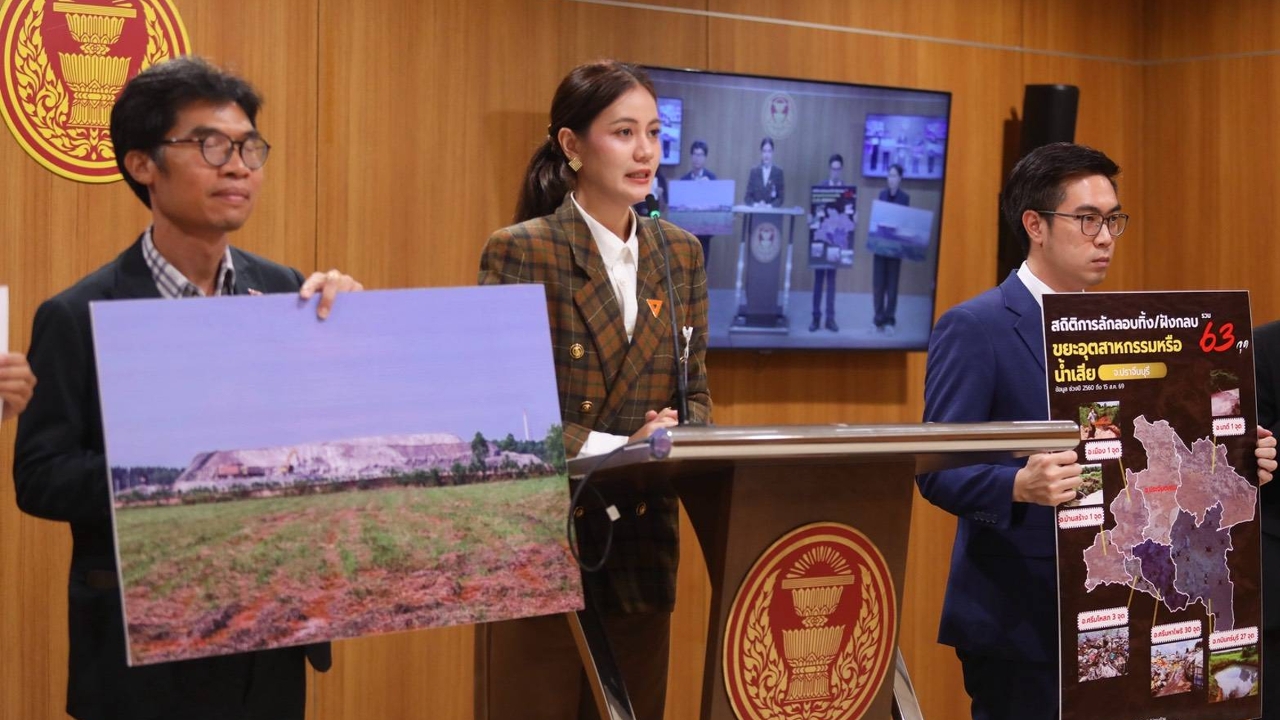
'Narumat' urges the government to explain the acceptance of Chinese funding to develop the recycling industry, fearing it may open the door for old batteries and solar panels to be dumped in Thailand. She points out that even China itself has banned waste imports, so why does Thailand allow it?','tags':['recycling industry','Chinese funding','waste import ban','batteries','solar panels','Thailand']
On 1 November 2026, Ms. Narumat Piambandit, Member of Parliament for Chonburi District 6 from the People’s Party, spoke about the Cabinet’s resolution on 27 October approving the Ministry of Industry to sign an agreement with the Embassy of the People's Republic of China. The agreement involves receiving financial support totaling 375,900 US dollars from the Mekong-Lancang Cooperation Special Fund. One funded project is to develop the recycling industry capacity in the Mekong-Lancang subregion to manage and recycle car batteries, solar panels, and electronic waste.
Ms. Narumat said that although the government presents this as a significant step toward a green industry, as a representative of the people in Si Racha and Ko Si Chang districts — home to Laem Chabang port, a major gateway with many containers passing through monthly — she has serious concerns and important questions needing government answers.
Her first question concerns the waste management policies of the funding country. She found that China has enforced the 'National Sword' policy since 1 January 2018, which was later upgraded to a complete ban on all types of waste imports without issuing recycling import permits. This ban covers electronic waste, circuit boards, old electrical appliances, and all battery types. Violators face fines up to about 24 million baht and life imprisonment for serious illegal hazardous waste imports. China manages its own waste domestically and completely blocks waste imports from other countries. However, through this fund, our region is being encouraged to develop this into an industry, accepting what China refuses.
Ms. Narumat continued that she does not deny the importance of recycling. Waste from electric vehicle batteries and solar panels domestically is certainly increasing, and Thailand needs an efficient system. However, developing a regional recycling industry without legal guarantees that all raw materials must come from domestic sources could open the door for Thailand to become a dumping ground for toxic waste from abroad. This echoes lessons from the metal smelting industry, where even the Customs Department chief admits toxic waste has been smuggled mixed with scrap metal, exploiting loopholes since recycling and smelting factories were permitted from 2016. Now, thousands of such factories exist nationwide.
Ms. Narumat further questioned whether the government’s current oversight system is sufficient. She revealed that in fiscal year 2026, Customs seized 10.29 million kilograms of hazardous and electronic waste but managed to return only 5.29 million kilograms to origin countries. The question remains: where is the remaining approximately 5 million kilograms of electronic and hazardous waste currently stored or disposed of? No transparent explanation has been provided publicly. Meanwhile, residents in Rayong and Prachinburi provinces continue to suffer health and environmental impacts from illegal factories and toxic waste warehouses. Customs also admits it cannot inspect all container details. Rapid expansion of new recycling industries for higher-risk materials like solar panels and batteries, rich in heavy metals and hazardous chemicals, is like building a new house on a crumbling foundation.
She therefore calls on the government to address four key public concerns clearly and directly.
1. The government must clearly state whether the funded project will lead to authorization of imports of used batteries, old solar panels, or electronic waste from abroad into Thailand. If not, what legal guarantees will be written into policy frameworks developed from this project?
2. The government must transparently disclose all study results and policy recommendations arising from this project to the public.
3. The government must urgently fix and reform the existing toxic waste oversight system, especially tracking the remaining 5 million kilograms of unresolved toxic waste, recovering illegal industrial waste from violating factories, and systematically accelerating health checks for communities around industrial areas.
4. The government must promptly decide on proposals to ban imports of scrap metal and scrap rubber from abroad, which currently await responses and actions from the Ministry of Commerce.
"International cooperation is positive, but it must help Thailand better manage its own waste — not open the door for Thailand to become a dumping ground for waste that even the funding countries refuse to accept," she said. Ms. Narumat concluded her remarks.