

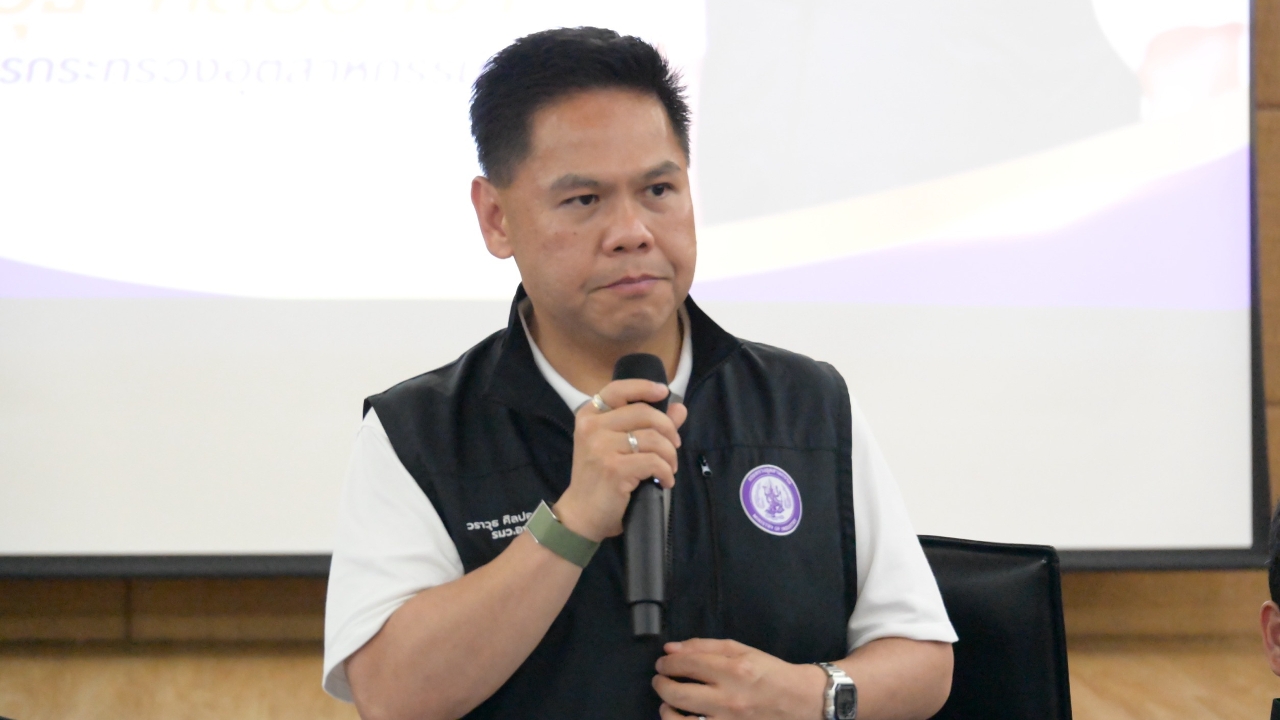
Warawut launches a strict law enforcement operation for inspection, supervision, and rigorous enforcement against industrial waste disposal factories, ordering officers to fully enforce the law.
On 1 November 2026 at the Ministry of Industry, Warawut Silpa-archa, Minister of Industry, chaired the launch of the 105th and 106th strict law enforcement operations for factory operations. Tatpong Sasomsap, Assistant Minister of Industry, Pasakorn Chairat, Permanent Secretary of Industry, and industry executives and provincial officials nationwide attended.
Warawut delivered policy guidance to ministry executives and provincial industry officials nationwide, saying Prime Minister and Interior Minister Anutin Charnvirakul places great importance on this issue. Thailand has reached a point of no return; if action is not taken now, the country will suffer greatly, both in social media and reality. Over the past five years, incidents in fields and water sources have escalated to a level that demands reflection: if your family lives there, would you watch idly as rainfall washes it away or let industrial waste remain? Many have families and children; would you let them play only to encounter industrial waste debris or discover industrial waste dumped underground? Would you accept this or use your authority to bring change to Thailand?
Warawut said today's initiative is unprecedented: mobilizing 50 special task teams nationwide to work in five provinces—Samut Prakan, Prachinburi, Chonburi, Chachoengsao, and Rayong—and others. He noted the unusual cooperation between the Ministry of Natural Resources and Environment's Pollution Control Department and the Department of Industrial Works, which have sometimes been at odds. Now, they will unite to show Thais that when government agencies work as one, corrupt actors cannot exploit loopholes by filing complaints with one agency then another. This problem will be eliminated as the government agencies unite to confront these wrongdoers.
Warawut added that he understands the difficulty and challenges ahead but emphasized the importance of inspecting and safeguarding the health of over 65 million citizens by ensuring factories comply with conditions and regulations. Every time he sees news or industrial waste piles, he feels anger and determination. He dreamed that if he ever became Minister of Industry, he would eradicate this issue. Now that he is minister, they are working to realize that dream for the Thai people.
“These wrongdoers must be eliminated. Please do not blame any particular agency; put that aside for now. Our duty is to clean up and eradicate this issue, wherever it leads. Use whatever laws necessary against these people and enforce them fully. Some say provincial industry officers only fine and then move on after inspections. I want to see asset seizures, deportations, and imprisonments. Dumping industrial waste and paying fines of 500,000 to 1 million baht is trivial compared to the value of a water source.” Warawut stated.
Warawut stressed that the most important thing is the safety and health—physical, mental, and emotional—of the people, which cannot be measured in money. The public must feel secure and at ease. Today is the day to eradicate these problems. Regarding industry ministry laws, he urged all executives to know the scope of their authority and boundaries in each area. If lacking authority, they must seek assistance from the military, police, or provincial governors, but be careful not to exceed legal limits. Understand the laws held and contact legal departments if uncertain. Cooperation with courts and prosecutors is as important. If access to premises is denied, know which law to use for inspection.
“Once the law is applied, enforce it fully—no half-measures. Don’t just fine and leave. If I could, I would press criminal charges for homicide because industrial waste harms or kills those exposed. Enforce strictly without concern for who sent you. I am equipping you with authority. Report problems to me. If you say a local influential person is involved, bring them on—I don’t care about local powers. They will face consequences.” Warawut added.
Today, Warawut Silpa-archa is the Minister of Industry. Only two people outrank him: Supachai Thammavan, Deputy Prime Minister and Minister of Commerce overseeing the Ministry of Industry, and Prime Minister and Interior Minister Anutin Charnvirakul. No one else outranks him. Regardless of factories’ billions, size, or influence, officials must arrest and prosecute all. Do not concern yourself with names or status, only whether they comply with the law and conditions. If not, prosecute fully.
The Minister of Industry said that after inspections, follow-up is crucial. If operations resume afterward, and claims arise that the owner is highly connected or warns officials not to interfere, there is only one person who can transfer officials: Pasakorn Chairat, Permanent Secretary of Industry. So, do not fear business owners; they cannot move you. Proceed fully, enforce laws strictly, and fear no one. This will restore public confidence.
He added that he rejects accusations against the ministry. His father once worked there, and the Ministry of Industry is Thailand's oldest ministry. Once, Banharn Silpa-archa served as minister, and now his son Warawut does. He will not allow anyone to disparage their ministry. He urged officials to fully exercise their powers, prosecute any corruption or wrongdoing by individuals, agencies, or companies, but not harass anyone unfairly. If officials themselves are corrupt, the Permanent Secretary must handle it fully. He will prosecute others breaking the law, but official misconduct is intolerable.
Warawut encouraged everyone, acknowledging the difficult work ahead. As Minister of Industry, he invited officials to report any problems. No problem reported will be left unsolved. If issues arise with other agencies, inform him and he will resolve them, supported by his superior, Anutin Charnvirakul, who entrusted him to eradicate those polluting Thailand’s land for future generations. What they are about to do will make new history for the Ministry of Industry. Failure is not an option.
He concluded that this is a challenging task: over 1,500 factories are not easy to handle. But even if 10% can be restricted, licenses revoked, financial sources traced, and assets seized, it will greatly benefit the country. Thais currently lack confidence in the ministry, including himself, but daily results will build trust. The operation begins 2 November. He expects to see outcomes by that evening, as the public watches closely to determine if the Ministry of Industry is sincere. Only results will prove it.