

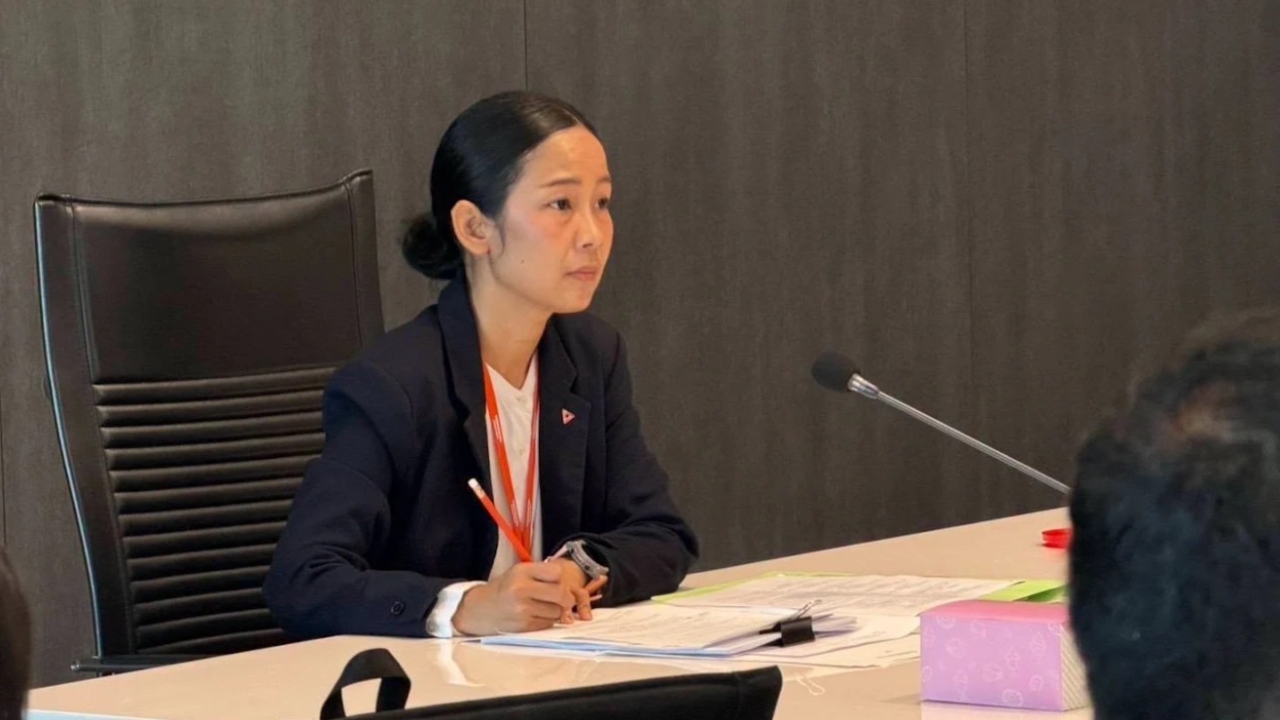
Sasinan Thamnitinan, Bangkok MP from the People’s Party, highlighted two cases reflecting problems with bail rights and temporary release standards. She pointed out the need for thorough consideration and uniform standards regardless of who the suspect is or their political affiliation.
On 2 Nov 2026, Ms. Sasinan Thamnitinan, MP for Bangkok’s 11th district from the People’s Party, spoke about the court’s recent orders denying temporary release in two cases this week. The first, on 30 Oct, involved the Criminal Court refusing bail to the admin of the 'Godd Dam' page, accused of distributing a fake money transfer slip. The case is still under investigation with no charges filed yet. The court cited the seriousness of the charge, the broad impact on social peace, and reasonable suspicion that the suspect might flee.
The second case, on 1 Nov, saw the Appeals Court deny bail to Tee Wannawalee Thamsataya and Boy Pongsathon Tancharoen after the lower court sentenced each to 2 years and 8 months in prison for speeches made at a 2020 rally. The Appeals Court reasoned that the case involved a severe penalty, damaged public trust in the monarchy, and there was reasonable belief the defendants might flee during the appeal.
Ms. Sasinan said the two cases differ in facts and legal status. She is not judging who is right or wrong nor challenging the court's authority. Instead, she questioned whether the criteria for restricting liberty before a final verdict are applied comprehensively and uniformly, regardless of who the accused is, the case type, or political side.
Ms. Sasinan noted that Section 29 of the Constitution clearly states that in criminal cases, suspects or defendants must be presumed innocent, and they cannot be treated as guilty before a final verdict. Detention should only be as necessary to prevent flight, and bail requests must be considered as prescribed by law. Meanwhile, Section 108/1 of the Criminal Procedure Code lists five concrete grounds to deny bail: reasonable belief of flight, tampering with evidence, committing other dangerous acts, unreliable surety or bail, and bail obstructing investigation or trial. Importantly, bail denial orders must provide written reasons. Thus, the severity of the penalty or charge may be a factual consideration but should not replace formal legal grounds for bail denial.
Ms. Sasinan further invited society to consider three key questions:
1. How is flight risk assessed? Is it based on each individual’s circumstances with supporting facts, or mainly on the penalty severity and charge nature?
2. Are there alternatives to detention, such as travel bans, mandatory check-ins, or electronic monitoring to mitigate risk without unnecessarily restricting freedom by imprisonment?
3. Is this uniform standard applied equally to everyone—whether authorities, politicians, ordinary citizens, or political dissenters with differing views?
Ms. Sasinan concluded that raising these questions is not rejecting judicial authority but affirming that all discretion within the justice system must be grounded in law, reason, and transparency. Freedom should not depend on who the person is or the case type. Granting bail does not determine innocence, and denying bail must not become premature punishment before final judgment.
"As a lawyer and MP, I will advocate for reviewing temporary release criteria to make them clear, transparent, proportionate, and seriously consider alternative measures. Detention should only be a last resort, not the first choice. In justice, liberty must be the principle, and restrictions on liberty must be justified exceptions," Ms. Sasinan said.