

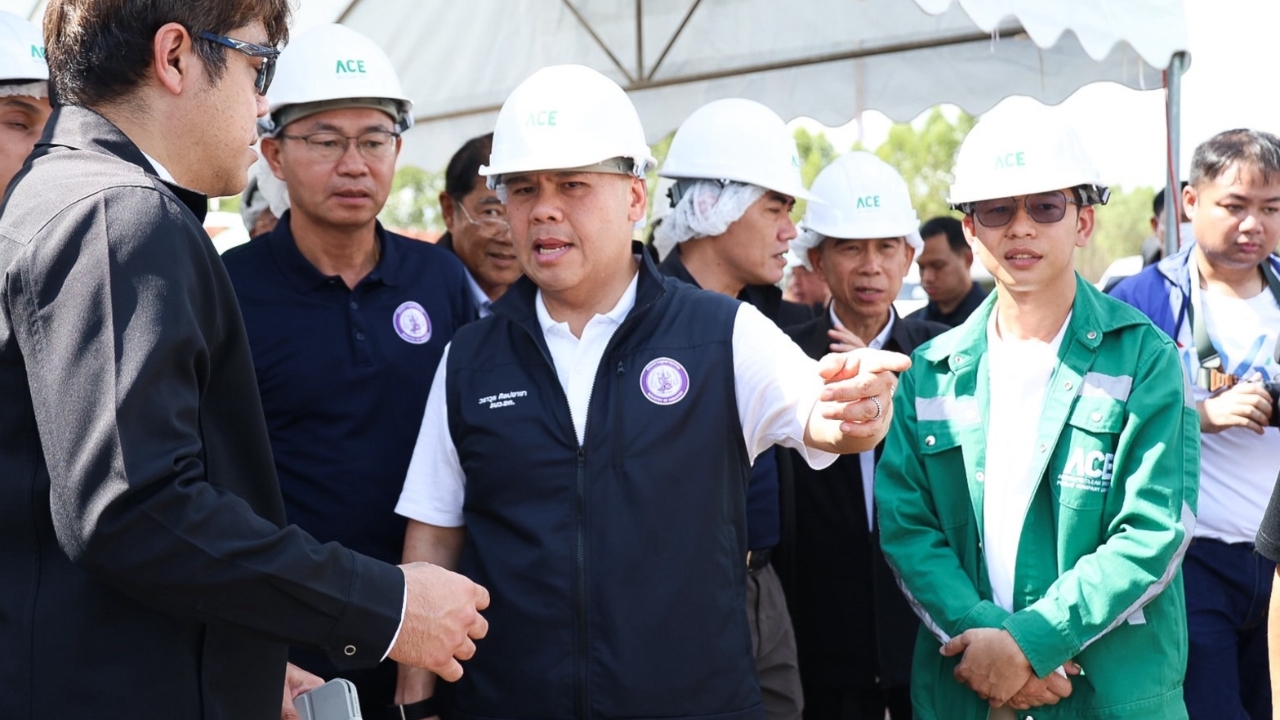
Minister Warawut conducted an inspection of an industrial waste disposal plant in Udon Thani, praising it as a quality example with good management. He ordered 50 special task forces to expedite inspections of red zone factories in five provinces and instructed the Department of Industrial Works to halt issuance of factory licenses 105 and 106 in all cases.
On 2 Nov 2026 in Udon Thani, Minister of Industry Warawut Silpa-archa and his team, including Secretary Thanetphon Thanabunyawat and Permanent Secretary Phaskorn Chairat, visited Advanced Asia Power Plant Co., Ltd. This factory, classified as number 105, operates sorting and landfill of non-hazardous industrial waste, with an investment of 140 million baht and 20 employees. It manages landfills according to set criteria, operates an environmental engineering-compliant wastewater system, and maintains up-to-date industrial waste controller registration. Chairman Mongkol Prukwattana of ACE Group welcomed the delegation.


Minister Warawut said after inspecting the plant that it is a quality operator and a good example for others. The landfill follows Ministry of Industry standards regarding depth and slope for each landfill layer, has a wastewater treatment system for leachate, and maintains green buffer zones planted with eucalyptus trees to prevent overflow incidents. The company also conducts public benefit activities, supporting surrounding communities by creating jobs and fostering social responsibility, which is central to all factories in communities.


He added that a single bad actor can spoil the reputation of many, which is why the Ministry has deployed 50 special teams to five provinces in the eastern and central regions, with plans to extend inspections to all 71 provinces nationwide. Companies unsure of compliance should correct issues promptly. These teams will inspect all 3,049 type 105 and 106 factories nationwide within one year, aiming for full standards compliance. The Ministry also urges community and local leaders to report irregularities via the Department of Industrial Works’ 24-hour hotline 1564 for community safety.
Asked if inspections in the five provinces have found irregularities or require further directives, Minister Warawut said officials are already in the field and expected to report progress by evening. Each team knows which factories and areas are red zones and will prioritize inspecting these high-risk sites, focusing on protecting nearby populations. He emphasized strict legal compliance to avoid mistakes that could lead to lawsuits, assuring full protection for all officials performing these duties.


When questioned about the seriousness of inspections in the five provinces, Warawut said the 50 special teams deployed to Samut Prakan, Chonburi, Rayong, Chachoengsao, and Prachinburi provinces have been instructed to enforce laws firmly—not just issue fines but pursue legal actions that trace shareholders and investigate nominee arrangements. The Ministry coordinates with the Ministry of Commerce, the Department of Special Investigation, and the Anti-Money Laundering Office to verify import declarations. If violations occur, customs laws allow criminal prosecution and asset seizure.
Regarding public opposition to electronic waste plant construction, especially in the eastern region, Warawut stated the Department of Industrial Works has been ordered to suspend all issuance of licenses 105 and 106 until operator inspections are complete. He understands public concerns and aims to act quickly within legal frameworks. Closing or canceling operations requires procedural compliance; skipping steps risks lawsuits against the Ministry, which could worsen problems and harm the public. He emphasized a cautious but certain approach is best.

Permanent Secretary Phaskorn Chairat revealed that many industrial waste disposal and treatment factories currently operate legally and meet standards. Meanwhile, illegal factories operating without licenses require urgent, serious scrutiny and enforcement to maintain confidence in the country’s industrial waste management system, which is vital to advancing Thailand’s Bio-Circular-Green Economy (BCG) model.
Previously, the Udon Thani Industrial Office ordered Advanced Asia Power Plant Co., Ltd. under Section 37 of the 1992 Factory Act to improve the embankment at the landfill exit to prevent rainwater from leaching waste outside the site. The company has completed the required improvements and the order has been lifted.
The company plans to open a second landfill phase soon as the first landfill nears capacity. Preparations include ensuring environmental management systems meet standards. The plant complies with annual operational monitoring, industrial waste management documentation (Forms GO.1 and GO.2), monthly i-Single Form reporting, and annual soil and groundwater quality reporting.
In the upper northeastern region’s five provinces—Bueng Kan, Loei, Nong Khai, Nong Bua Lamphu, and Udon Thani—there are 1,562 industrial waste generators (WG). There are 30 type 105 and 106 factories acting as waste processors (WP), maintaining a ratio of 53 generators to one processor, which is considered an appropriate balance.
The Ministry of Industry will continue promoting legal, safe operations of industrial waste disposal and treatment factories that meet environmental standards. Concurrently, it will rigorously enforce actions against violators to enhance transparency and safety in industrial waste management, supporting sustainable growth of the circular economy.