

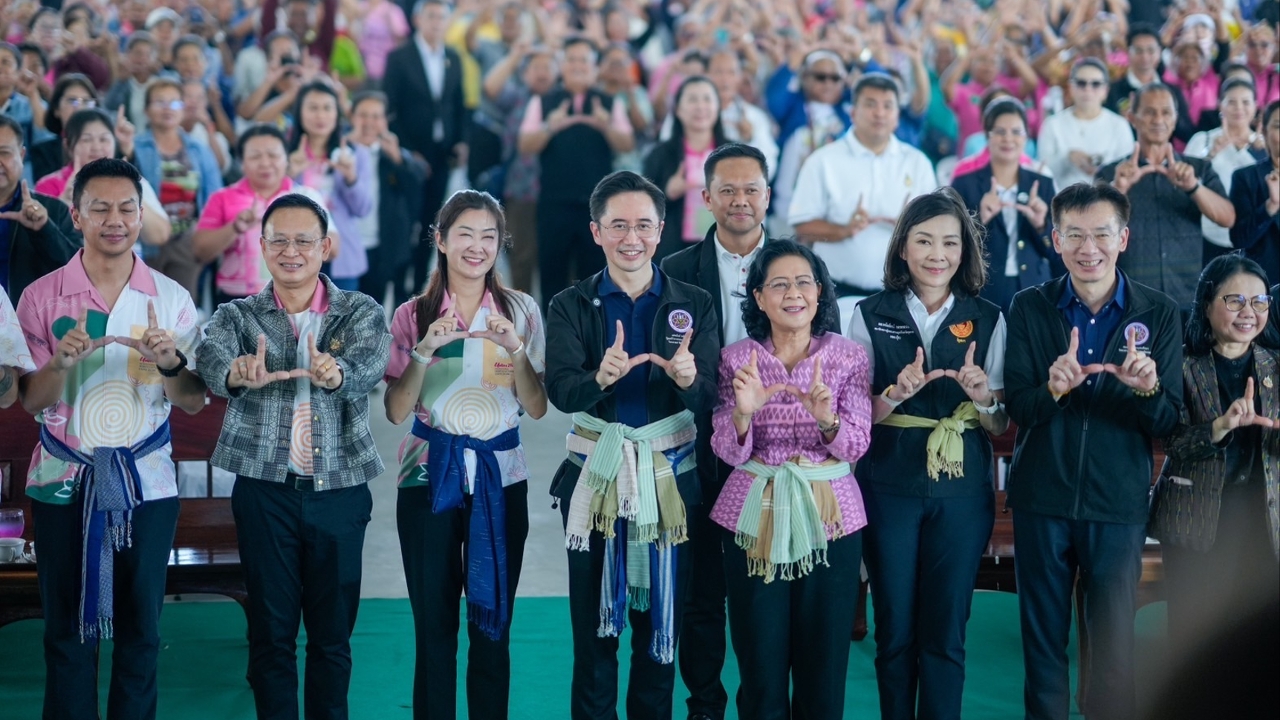
“Yotsanan” showcases the 5-month pilot success of the “Custom Fertilizer for Thai Farmers” project, cutting chemical fertilizer costs by 50%. The initiative integrates several agencies to deliver 5 machines to 5 cooperatives in Udon Thani, preparing for nationwide expansion.
On 2 Nov 2026 GMT+7, Mr. Yotsanan Wongsawat, Deputy Prime Minister and Minister of Higher Education, Science, Research and Innovation (MHESI), along with Ms. Piyarach Tiyapairat, Deputy Minister of Agriculture and Cooperatives, visited Udon Thani province to inspect support for research and innovation projects there, ahead of the Cabinet meeting on the road from 1-3 November.
The key destination was Udon Thani College of Agriculture and Technology to review progress of the “Custom Fertilizer for Thai Farmers” project. Governor Chaiwat Chuenkosum welcomed the delegation, and Associate Professor Dr. Weerachai Artharn, Governor of the Thailand Institute of Scientific and Technological Research (TISTR), presented the operational report.
A highlight was the signing of a significant inter-ministerial Memorandum of Understanding (MOU) to fully advance the project. This collaboration involved TISTR under MHESI, working with the Department of Cooperative Promotion, Department of Land Development, Bank for Agriculture and Agricultural Cooperatives (BAAC), and Department of Agriculture under the Ministry of Agriculture and Cooperatives.
Mr. Yotsanan spoke about strategies to reduce production costs for farmers, noting that imported fertilizers have become more expensive. Discussions with relevant agencies focused on ways to assist farmers nationwide, especially by importing base fertilizers to produce blends tailored to individual farmer needs.
The key approach involves using soil analysis results to determine fertilizer formulas suitable for each cultivation area, as soil conditions and fertilizer requirements differ by location. Knowing soil properties allows appropriate fertilizer use, reducing reliance on 100% chemical fertilizers by mixing in organic fertilizers, which also improves soil quality.
Mr. Yotsanan explained that the fertilizer production machines have been trialed in pilot areas for about 4-5 months to build farmer confidence, since many initially doubted whether new fertilizer formulas would yield as well as conventional ones. Demonstrating concrete results was necessary before scaling up to other regions.
The next phase will focus on expanding knowledge and fertilizer production technology so farmers can practically apply them and produce formulas suited to their own land, thereby reducing unnecessary fertilizer use and lowering cultivation costs.
Additionally, support has been provided with 5 more fertilizer production machines, coordinated with the Ministry of Agriculture and Cooperatives and interested provincial agencies and areas, allowing deployment or procurement as appropriate.
Farmers are not required to use only the new fertilizer production machines; they may also use existing general fertilizer mixers. The essential point is applying knowledge and soil analysis results to produce fertilizers tailored to plant needs and local conditions, helping reduce costs and expenses over the long term.
After the opening ceremony, the Deputy Prime Minister and team delivered automatic fertilizer mixing machines to five key cooperatives in Udon Thani: BAAC Customer Marketing Agricultural Cooperative, Kumphawapi Agricultural Cooperative, Nong Han Agricultural Cooperative, Sangkhom Agricultural Cooperative, and Nong Wua So Agricultural Cooperative, to extend services to local farmers.
Overall, the project’s progress shows clear results in the area. Currently, 442 farmers from eight districts in Udon Thani participate, covering over 2,818 rai cultivating rubber, rice, cassava, and sugarcane. Farmers learn to use field soil test kits to analyze nutrients and calculate organic-chemical fertilizer formulas matching soil and crop needs.
This approach has enabled farmers to reduce chemical fertilizer use by more than half. For example, among the first 41 BAAC customers in Udon Thani using custom fertilizer, 343 bags (17,150 kg) were applied, saving 139,200 baht in chemical fertilizer costs immediately. This demonstrates that innovation can effectively reduce farmers’ expenses, while recycling agricultural waste into fertilizer helps lower PM 2.5 pollution and restores soil health long-term.


