

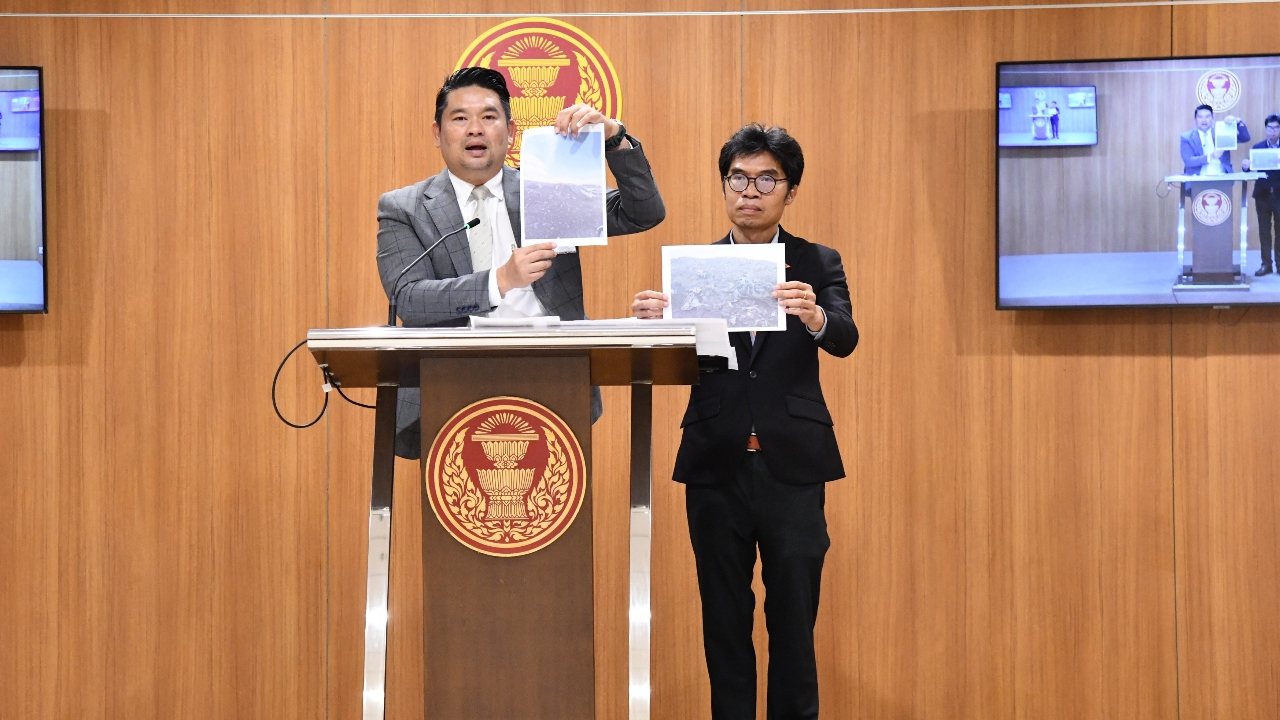
Anupap and Poonsak urged the government to swiftly inspect and manage hazardous industrial waste in Samut Sakhon and Samut Songkhram, fearing heavy metal contamination in water sources that could affect public health and the environment.
On 3 Nov 2026 at the Parliament building, Anupap Likit-amnuaychai and Poonsak Janjampee, members of the People's Party, held a press conference addressing the issue of industrial and electronic waste in Samut Sakhon and Samut Songkhram provinces.
Anupap Likit-amnuaychai stated that hazardous industrial waste from metal smelting, electronic waste, and imported scrap metal is impacting the environment and local residents, particularly in the border area between Samut Sakhon and Samut Songkhram. Large open-air industrial waste piles have been reported since 2023–2024, despite an environmental committee’s investigation that led to factory shutdowns in 2025. Currently, operations have resumed. The waste piles and their use in road fill and aquaculture pond embankments risk heavy metal contamination—lead, cadmium, mercury—of soil and water. Nearby fish deaths have been reported, with potential harm to the Gulf of Thailand's marine ecosystem and public health through the food chain.
Regarding government measures, 50 special task forces have inspected 80 factories, resulting in the closure of one factory types 105 and 106, and orders for improvements at over 60 others. Samut Sakhon has the third highest number of such factories nationwide.
They call on the government, Ministry of Industry, and relevant agencies to urgently inspect water quality and industrial waste management, strictly enforce laws against offending businesses to prevent evidence tampering or waste relocation, and investigate public officials’ conduct to prevent corruption and reduce long-term health and environmental impacts.

Poonsak Janjampee noted that factories in Samut Sakhon and Samut Songkhram with hazardous waste storage problems are those previously inspected and ordered to cease operations in 2025. However, industrial waste accumulation has increased, reflecting poor oversight and waste management. The Ministry of Industry’s plan to inspect 3,049 high-risk factories—groups A and B by November and group C by December—should not focus solely on completing inspections but must actively address hazardous contamination and rehabilitate affected areas. For example, Prachinburi province has 67 illegal industrial waste dumping sites outside the factory inspection list. In many areas, industrial waste is improperly used for road fill, risking heavy metal spread into soil and water, affecting public health and agriculture.
Therefore, they urge the government to expedite environmental quality inspections, transparently disclose contamination test results, allocate budgets to eliminate residual industrial waste, and rehabilitate vulnerable areas in Prachinburi, Samut Sakhon, Samut Songkhram, Phra Nakhon Si Ayutthaya, Suphanburi, and Lopburi provinces. They emphasize that merely shutting down factories cannot resolve pollution without concrete waste management and site restoration to prevent long-term impacts on people and the environment.
