

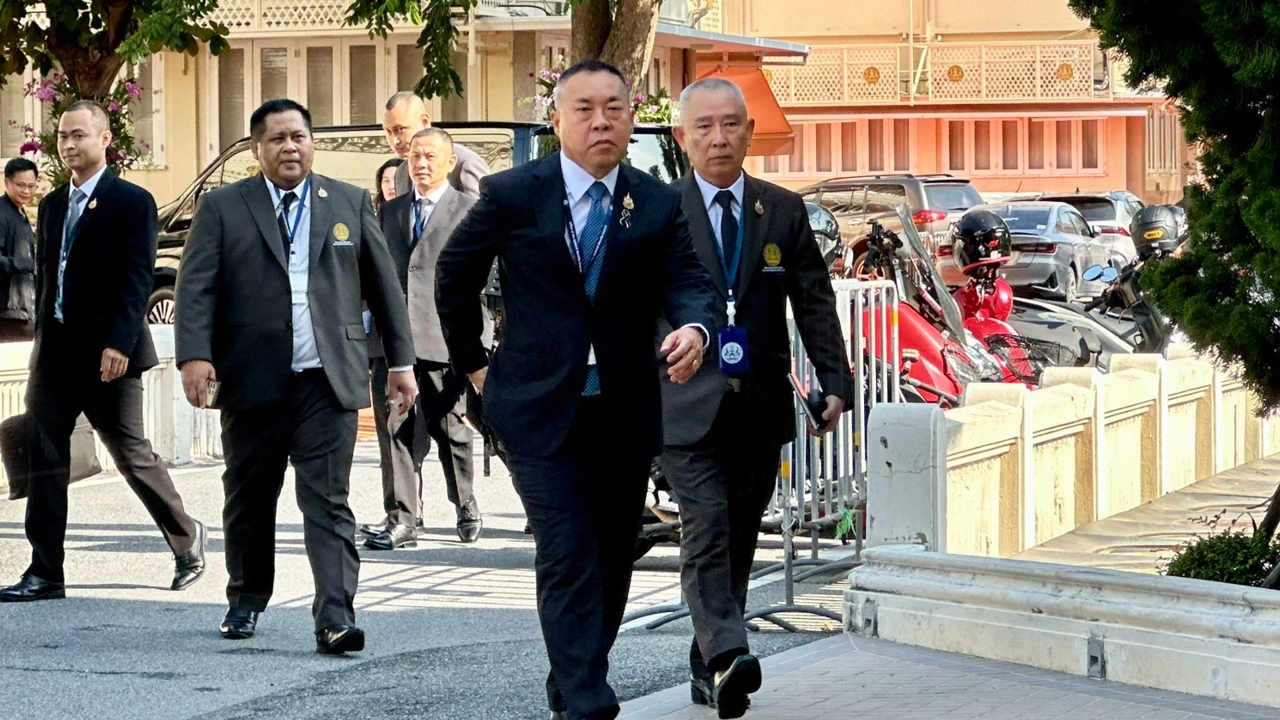
The NSC Secretary-General discussed with operational units a plan to address the Middle East situation and cyber threats, preparing for crisis management to protect infrastructure and public safety. Experts Fuadi and Manoch joined to offer observations. "Big Poo Duang" acknowledged the world's volatility and uncertainty.
At 09:00 on 4 Nov 2026 at Phakdi Bodin Building, Government House, General Chaiyapruk Duangprapath, Secretary-General of the National Security Council (NSC), chaired a meeting with relevant government agencies and academic experts to consider plans addressing possible security issues arising from the Middle East situation. Participants included representatives from various agencies and foreign affairs experts such as Mr. Hatai Chunhapharan, Advisor to the National Intelligence Agency; Major General Sutat Yuthapimphon, Director of Operations and Intelligence, Defense Policy and Planning Office; Mr. Worawut Samutkalin, Director of Policy and Planning, Ministry of Foreign Affairs; military representatives; officials from the National Cybersecurity Security Committee Office; representatives from the Attorney General’s Office; Mr. Fuadi Pisuwan, Political Science lecturer at Thammasat University; Mr. Manoch Aree, Political Science lecturer at Srinakharinwirot University; Mr. Wanvichit Boonprong, Political Science lecturer at Rangsit University; Mr. Thatcha Julkhat, Engineering lecturer at Mahidol University; and Ms. Lalida Hanwong, History lecturer at Kasetsart University’s Faculty of Social Sciences.

General Chaiyapruk said at the meeting that originally the Prime Minister wished to attend in person and approved use of this building. However, he explained that if the Prime Minister came, the discussion would focus on detailed adjustments to operational guidelines derived from the national preparedness plan, making the meeting too broad. Therefore, this session was for operational units first. Once the guidelines are complete or nearly so, they will be presented to the Prime Minister, and there may be another meeting with senior commanders to hear the results.
General Chaiyapruk said that given the current global situation’s volatility and uncertainty in all regions, the NSC already has a national preparedness plan. However, its details on specific agencies or operations are broad. Thus, this approach focuses on problems arising in the Middle East region, with the idea that it can be applied elsewhere. He and his team reviewed details and set various scenarios to anticipate future developments, enabling preparations for each scenario. Experts were invited to brainstorm and provide observations. After this event, the NSC will refine the details and may contact these experts again to consider appropriateness or whether additions are needed.
Reporters noted that during the meeting, discussions included security planning in the context of preparedness and crisis management. Initial assessments covered key current crises such as the Thailand-Cambodia situation, scammers and call centers, conflicts between the United States, Iran, and Israel, and the Russia-Ukraine war. The approach emphasizes proactive integrated prevention from normal conditions, with a national preparedness plan and crisis management plan to strengthen local security and conduct national crisis management drills. The plan targets six objectives: 1. A stable country ready to face threats even in normal conditions; 2. Security-related projects incorporated into provincial development plans; 3. Integration of budgets from all social sectors; 4. Public safety in life and property; 5. Protection of critical infrastructure; and 6. Crisis management exercises aligned with current security situations.

