

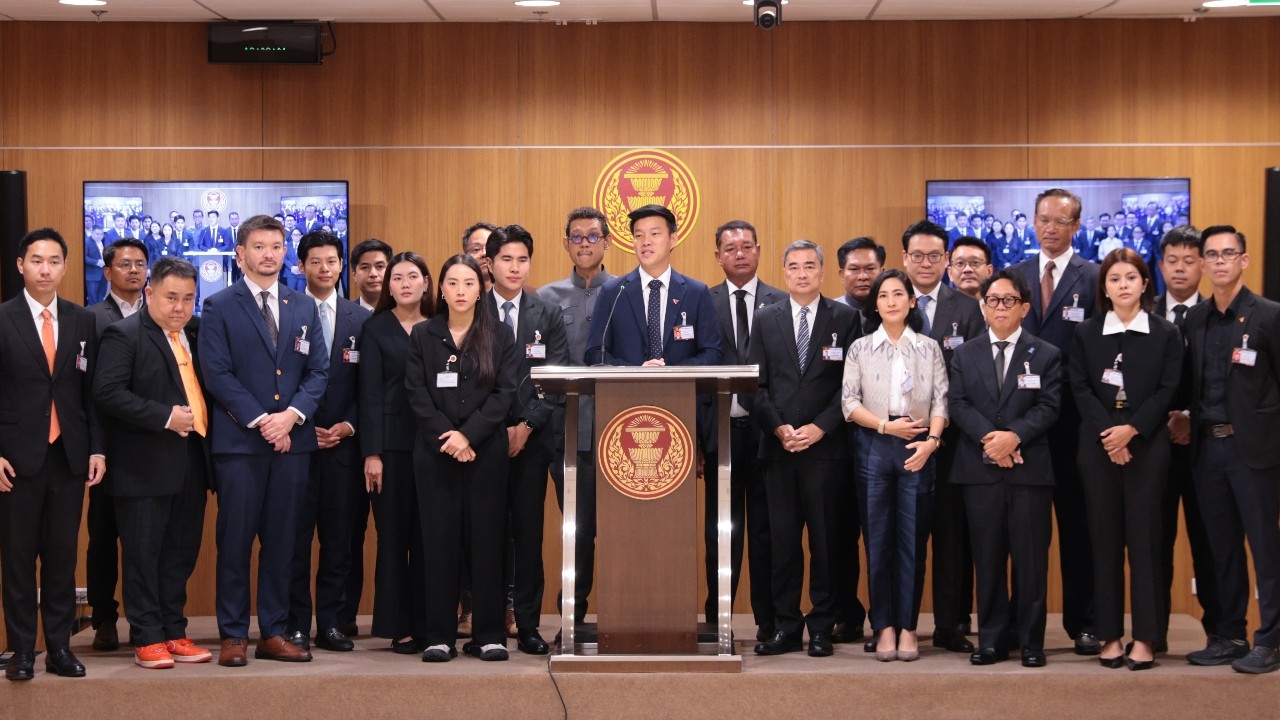
The opposition accuses the government of using every mechanism to block, interfere with, and intimidate oversight. They expose three power-grabbing tactics: controlling parliamentary committees, cutting off Senate corruption cases, and deploying spyware to monitor mobile phones.
At 1:00 p.m. on 4 Nov 2026 at the Parliament Building, Mr. Nathapong Ruangpanyawut, leader of the People’s Party and opposition leader in the House of Representatives, together with Mr. Abhisit Vejjajiva, leader of the Democrat Party, held a press conference titled “Blocking and Intimidating the Opposition’s Oversight Role.” Mr. Nathapong said they suspect the government or those in power within the Blue Regime are using controllable mechanisms to obstruct, interfere with, and intimidate the opposition’s duties. First, Speaker Sophon Sarum approved the procedure that all 35 parliamentary committees’ activities must pass by majority vote. Since the government has the majority, this effectively renders the opposition unnecessary in parliamentary duties. Committees will become mere rubber stamps endorsing government wrongdoing as correct.

They accuse the government of using independent organizations to interfere with the judiciary.
Mr. Nathapong said secondly, there is an attempt to interfere with the justice process in the Senate corruption case. The Election Commission (EC) reportedly voted 5 to 2 to file a case with the Constitutional Court to clarify the authority between the EC and the Supreme Court. This is an attempt to use an independent agency like the EC—whose majority comes from a Senate faction—to borrow the Constitutional Court’s ruling that even if the Supreme Court investigation finds additional evidence implicating others not named in the EC’s 11-person petition, those individuals cannot be prosecuted. This clearly shows the Blue Regime’s network is using controlled independent bodies to interfere with the judicial process in the courts.

They raised the issue that they were attacked by advanced spyware.
The People’s Party leader said thirdly, there is an attempt to intimidate opposition MPs, especially himself and Mr. Abhisit, who received warnings from Apple that their phones may be targeted by advanced spyware, typically used only by national government agencies. This led him to seriously suspect that he and Mr. Abhisit are being attacked and threatened by the Thai government. This is a serious problem they will not accept: the government using power—potentially through the parliamentary speaker—to consolidate committee powers within the executive branch.


“Abhisit” warns of possible misuse of majority power to dissolve committees.
Mr. Abhisit said he has led the opposition several times in Thailand and knows that every era faces constraints and obstacles in oversight duties. Governments often dislike being scrutinized, even though oversight is a core democratic process. Beyond the circular letters, there is now an attempt by Bhumjaithai Party members to amend parliamentary rules to allow majority votes to decide, possibly leading to dissolving committees or electing committee chairs by majority vote rather than by proportional agreement among MPs. This appears to be a continuous effort to hinder legislative oversight mechanisms, making them ineffective. Globally, parliamentary systems are cautious about majority dominance and rules but develop political traditions to respect each side’s role.
He advised the Speaker of the House to reconsider his orders with respect to the legislature’s dignity.
Mr. Abhisit added that although the circular called a meeting of all 35 committee chairs, the legal team summarized the approach. He recommended the Speaker call another meeting to review and reach consensus on what can be implemented, such as adding agenda items through discussion and notification without requiring majority votes, ensuring fairness. He urged Speaker Sophon to signal to Bhumjaithai that any rule changes should respect the legislature’s dignity and duties. Interference through processes like the case of Ms. Kan Dee Liaopairoj, a party-list MP and Democrat deputy leader, who was sued despite not being named, is strange and unnatural. Private companies using legal rights to oppose politicians is also problematic. He called for consideration of the Supreme Court president’s advice on anti-SLAPP measures to ensure fair practice.
He stressed the issue of being targeted by Pegasus spyware and urged it not to come from the government.
"Regarding alerts about mobile data threats in many countries, that has occurred before. In our case, Apple clearly warned that these attempts target individuals because of their roles and professions. The spyware mentioned is sold only to governments and is very expensive to use. If I recall correctly, 3-4 years ago about 30-40 Thais faced this issue and are still fighting in administrative courts, although civil courts dismissed the case. I want to emphasize I have used an iPhone for a long time and never received such warnings, nor have people I know. So, attempts to explain this as widespread globally are misleading. I want the Minister of Digital Economy and Society to understand the reality, as the warnings are clear. We demand the government confirm that no security or government agency is conducting such acts," Mr. Abhisit said.
When asked about whether the circular on committee powers violates ethical standards or whether they would file a complaint with the National Anti-Corruption Commission, Mr. Nathapong said there have been attempts to cite longstanding meeting rules. If those rules have existed for a long time, then past parliamentary practices were incorrect. They see the latest procedure as an attempt to block the opposition’s role. They consider the Speaker’s exercise of power potentially abusive and are discussing with the opposition which agency to file a complaint with. Regarding Bhumjaithai party-list MP Nikorn Jamnong’s statement that unity is needed and the opposition and government shouldn’t be divided in committees, Mr. Nathapong said committee work differs from the full house. Collaboration must respect the legislature’s oversight role. Claiming unity that prevents the opposition’s oversight function is unreasonable.
“Mark” sarcastically said if you want cat photos, just ask nicely instead of hacking with spyware.
When asked about the warnings that Mr. Abhisit and Mr. Nathapong’s iPhones were targeted by Pegasus spyware attempts while the Minister of Digital Economy and Society said investigations showed it was not Pegasus but normal malware that also triggered warnings for others, and about the planned National Cybersecurity Committee meeting and whether information would be shared, Mr. Nathapong said he is concerned. Given multiple incidents of spyware alerts, he wonders if the Thai government is behind them. He is uneasy about sending his iPhone to state agencies for inspection, fearing greater data access. However, civil society organizations working with international bodies are examining intrusion traces, and they will have their phones checked as well. He confirmed that while warnings have been issued in 159 countries, only some individuals have been targeted.
Mr. Abhisit added, "Opposition MPs must be cautious as such incidents can occur. I am not intimidated but emphasize it must not be state or government agency actions, as this violates personal rights. If they want cat photos, they can just ask me nicely instead of hacking with spyware."