

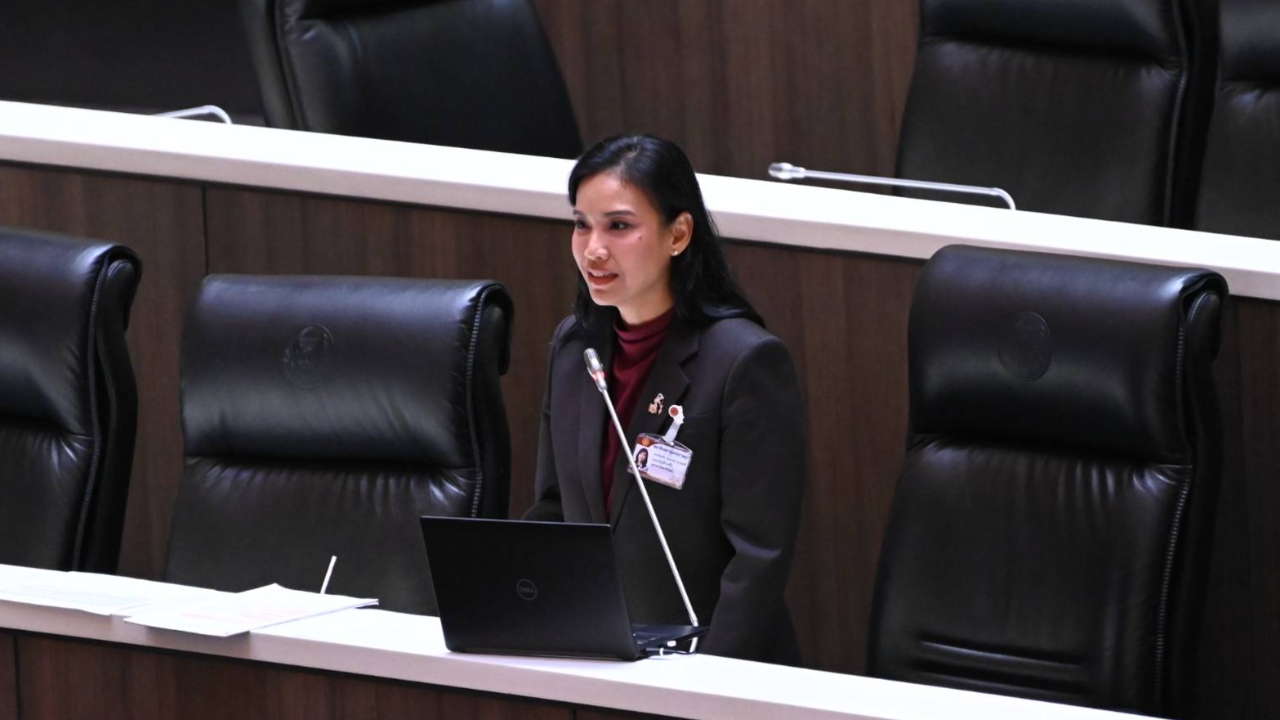
Radklao points out that detention centers in almost every Thai province are located within prisons. She is pushing a Democrat Party bill proposing the Miranda Warning model to require courts to proactively inform detainees of their rights and to introduce Germany's Day Release system to ease prison overcrowding.
On 4 Nov 2026 GMT+7, Radklao Intawong Suwankiri, a party-list MP from the Democrat Party and co-sponsor of a bill amending the Criminal Code to abolish detention in lieu of fines, summarized her points to Parliament to clear misunderstandings and highlight key flaws in the current fine penalty system. She explained that some MPs mistakenly believed detention in lieu of fines occurs at separate facilities or police stations. In practice, police holding cells are used only during investigations for up to 48 hours. Only five provinces—Pathum Thani, Trat, Roi Et, Lampang, and Nakhon Si Thammarat—have detention centers separate from prisons. The other 70-plus provinces have detention facilities located inside prison compounds.
Thus, the claim that sending someone to detention is not imprisonment does not align with reality, because ultimately those unable to pay fines end up in prison. This happens amid a prison overcrowding crisis at 131% capacity, akin to rivers converging to concentrate the poor behind bars. The Democrat Party's bill is designed as a practical middle ground, with progressive principles similar to other parties' drafts but with a carefully crafted enforcement mechanism comparable to the cabinet's draft. She summarized five key principles:
1. Fines must be enforced against property, not liberty, in line with the cabinet resolution on 5 July 2023, which stated that detention in lieu of fines violates the rule of law. Fines should be handled through assets; human freedom should not be exchanged or substituted.
2. Although alternatives exist, the poor cannot access them. Despite court regulations established in 2002 and 2020, the current system fails because poor people cannot access the processes.
3. Shifting the burden to defendants to apply themselves is a failure. South Korea's experience showed that when defendants had to apply for community service themselves, less than 1% accessed this right, and 43.94% ended up detained. This proves systems relying on defendants to request relief do not work.
4. Keeping detention as a last resort still results in imprisoning the poor because frontline officers choose the easiest method—detention. Germany once used this approach but had to reform by halving detention days. Thai law under Criminal Procedure Code section 89/1 allows detention outside prisons, use of electronic monitoring bracelets, and house arrest. Thus, thinking should not be limited to just imprisoning people.
5. Establish a comprehensive tiered fine enforcement system that offers payment plans, confiscates assets or freezes claims if evaded, and requires community service if no assets are available.
To address concerns that removing detention penalties would halt court processes, Radklao proposed applying a Miranda Warning-like principle used internationally by police, such as “You have the right to remain silent,” to courts. She suggests mandating judges to inform defendants immediately of their rights to installment payments and community service, along with enforcement measures for violations. This approach requires no extra budget and directly solves the public’s lack of legal knowledge.
She also presented Germany's Day Release prison model, which allows non-violent inmates to work and live normally during the day to maintain their jobs and support families, then return to supervised detention at night. This system helps prevent family breakdowns.
Finally, Radklao called on the House of Representatives to approve the principles of all five bills so the special committee can integrate their strengths. She invited representatives from the judiciary, probation department, corrections department, the Attorney General, civil society, and international experts to collaborate in genuinely reforming Thailand’s justice system, avoiding repeated failures.