

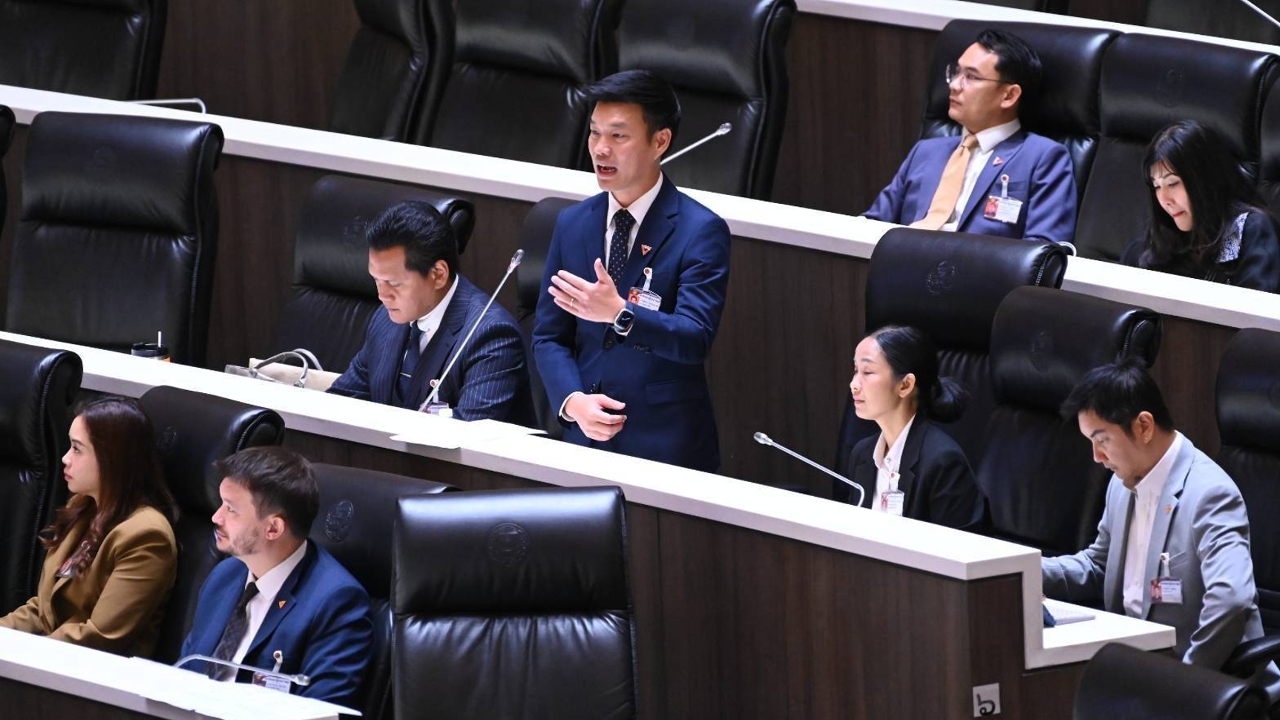
Nattapong joins the proposal to amend the Criminal Code to abolish imprisonment in lieu of fines, emphasizing that if implemented, it must be thorough. He calls for removing imprisonment penalties from the justice system and recommends studying income-based fine systems to reduce disparities between rich and poor.
On 4 Nov 2026 GMT+7, during a House of Representatives meeting, the amendment bill to the Criminal Code concerning improvements to imprisonment instead of fines was discussed. The People’s Party was among those proposing the bill alongside the Cabinet and other parties. Mr. Nattapong Ruangpanyawut, leader of the People’s Party and opposition leader in the House, participated in debating the party’s draft and its key differences from other versions.
Mr. Nattapong stated that Thailand’s justice system still faces major problems, including prison overcrowding and the issue of prisons mainly detaining the poor. Although this bill does not directly aim to solve overcrowding, both issues highlight the need for comprehensive reform of the justice system to fully address these problems.
Data from late 2025 shows that nationwide prisons can hold about 240,000 inmates, but the actual population exceeds 300,000—about 21% over capacity—indicating that Thailand has yet to fully resolve the issue of prison overcrowding.
Thailand has previously tried to address excessive criminal penalties through the Act on Administrative Fines, in which I served as a special committee member. However, converting criminal fines to administrative fines still faces limitations because only offenses punishable solely by fines qualify, excluding minor offenses that include imprisonment or detention.
Meanwhile, some offenses with high fines but punishable only by fines have been included in the system. Although there have been attempts to revise the attached schedules, the problem remains unresolved. This teaches us that amending laws without thorough consideration may leave original issues intact.
Mr. Nattapong further explained that the issue of "prisons detaining the poor" arises mainly from two economic constraints. First, poor defendants often cannot afford bail or surety, resulting in detention during trial despite the presumption of innocence. Second, when courts impose fines, those who cannot pay face imprisonment instead, which this bill seeks to fix.
Therefore, if the bill proceeds to the special committee, it should decisively abolish imprisonment in lieu of fines and replace it with community service. Retaining imprisonment in the law, even with some revised criteria, risks perpetuating inequality in practice. The Cabinet’s draft, which still includes imprisonment, could cause future problems.
Mr. Nattapong added that the government and related agencies should consider reforming Thailand’s entire fine system, especially studying an income-based fine system, or Day-Fine System. This approach was discussed during the administrative fine law review, but the committee prioritized tackling excessive criminal penalties first and postponed fine system reform to another law.
He noted that fixed fines affect rich and poor differently even for the same offense and fine amount. For example, speeding fines of a few hundred or thousand baht may be negligible for wealthy individuals but impose a heavy burden on those with low income.