

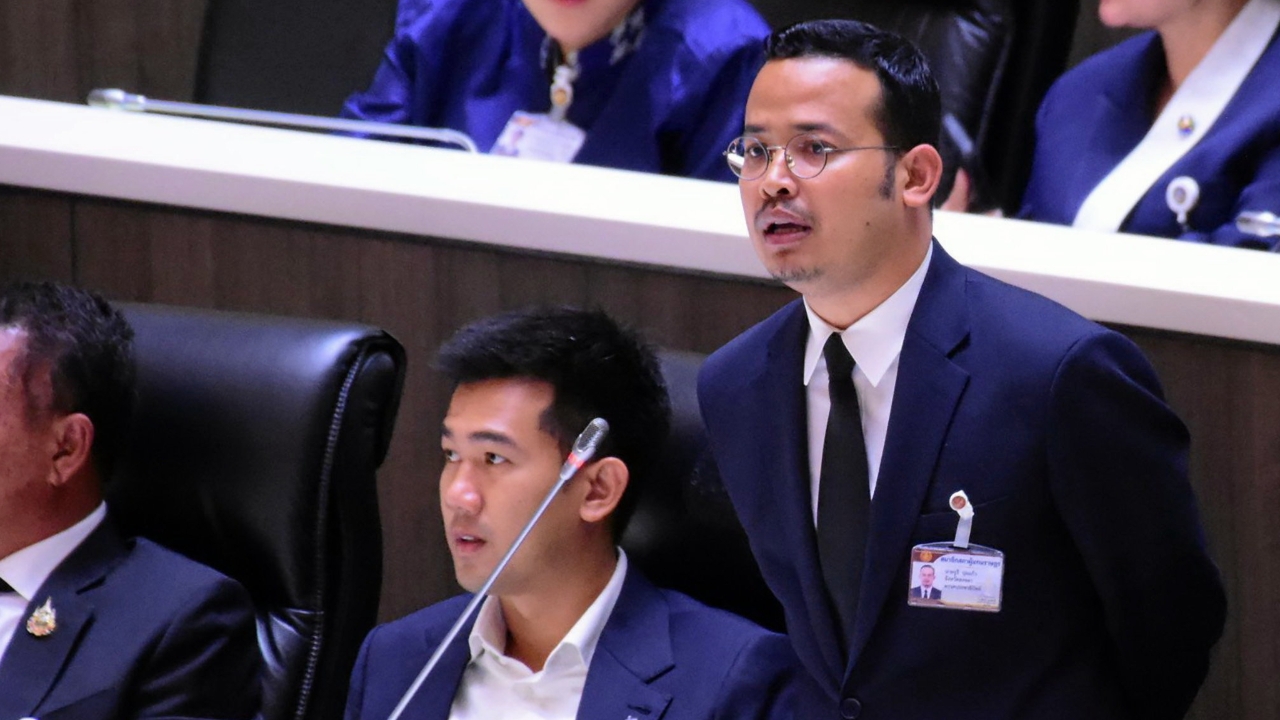
Juree, a Songkhla MP from the Democrat Party, raised a question about the Community Solar Project’s 200-billion-baht loan, accusing it of being overpriced, favoring investors, squeezing out SMEs, and amid heavy rumors of 30,000 baht kickbacks in Chiang Mai.
On 5 Nov 2026 GMT+7 at Parliament during a House of Representatives meeting, Juree Numkaew, a Songkhla MP from the Democrat Party, submitted a verbal question on the Community Solar Project. She originally intended to question Deputy Prime Minister Ekniti Nitithanprapas, chairman of the project screening committee, but due to his busy schedule, Energy Minister Eknat Promphan was assigned to clarify and respond instead.
Juree began her question by noting that although the project’s stated goals are commendable—supporting clean energy, reducing electricity costs, and turning rooftops into power sources—the enormous 200-billion-baht loan raised unavoidable public doubts about transparency and whether benefits truly reach citizens or instead flow to investors and serve as a channel for politicians to recoup investments.
Juree highlighted that the government set the price for a 5-kilowatt solar panel installation package at 140,000 baht per unit, subsidizing 50,000 baht, even though the current market price for similar installations with the same warranty is only about 80,000 to 90,000 baht. She questioned why the government’s project price is so much higher and whether the government has considered the disadvantages or risks borne by citizens.
In her next point, Juree reflected the difficulties faced by small contractors and SMEs, stating that although the government announced the project would create opportunities for small contractors to thrive, in practice it imposed obstacles such as a high deposit of 50,000 baht held for 3–6 months during approval. This prevented small SMEs lacking reserve capital or bank guarantees from competing with large investors.
Furthermore, the Community Solar Project’s public guidebook, section 4, clause 4.2, states that the Metropolitan Electricity Authority (MEA) or Provincial Electricity Authority (PEA) will provide installation services or act as registered installers. Allowing state electricity agencies to compete as contractors against small private businesses is highly unfair to local operators.
Juree also questioned the project’s loan usage deadline of 30 September 2027 and the goal to enroll 1 million households, noting that previous years’ data shows the system can only install and connect about 120,000 households. Given the time constraints to complete grid connections by July–August 2027 before project closure, reaching the 1 million household target seems nearly impossible.
She further raised rumors that the government might solve this by allocating quotas to 200 pro-government MPs to collect 5,000 household names each, artificially inflating numbers to meet the 1 million target. She expressed hope this is not true, warning that rushing to meet targets could compromise installation quality and open wide doors for corruption.
Towards the end of her question, Juree raised complaints about kickbacks in Chiang Mai, reporting a survey sent to installers offering only 110,000 baht per unit, while the project budget is 140,000 baht. This raised questions about the missing 30,000 baht and who receives it. Such blatant practices lead the public to suspect political or authoritative figures are behind and directing these actions. She called on the relevant ministers to transparently clarify these facts to society.