

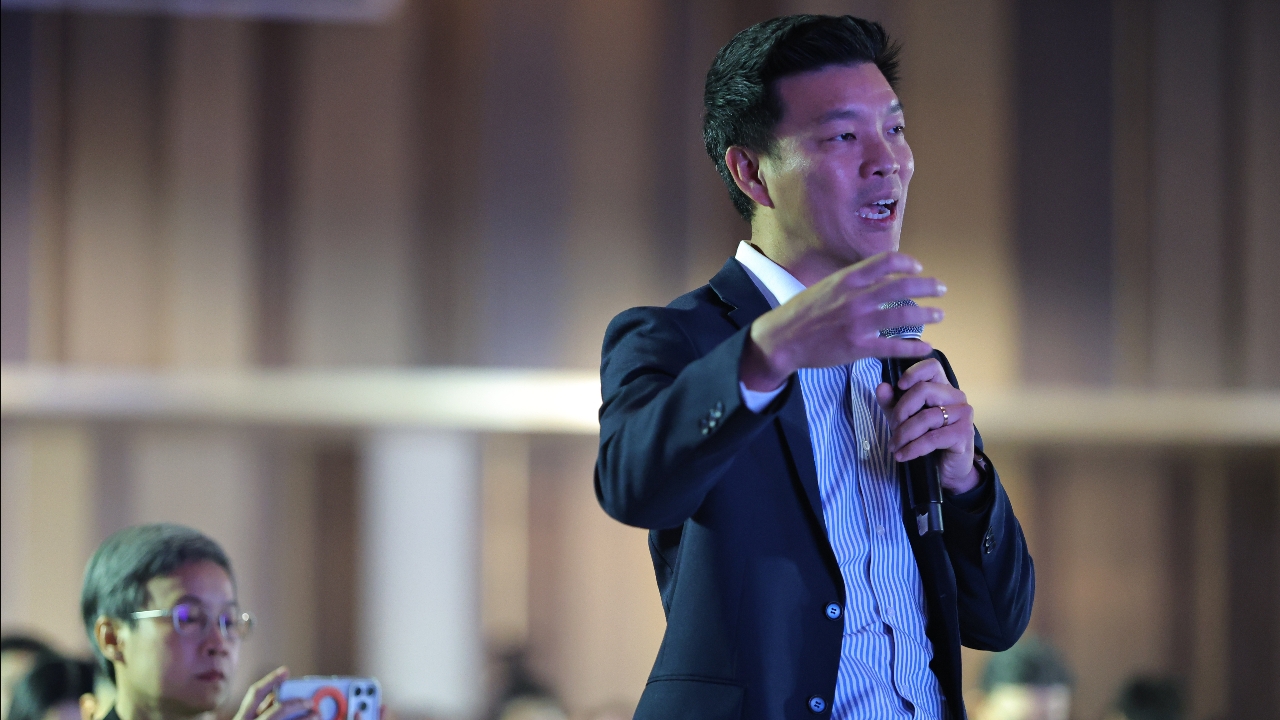
"Teng" led the People’s Party in attending the 2028 Pre-Budget Consultation, advocating for a transparent overhaul of the budget reform system, open disclosure of budget requests, and pushing for the Budget Procedures Act to establish a sustainable system that does not simply follow government preferences.
On 5 Nov 2026 GMT+7, the Budget Bureau held an academic seminar to gather opinions prior to drafting the fiscal year 2028 expenditure budget (Pre-Budget Consultation). Representatives from various sectors, including MPs and the People’s Party, participated to express their views on the budget formulation approach.
Mr. Decharat Sukkamnerd, director of the Center for Future Policy and spokesman for the opposition leader, stated that the existing policy-making problem lies in dispersed goals with funding unbalanced relative to the scale of problems, lacking outcome monitoring and time alignment. He proposed that this budget formulation set clear objectives, focus on 2–3 year long-term results, use non-budget mechanisms, and integrate local administrative organizations in budget planning. He also suggested creating a “production calendar” to align budgets with actual agricultural cycles and designate lead agencies for implementation. Additionally, he proposed establishing an emergency fund for disaster and new plant disease responses.
Mr. Decharat emphasized five urgent issues: managing water and climate outside irrigation areas; stabilizing agricultural product prices using existing fund mechanisms; concretely reducing production costs; expanding and diversifying export markets; and supporting young farmers as service providers and product managers to sustainably increase agricultural value.
Mr. Surachet Praveenwongwut, party-list MP of the People’s Party, noted that the government has previously spent hundreds of billions of baht mainly on road construction, an approach inconsistent with sustainable development. He proposed shifting the focus seriously to developing public transport and rail systems and setting a master plan for actual large-scale projects.
Mr. Surachet also proposed setting preliminary budget caps and prioritizing projects, demanding that road construction projects valued at 600 million baht or more be submitted for Cabinet review to foster genuine competition and transparency, breaking the cycle of collusion among established contractors.
Ms. Nattaya Boonyapakit, party-list MP of the People’s Party, proposed focusing budget formulation on enhancing human capital from early childhood (0–6 years), a stage that yields the highest return on life foundations, yet has historically received the smallest budget allocation compared to other ages.
She further proposed monitoring child development budgets from all government agencies to enable parliamentary and public scrutiny, called for reinstating child development indicators to measure outcomes, and suggested that savings from declining birth rates be retained as demographic dividends to enhance welfare—especially by providing universal child subsidies and including the student loan fund (กยศ.) in the main budget as a fundamental right rather than relying on uncertain central budget allocations.
At the seminar, the People’s Party leader, serving as opposition leader, stated that reforming and transitioning the annual expenditure budget process requires restructuring Thailand’s budget system to align with international standards, including top-down budgeting and consolidated budgeting. He also proposed that the government include fiscal obligations outside the public debt definition—such as local government and state enterprise debts—in the budget documents fully, allowing Parliament comprehensive fiscal oversight.
Mr. Natthapong added that the core of budget reform is transparency through disclosure of all budget requests compared against the annual expenditure budget bill draft, enabling the public and all sectors to jointly monitor and prevent issues of biased budget allocation or distribution limited to political constituencies.
The People’s Party has already submitted a new Budget Procedures Act draft to Parliament to institutionalize effective pre-budget consultation and budget framework setting as a permanent system in Thailand, independent of each administration’s policies.
The proposal includes budget formulation components to push Thailand toward becoming a Green Compute Hub in the AI era through the 'three builds' concept:
1. Building the initial market through budgets for purchasing Smart Meters and Smart Grid systems.
2. Building the domestic supply chain by designing investment promotion measures and subsidies to attract investment in the sodium-ion battery industry, which uses salt mineral resources from northeastern Thailand.
3. Building technology by supporting research funding to increase charge cycles, reduce electricity costs per unit over the product lifespan, and sustainably enhance global competitiveness.
Representatives and MPs of the People’s Party said this event is a good start, as the government held the Pre-Budget Consultation process to hear views from various sectors before drafting the annual expenditure budget, something the party has long advocated. However, they noted insufficient time was allocated for feedback, which may prevent the government from fully considering diverse perspectives on budget formulation.


