

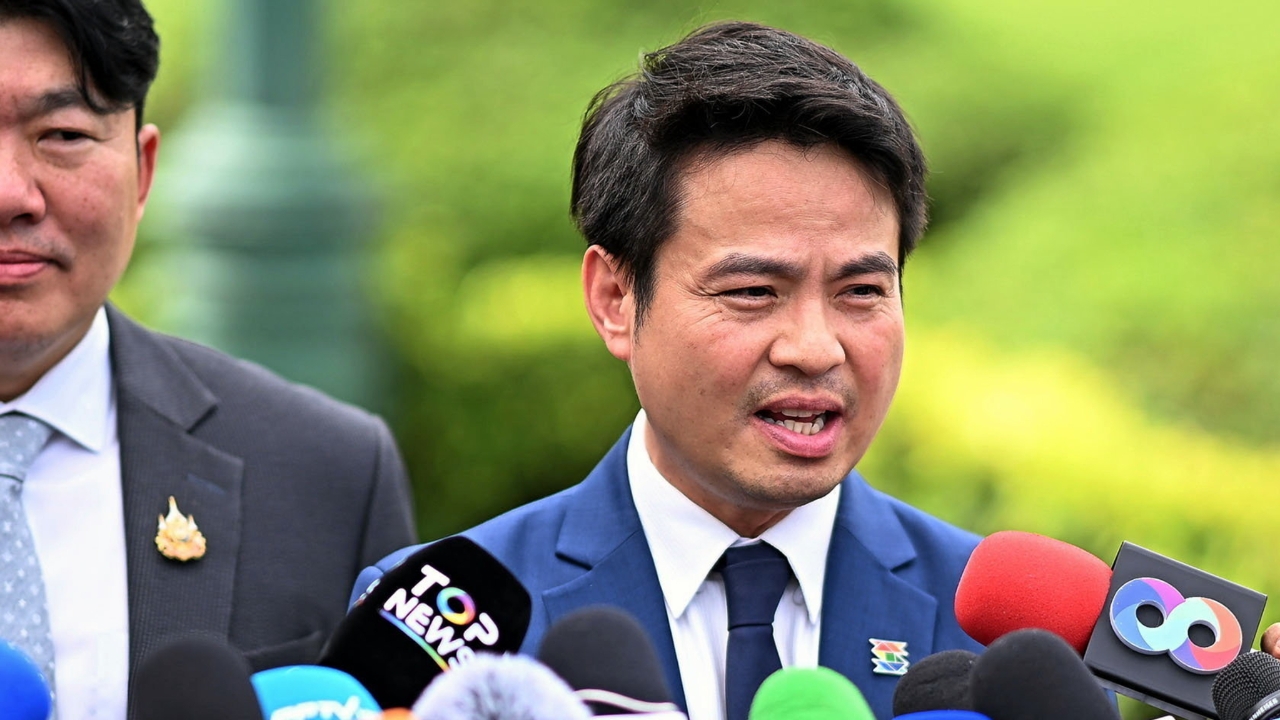
The regulations do not grant the committee chair the power to summon individuals. Phradorn insists there is no 'Blue Regime,' sees the opposition's claims as mere prelude to a no-confidence debate, and questions what authority was used to invite Prime Minister Anutin to explain in the parliamentary chamber, asking who the real dictator is?","tags":["parliamentary rules","committee powers","Prime Minister","political dispute"]
At 11:10 AM on 6 November 2026 GMT+7,","tags":["time","date"] Phradorn Prisananantakul, Minister attached to the Prime Minister's Office,","tags":["government official","Minister"] spoke at the Government House regarding the case of","tags":["Government House","statement"] Sophon Sarum, Speaker of the House of Representatives,","tags":["parliament","Speaker"] issuing a regulation requiring the chairs of 35 parliamentary committees to have a resolution before summoning individuals to explain, which has drawn criticism suggesting executive overreach into parliament. He said this is understood as a general guideline for committees, nothing new, and aligns with regulations and the constitution. Normally, when committees consider issues, the regulations clearly grant the committee the power to summon, but do not state that the committee chair alone can summon. He believes this clarifies the matter clearly."tags":["parliamentary committees","regulations","summoning authority"]
Regarding the belief that the chair has the power to set the agenda, this is correct, but the chair’s agenda setting must be approved by the meeting. Some have questioned how the House Speaker can set any agenda. Before doing so, the Speaker must consult with the party whips to agree on which agenda items to consider weekly. The chair does have the power to set the agenda, but deliberations are the parliament’s authority. The parliament’s agenda decisions require consensus. For example, bills must be submitted to parliament for a resolution to reschedule or change the agenda. This shows it is parliament’s authority, not the chair’s, to prioritize agenda items. Committee regulations align with parliamentary regulations."tags":["agenda setting","parliamentary procedure","committee regulations"]
On whether this issue escalated to criticism that the 'Blue Regime' has taken over the legislature, Phradorn stated,","tags":["political criticism","Blue Regime"] The 'Blue Regime' does not truly exist. The Prime Minister and the head of his party have already said it does not exist; there is only the Blue Party. He has consistently said the 'Blue Regime' is just political rhetoric. It is being brought up frequently now as a prelude to the upcoming no-confidence debate called 'entertainment dictatorship.'"tags":["political rhetoric","Blue Party","no-confidence debate"] He believes this period is their prelude before their 'performance' scheduled for 7-11 December, reiterating that there is no 'Blue Regime.'"tags":["political strategy","no-confidence debate"]
When asked about the legal committee’s unanimous 7-0 vote to summon Prime Minister and Minister of Interior Anutin Charnvirakul to explain before the committee under the summons law, and whether this cannot be denied, Phradorn replied,","tags":["legal committee","summoning","Prime Minister"] The committee has the right to summon anyone. Inviting someone to explain must be by the committee’s joint resolution; this is a right they can exercise. However, the invitation should be to explain within the committee room. He is unsure what authority or regulation was used to summon the Prime Minister to explain in the parliamentary chamber."tags":["committee authority","summoning procedures","parliament"]
Phradorn continued that such a thing has not happened before and he believes no regulation covers it. He questioned those accusing others of parliamentary or national dictatorship, noting that if someone in a committee or as chair does not consult others and acts unilaterally, that is dictatorship. The test is simple: give power to someone and see how they behave. A dictator does not listen to others when in power and uses authority arbitrarily. He believes this is not what they or the government do; it is clear who does."tags":["dictatorship accusations","committee conduct","power abuse"]
When pressed on whether the Prime Minister is not required to explain, Phradorn said he has not seen the details yet and cannot answer. But as a committee member, if the majority votes to invite someone to explain before parliament, he questions under what authority or regulation this is done. Normally, committees invite discussions within their rooms; he has not seen anyone summoned to explain in the parliamentary chamber using the committee chair’s authority."tags":["Prime Minister","parliamentary procedure","summoning authority"]},{
Additionally, as overseer of the Budget Bureau, Phradorn discussed the government’s, opposition’s, private sector’s, and state agencies’ consultations on the 2028 annual budget (Pre-Budget Consultation). This open consultation occurs before budget drafting and allocation decisions. Deputy Prime Minister and Finance Minister Akniti Nitithanprapas aims to instill fiscal discipline and reduce budget deficits. This consultation seeks to make the 2028 budget comprehensive."tags":["budget planning","consultation","fiscal discipline"]
Regarding what adjustments might be appropriate for the 2028 budget after consultations, Phradorn said that yesterday’s Pre-Budget Consultation was divided into three groups. He personally finds the discussion on off-budget funds or agencies’ reserves most intense, focusing on how to combine these with the budget to reduce expenditure in that area."tags":["budget adjustments","off-budget funds","government finance"]}]}