

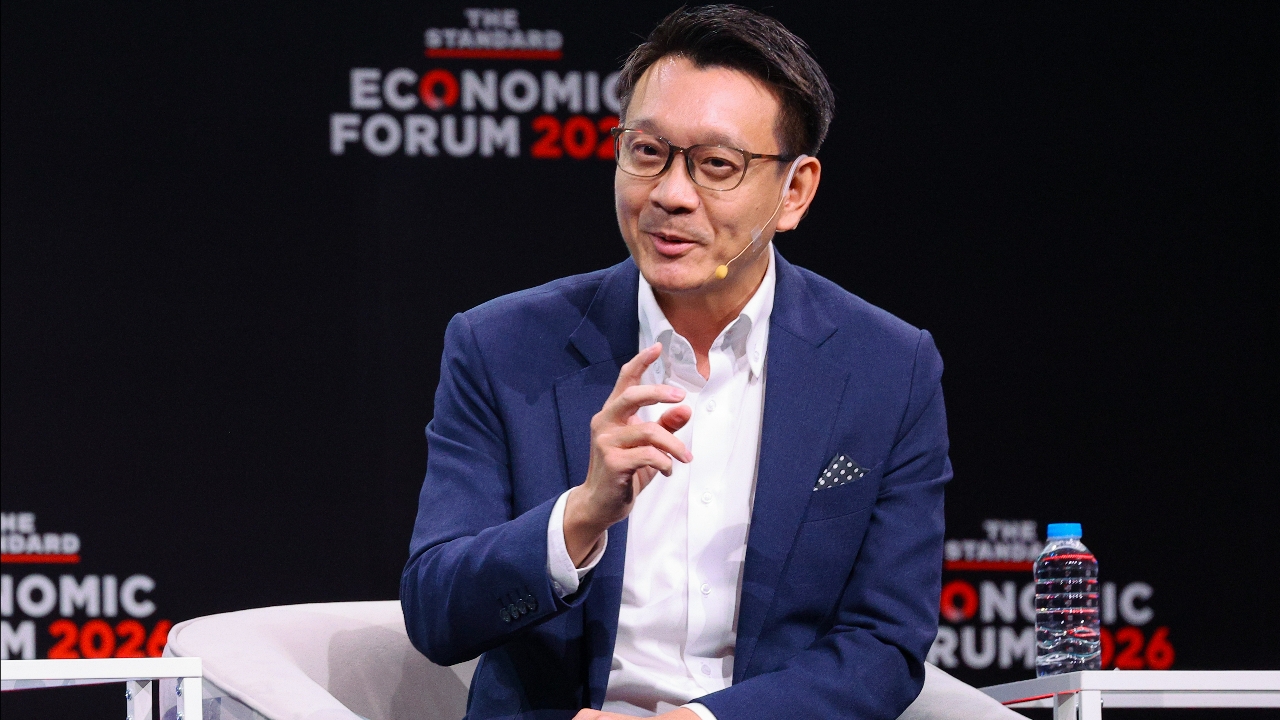
Veerayut points out that Thailand must stop fearing being left behind and must boldly negotiate with multinational capital. He advises that tax measures alone do not increase local content; policies must be designed and tailored for each industry to be effective.
On 6 Nov 2026, Veerayut Kanchoochat, deputy leader of the Prachachon Party and chairman of the Economic Development Committee, spoke about presenting the “New Local Content Strategy” to enhance Thailand’s economic value at THE STANDARD ECONOMICS FORUM on 5 Nov. He stated that for Thai industries to continue growing, the country must stop fearing technology gaps to the point of fully yielding to multinational companies but ending up with no indigenous technology.
He notes that Thailand is trapped in a fear of missing out (FOMO).
Veerayut began by reviewing industrial development lessons from Asian economic tiger countries like South Korea and Taiwan, which imposed “mandatory” measures requiring foreign investors to form joint ventures and transfer technology to local firms. Meanwhile, Malaysia and Singapore, with less bargaining power, adopted “positive incentives” by subsidizing skilled labor wages, funding overseas training, and encouraging local participation in production chains. As a result, Malaysia now has producers integrated throughout the semiconductor supply chain from upstream to downstream.
In contrast, Thailand lacks a clear industrial policy direction. Veerayut opined this is because Thai policymakers are overly afraid of missing out on technology, resulting in a FOMO-driven approach that almost always concedes to foreign companies’ conditions without the courage to negotiate benefits back to the local economy.
Three-dimensional industrial development strategy.
Veerayut proposed that Thailand must completely change its thinking by adopting the “New Local Content Strategy,” which focuses on three main dimensions:
First dimension: Do not mistakenly believe that tax measures alone, such as raising the electric vehicle (EV) import tariff to 35%, will automatically stimulate domestic parts production. The government must also implement direct support measures to build industries alongside.
Second dimension: Direct measures must be “tailor-made” to suit each industry’s context, not limited to simply counting local content percentages. They should include future-oriented investments such as establishing hydrogen energy R&D centers or co-developing automotive software.
Third dimension: The government must allocate budgets to achieve a “balance” between supply and demand sides, rather than focusing subsidies solely on buyers. For example, Thailand has spent over 20 billion baht subsidizing EV manufacturers but has barely allocated funds to upskill or reskill Thai workers to handle new technologies.
Do not neglect rule of law and fair competition.
Towards the end, Veerayut issued a warning to the government regarding future economic development policies, saying solutions must address root causes seriously, not just offer appealing visions or progressive rhetoric while neglecting long-standing structural problems.
Veerayut gave an example that building investor confidence should go beyond vision statements or investment incentives and subsidies. It requires rigorous law enforcement under rule of law and good governance principles. At the same time, innovation cannot truly flourish without the government ensuring fair market competition that allows new players incentives to continuously develop and produce better goods and services for sustainable economic competition.