

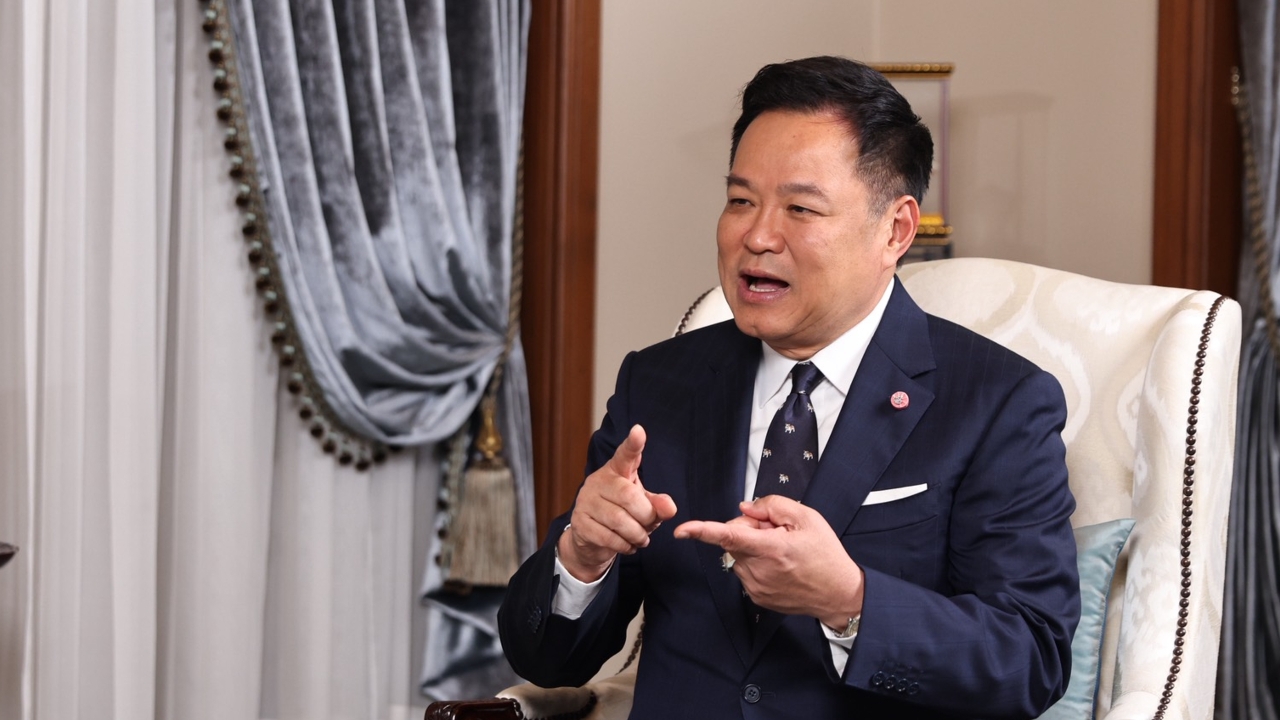
The Prime Minister highlights Thailand's strong food and energy sectors, asserting the government will never allow any family to face food shortages. He is confident in handling global instability and stresses that the 72-hour supply advisory is not a crisis signal. The government is pushing B20 biodiesel to reduce imports and increase farmers' income.
7 Nov 2026 GMT+7 Anutin Charnvirakul, Prime Minister and Minister of Interior spoke on the program “Talk with Prime Minister Anutin” about global security, economic, and energy situations, stating Thailand has a strong enough foundation to handle volatility and can turn global risks into economic opportunities.
The Prime Minister also addressed the public advisory to prepare a 72-hour supply, emphasizing it does not mean the country is entering war or food shortage. Citizens can continue their daily lives as usual. The government's priority is an early warning system, assistance, and quick access to vulnerable groups during emergencies.
“Live your life normally. There is no concern about food or essential goods shortages beyond normal conditions. The government will never allow any family to face food scarcity without receiving help,” he said.

Anutin further revealed that cyberattacks abroad disrupting food supply chains highlight Thailand’s strengths, as it is a fully integrated food producer with markets and production spread nationwide. Thailand does not rely solely on imported food or centralized storage. Food security is not just about feeding the population but is a strategic asset in a geopolitically volatile world. Trading partners seek stable food sources, and Thailand can ensure food security for itself and export markets.
On energy, the Prime Minister stated Thailand has no issues with oil volume or import sources, as procurement is diversified across regions. The real impact is oil and gas price volatility from Middle East tensions. The government uses tax measures and works with refineries to ease public burden. One effective policy is cutting excise tax on B20 biodiesel, containing 20% palm oil, making it nearly 10 baht cheaper per liter than regular diesel. This raised daily consumption from about 5-6 million liters to around 9 million liters.
“People are increasingly using it, now about 9 million liters daily. This is a clear change. As biofuel use rises, the country reduces oil import dependence while boosting palm oil demand for farmers.”
If biodiesel consumption reaches about 20 million liters daily, from a total diesel use of roughly 50 million liters, it could cut crude oil imports by millions of liters per day, saving nearly 100 billion baht annually. Money previously spent on energy imports can circulate domestically through palm growers. Additionally, bioenergy policies for sugarcane and cassava are seen as new markets for agriculture, providing farmers steady income beyond relying solely on commodity prices.
The Prime Minister continued, In a world where food security regains importance, Thai farmers are the country’s heroes. The government must create conditions for farmers to have stable incomes, market access, and sustainability without relying on temporary measures during price fluctuations.

Regarding the economy, foreign investment is another focus. Thailand is accelerating efforts to upgrade standards to join the Organisation for Economic Co-operation and Development (OECD), aligning business rules, transparency, and governance with international norms. Simultaneously, the government promotes Thailand Fast Track, allowing investors to deal with the Board of Investment (BOI) as a single point, reducing multiple agency coordination. This policy addresses past investor delays and assures non-discriminatory treatment in investing in Thailand.
The Prime Minister also disclosed talks with Google executives, who are ready to increase investment in Thailand. They see Thailand’s strength not in cheap labor anymore but in the quality of Thai workers, who can upskill toward an AI-driven economy, alongside favorable location, infrastructure, and logistics.
“We will not let AI control us; we must control AI. This is policy—to prevent AI from causing unemployment among Thai people. Therefore, we must manage AI effectively. Incoming investors must create jobs and transfer opportunities to Thai workers, not just bring capital,” he said.
He added that several investors, initially in early phases, have plans extending to phases 7-8, showing their intent to use Thailand as a long-term base. Political stability, infrastructure, distribution systems, and regional networks are key factors.
Anutin noted the key challenge now is for Thailand not to hinder itself after gaining investor confidence. In a world where food security, energy, technology, and geopolitics interconnect, countries with stable production bases, resources, and clear rules will have the advantage.