

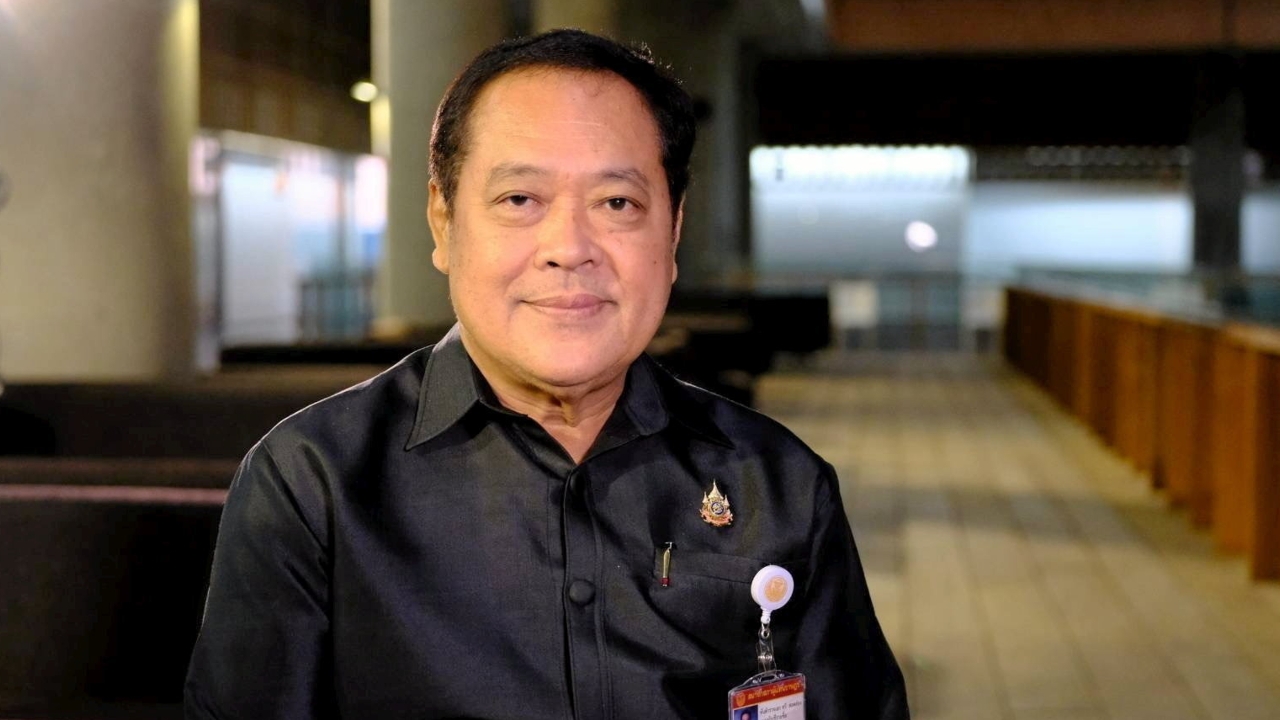
Tawee points out that the Appeal Court president's ruling on the Senate vote-rigging case opens a legal door for victims to enter the court's jurisdictional review process, reflecting the rule of law principle that "no one is above the law."
7 Nov 2026 GMT+7 Pol. Col. Tawee Sodsong List MP and leader of the Prachat Party, Pol. Col. Tawee Sodsong, revealed that on 6 Nov 2026, the Appeal Court president issued ruling No. Wt. 27/2569, dated 6 Nov 2026, stating that the case filed by a victim against the Election Commission Secretary-General and commissioners falls under the jurisdiction of the Criminal Court for Corruption and Misconduct Cases. The plaintiff is Mr. Pongsakorn Tangkittrakool, candidate for the Senate Group 2, Law and Justice Process group, number 71, who advanced to the national election and was placed fourth on the reserve list.
On 27 June 2024, just one day after the national election, Mr. Pongsakorn filed an objection with the Election Commission (EC), alleging collusion or corruption in the Senate election held at IMPACT Forum, Muang Thong Thani, Nonthaburi Province. The plaintiff claimed to be a direct victim of a possibly unfair or unjust election and has the right to sue under the Criminal Procedure Code Section 2(4) in conjunction with the Constitution-related Act on Senate Members Acquisition B.E. 2561 (2018), Section 88.
The key point is that the plaintiff is a candidate who filed an objection within the deadline under Section 64 of the Constitution-related Act on Senate Members Acquisition B.E. 2561, alleging that the Investigation and Inquiry Central Committee No. 26 found conduct consistent with the objection and issued charges against six candidates from Group 2, whom the EC had already certified as Senate members.
However, the plaintiff accused the EC of ignoring the objection without prompt consideration, delaying by appointing the Adjudication Committee No. 36, even though the Investigation and Inquiry Central Committee No. 26 had gathered evidence and opinions on 229 accused persons. The plaintiff viewed this as an attempt to evade duty under Section 32, affecting his rights as a victim under Section 88.
The plaintiff sued Mr. Sarawong Bunmee, EC Secretary-General, and eight EC commissioners; later, two commissioners were withdrawn from the suit as minority dissenters, leaving six defendants: one Secretary-General and five commissioners, considered the majority. The suit was against individuals holding office, not directly against the EC organization.
Pol. Col. Tawee further stated, The core of the complaint is that those responsible for ensuring election integrity are defendants accused of neglecting or abusing their duties. The plaintiff alleges the EC rejected key evidence from the Department of Special Investigation (DSI), including financial transaction data, money transfer proof, telephone communication data, and forensic evidence potentially linking suspects involved in a Senate election rigging network. The plaintiff submitted a letter contesting and requesting a review of the decision on 21 Jan 2026, but the EC issued a letter dated 11 Mar 2026 denying the review request.
The allegations in the complaint refer to the Constitution-related Act on Senate Members Acquisition B.E. 2561 Sections 32, 58, and 69, relating to evading duty, corruption in duty, obstructing lawful processes, misconduct, conspiracy, and prescribed penalties.
Another legal issue concerns Section 62, which requires the EC to petition the Supreme Court when there is "reasonable evidence to believe" a candidate or others committed or were complicit in corruption affecting the election's fairness. The plaintiff argues that this standard differs from the criminal proof standard for conviction.
The Appeal Court president's ruling No. Wt. 27/2569 is significant for the rule of law, addressing the rights of victims of corruption in unlawfully obtaining Senate membership, which impacts the sovereignty of the Thai people under Constitution Section 3. It reasons that all citizens, including the plaintiff, are victims entitled to file lawsuits directly in lower courts under the Criminal Procedure Code Sections 2(4) and 28(2), subject to legal conditions for each case.
Moreover, the Constitution-related Act on the Election Commission B.E. 2560 (2017) Section 38 states that all seven EC commissioners and the Secretary-General, in performing duties, are state officials under the Criminal Code and anti-corruption law. Therefore, when sued for improper or negligent performance or corruption, the Appeal Court president ruled the case falls under the jurisdiction of the Criminal Court for Corruption and Misconduct Cases per the Establishment Act B.E. 2559 (2016), Section 3 paragraph one (1).
The Prachat Party leader added that the 2024 Senate vote-rigging case is critical to democracy because if it is proven that a network was systematically established to control Senate election results, it undermines the legitimacy of legislative power acquisition and the constitutional system of checks and balances.
This ruling is not a verdict of guilt but opens the legal door for victims to enter the court's jurisdictional review process. It reflects the rule of law principle that no one is above the law, not even officials in independent organizations tasked with safeguarding election integrity, because justice requires opportunities for independent, thorough, and fair examination of facts and evidence.