

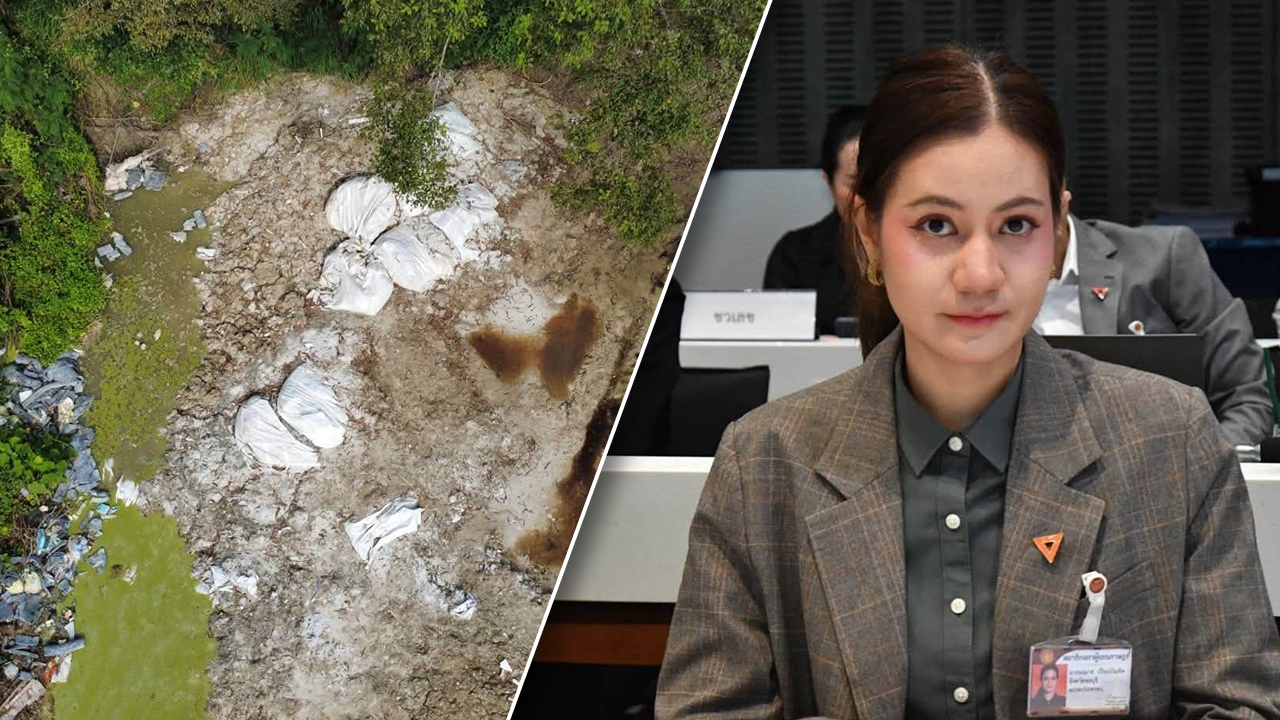
Chonburi MP Narumas exposes illegal dumping of industrial waste spreading to Ban Bueng, Chonburi, near the Nong Nam Kheaw reservoir. She calls for thorough underground water inspection, fearing impacts on raw water sources for tap water, and insists the public should not bear the costs of development risks or harms caused.
On 8 November 2026, Ms. Narumas Piambandit, Chonburi MP for Constituency 6 from the People’s Party, addressed the issue of illegal dumping of industrial waste. She said the crisis is no longer confined to Prachinburi Province but repeatedly occurs in the Eastern Economic Corridor (EEC) development zone, including Chonburi and Rayong provinces. The latest case was found in Village 2, Ban Nong Nam Kheaw, Klong Kio Subdistrict, Ban Bueng District, Chonburi, where industrial materials and waste were covertly dumped on about 10 rai of private land that was formerly a clay pit. The area emitted strong chemical-like odors, causing distress and serious concern among local residents about whether these chemicals and materials might leach into the soil and public water sources.
Ms. Narumas added that the Klong Kio Subdistrict Administrative Organization chief had urgently coordinated with relevant agencies to inspect the site. On 20 October, the Chonburi Provincial Industry Office collected samples for testing. Then on 22 October, the Office of Environmental and Pollution Control Region 13 (Chonburi) conducted a follow-up inspection and collected samples to analyze heavy metal contamination. Preliminary information indicates the waste originated from a factory in Si Racha District. Although officials reportedly fined the truck carrying the waste, Narumas firmly stated this issue cannot end with just a fine because the chemical waste remains dumped in the community. Residents have yet to receive clear government answers on plans to rehabilitate, excavate, or remove these hazardous materials.
Narumas emphasized that regardless of whether the materials are classified as hazardous industrial waste, no one has the right to dump or fill land arbitrarily. All factory waste must be properly treated and disposed of according to factory and environmental laws—not dumped on private land in the middle of a community, thereby shifting health risk burdens onto residents. Most concerning is that the dumping site is adjacent to a pond and near the Nong Nam Kheaw reservoir, a crucial raw water source for community tap water production. If chemicals or heavy metals wash into surface water or seep into underground water layers, it could cause widespread, incalculable health impacts on the population.
She called for inspections focusing on three key areas: First, conduct in-depth environmental impact assessments beyond just sampling the dumped materials. This must extend to testing water quality in the pond, Nong Nam Kheaw reservoir, and the underground water system around the area. Coordination with the Department of Groundwater Resources should be expedited to assess risks to community groundwater wells used for consumption, including excavation to examine quantities, depths, and types of buried chemicals.
Second, hold accountable the entire chain up to the source by investigating the original factory in Si Racha District. Authorities should verify whether the factory legally obtained permission to remove waste, identify who was contracted for transport and final disposal, and determine how the waste ended up illegally dumped on this private land. The roles of the landowner and all involved parties must also be examined, as merely fining the truck driver does not absolve the source factory of responsibility.
Third, with the government pushing to expand the EEC zone to other eastern provinces, she urged the government to first fix and close loopholes in existing industrial zones’ waste management. If oversight and control of industrial waste remain ineffective, expanding industrial areas will only multiply problems and spread pollution to more communities.
Narumas concluded that she will closely monitor results from soil, surface water, and groundwater testing, as well as enforcement actions against offenders from source to disposal. She aims to ensure waste is removed from the community and the environment is rehabilitated concretely. Residents should not be forced to choose between industrial growth and having a safe environment.
"Good development must promote economic growth alongside improving citizens’ quality of life, not leave the public to bear the costs of development," Ms. Narumas said.

