

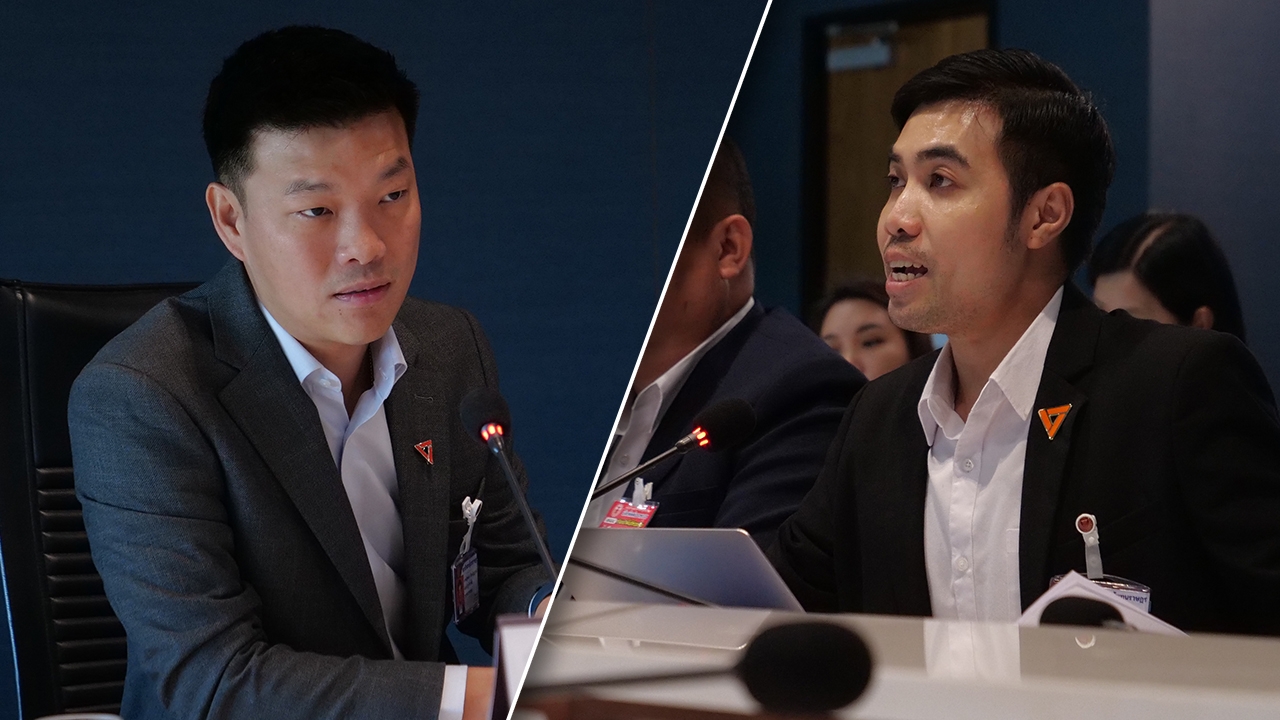
Teng Natthapong and Toto Piyarat sharply criticized the draft parliamentary rules proposed by the Bhumjaithai Party, accusing them of being responsible for reducing the powers of parliamentary committees and monopolizing government oversight. They exposed the Speaker's obstructive behavior and rejection of citizens' bills.
On 9 Nov 2026 GMT+7, during the weekly Shadow Cabinet meeting of the People’s Party, Piyarat Jenthep, a party-list MP, addressed the issue of the new House of Representatives rules scheduled for discussion on Wednesday. Originally, three drafts were on the agenda: two citizens’ drafts and one from the Kla Party, none of which diminished committee powers. However, an additional “problematic draft” was submitted by the Bhumjaithai Party’s Nikorn Jamnong, containing principles that clearly reduce committee authority. The draft requires that summoning individuals or requesting documents must be approved by a committee resolution, removing the committees’ previous flexibility. Similarly, live broadcasting of committee work would require committee approval instead of the chair’s discretion. Regarding closed meetings, which previously were at the chair’s discretion, the draft allows the Prime Minister and ministers to request closed sessions directly without committee approval, enabling the government to evade scrutiny more easily.
Piyarat added that if these rules pass, oversight work will become slower, less flexible, and unable to respond timely to crises. For example, the Disaster Prevention and Mitigation Committee, led by MP Phattharaphong Lilaphat, tried to urgently address the “arsenic-contaminated river” issue, which is a major news story, but could not immediately set it as an agenda item. Instead, they must follow the new process requiring resolutions and scheduling two weeks in advance, even though the rules have not yet been approved.
There is also ambiguity about the origin of three procedural guidelines released earlier, as the Speaker denies issuing them and the Secretariat did not sign them, leaving unclear whether these guidelines are official parliamentary directives or from another source. The People’s Party thus firmly opposes the draft rules as they undermine MPs’ effectiveness and open the door to power monopolization.

Meanwhile, Natthapong Ruangpanyawut, leader of the People’s Party and opposition leader, said the current Speaker of Parliament has distorted his powers in the oversight process. Beyond committee work, the Speaker has withheld MPs’ requests to investigate the National Anti-Corruption Commission (NACC), preventing the process from advancing. There have been persistent delays in amending the constitution article by article. The opposition has submitted two draft constitutional amendments to limit the Speaker’s discretionary power to obstruct NACC oversight and to allow citizens to initiate the removal of independent agencies. However, the Speaker has yet to convene a joint parliamentary session to consider these drafts.
Natthapong also highlighted an underreported issue concerning Thailand’s parliamentary role in international forums such as AIPA and IPU. Previously, joint meetings of standing committees included representatives from both opposition and government proportionally. Now, the Speaker refuses to convene these meetings, enabling him to unilaterally select all representatives at his discretion.
Natthapong further discussed the suppression of civil society power, noting the rejection of a citizens’ bill backed by over 60,000 signatures aiming to repeal the legacy of the 6 October Revolutionary Council’s orders. The justification was that the content did not align with constitutional chapters on rights and freedoms or state duties. In reality, civil society seeks to “erase the legacy of injustice” that includes increased defamation penalties during that era—covering defamation against individuals, officials, courts, and the monarchy. Such laws previously carried severe penalties (e.g., Criminal Code Section 112 with up to 7 years’ imprisonment, or draft amnesty laws to annul NCPO orders). This rejection is seen as a deliberate suppression of citizens’ rights and freedoms. The People’s Party and its working group concluded that all these issues—the attempt to control committee powers, the Speaker’s power consolidation, and the rejection of citizens’ bills—are dangerous signals undermining democracy. They plan to closely coordinate with civil society to strongly oppose these problematic drafts at Wednesday’s parliamentary session.
