

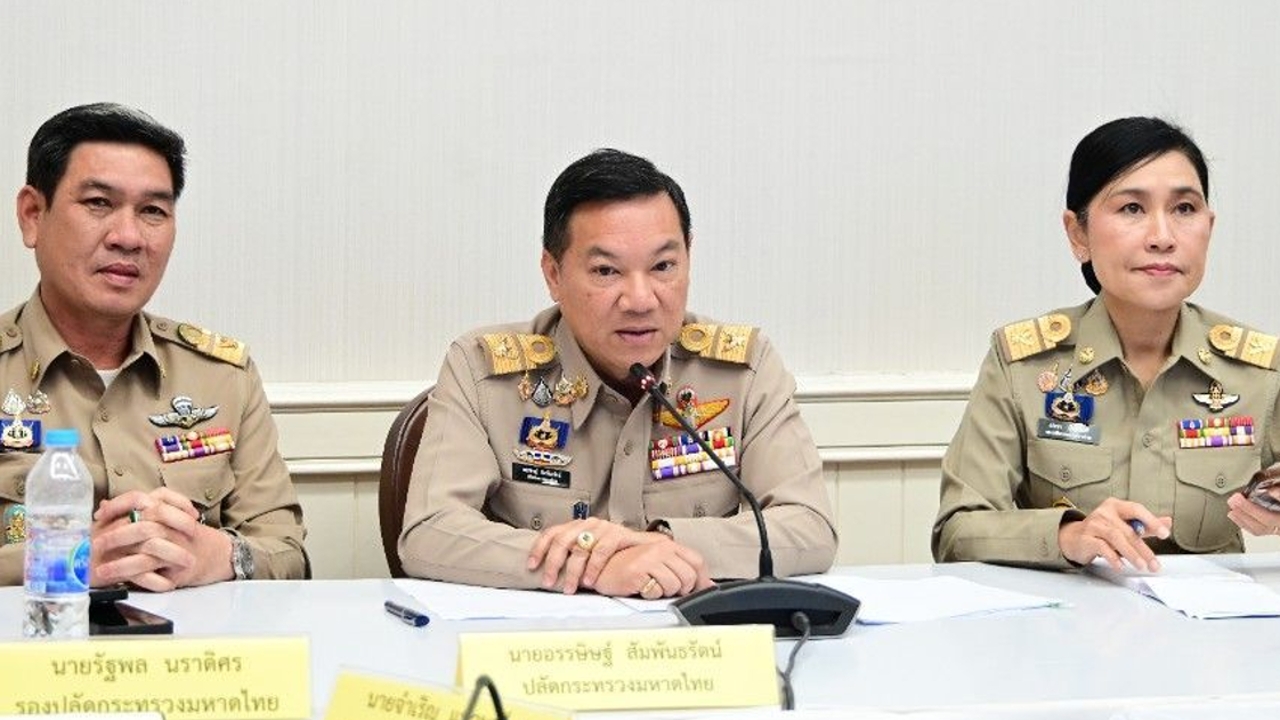
The Permanent Secretary of the Ministry of Interior has called an urgent meeting of 76 provincial governors to expedite solutions to six pressing problems, emphasizing that the Prime Minister has instructed governors to resolve all local issues successfully.
At 10:00 a.m. on 9 Nov 2026 GMT+7, Mr. Assisit Sampanrat, Permanent Secretary of the Ministry of Interior, chaired a meeting to drive the Ministry’s key missions with the 76 provincial governors via video conference. Also attending were Mr. Anupong Suksamanit, Mr. Ratpol Naradisorn, Ms. Arocha Nantamontri, Deputy Permanent Secretaries for administration, Mr. Jamroen Waenphet, Deputy Permanent Secretary, Mr. Nirat Pongsitthaworn, Director-General of the Department of Disaster Prevention and Mitigation, Lt. Col. Trakul Thotham, Inspector General of the Ministry of Interior, Ms. Worasuda Rattanasukon, Advisor on Integrated Provincial Administration, Police Lt. Col. Khetrath Chansilp, Security Advisor, Mr. Athaya Nuanuthai, Assistant Permanent Secretary, and senior executives of the Ministry of Interior’s Office of the Permanent Secretary.
Mr. Assisit stated that Prime Minister and Minister of Interior Anutin Charnvirakul places great importance on local administration under the supervision and management of provincial governors, who are regarded as the Prime Ministers of their provinces. Therefore, governors are tasked with driving administrative efficiency and maximizing benefits for the people, including the following:
1. When problems, complaints, or concerns arise in the area, whether related to laws or the administrative structure of any ministry, the provincial governor must resolve these issues. They must facilitate care and relief for the people. Currently, citizens from various provinces have traveled to submit suggestions to central authorities.
Governors are therefore requested to monitor these citizen suggestions. If the issues fall under the province’s responsibility, they must expedite solutions, facilitate processes, and inform the public about provincial actions. If they involve policy matters, the Ministry of Interior will compile these for submission to the relevant agencies.
2. Regarding encroachment on public beaches in Phuket province, the governor is asked to coordinate relevant agencies to enforce laws and court orders strictly, thoroughly inspecting all areas. If the matter exceeds provincial authority or involves multiple agencies, reports should be submitted to the Ministry of Interior for the Prime Minister and Minister of Interior to consider issuing directives to the involved agencies.
3. Illegal importation of electronic waste is strictly prohibited. Provincial governors must instruct their industry offices to inspect all factories in their areas. If illegal electronic waste imports are found, operations must be suspended, and related agencies informed to revoke licenses. Local governments should also oversee small factories, especially in industrial areas such as Rayong, Chanthaburi, Samut Sakhon, and Samut Prakan.
4. In the case of clashes between Myanmar military forces and Karen armed groups causing stray bullets in Mae Sot district, Tak province, the governor must prioritize the safety of citizens and property. This includes monitoring the situation, alerting residents, facilitating evacuation to shelters or safe areas, and coordinating with the Department of Disaster Prevention and Mitigation. They should expedite requests to the Comptroller General’s Department to consider exemptions from Ministry of Finance regulations on advance government funds for emergency disaster relief to construct additional shelters.
5. Regarding contamination detected in river waters, the governor of Chiang Rai province is to coordinate with the Ministry of Natural Resources and Environment, local leaders, and the Provincial Waterworks Authority to continuously monitor water quality. If the situation improves, public awareness should be raised. If not, contingency plans must ensure residents have access to safe, clean water for consumption. Long-term solutions should involve the Regional Border Committee (RBC) and discussions with the governor of Tachileik, Myanmar, to find sustainable resolutions. Meanwhile, governors of nine upper northern provinces should inspect water quality in all rivers, including Kok, Ping, Ruak, and Sai, to assess environmental impacts and collaborate with relevant agencies to ensure public safety. Additionally, 6. All provincial governors must instruct their provincial administrative offices to rigorously audit all foundations to ensure compliance with regulations and laws. Any violations must be dealt with according to the law.
Mr. Assisit added that provincial governors are responsible for all matters and must effectively oversee their areas. As the highest-ranking officials in their provinces, governors must manage provincial administration to maximize benefits for the government and the public. If problems involve any government agencies, governors must control and direct those agencies to alleviate issues and develop the area. If beyond their authority, they must report to central authorities for submission to the Prime Minister and Minister of Interior to consider issuing directives to related ministries.
In closing, Mr. Assisit emphasized the importance of public communication and awareness at the local level. Provincial governors must use the “provincial public relations” mechanism to disseminate factual information on completed, ongoing, or multi-agency coordinated actions so that the public receives accurate information and can respond appropriately to various situations and live normally. Accurate facts will help counteract fake news. The Ministry of Interior has assigned relevant agencies to monitor public issues continuously, supporting provincial roles in resolving problems 24 hours a day. Citizens can file complaints via the Damrongtham Center hotline at 1567 for related agencies to take concrete action.
