

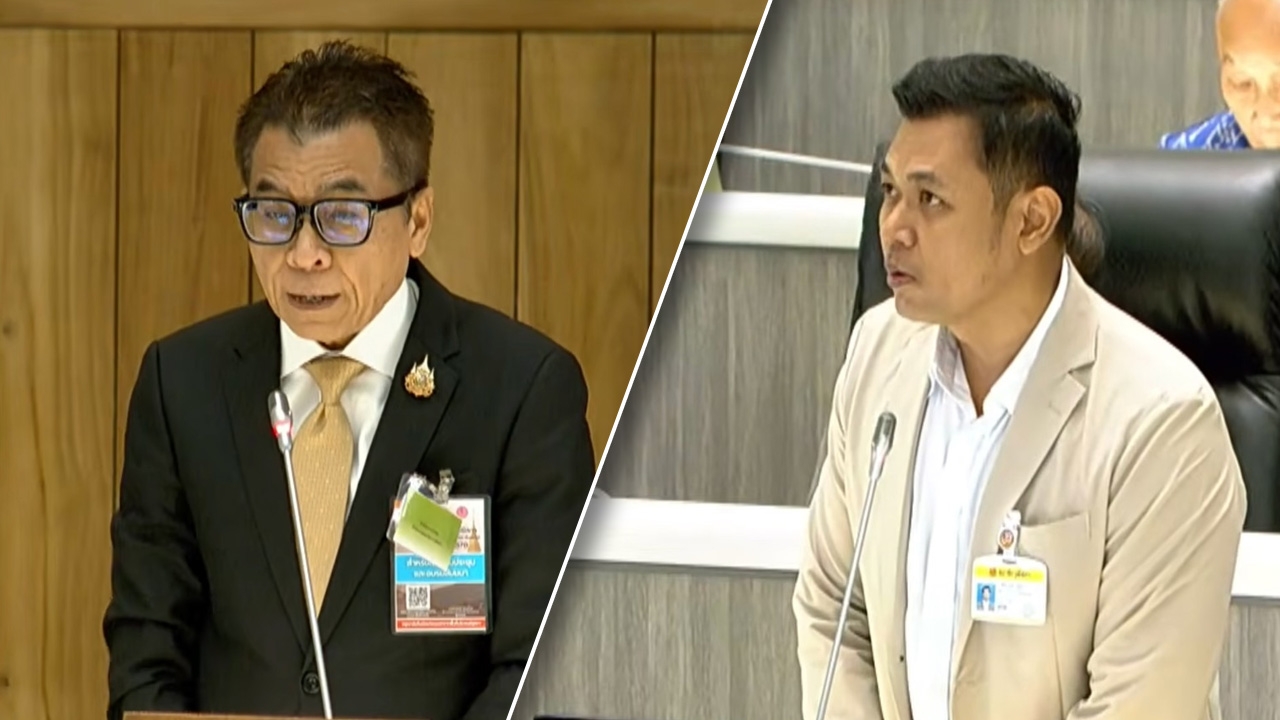
Senator Thewarit pressed the Election Commission (EC) on its submission to the Constitutional Court seeking interpretation of the Supreme Court's authority. Secretary Sa-wang rushed to clarify, fearing public misunderstanding. He denied that the EC was challenging the Supreme Court, stating the goal was simply to obtain a clear ruling to prevent disruptions in the EC's work.
On 9 November 2026 at 13:30 at the Parliament, during a Senate meeting chaired by Vice President Boonsong Noisophon, the EC's performance report for fiscal year 2025 was under review. At one point, Senator Thewarit Maneechai questioned the EC's 5-2 resolution to submit a request to the Constitutional Court to interpret whether the Supreme Court has authority to consider the qualifications of Senate candidates previously disqualified by the EC. Meanwhile, Senator Dr. Premsak Peayura argued that the Appeal Court President's ruling allowing citizens to sue the EC directly in the Criminal Court for Corruption and Misconduct provides a judicial avenue for public oversight of independent organizations. He stressed the EC must be accountable and not consider itself above scrutiny. He inquired how the EC is preparing for potential increases in citizen lawsuits, emphasizing the EC must act as the "womb of democracy" by producing representatives loyal to the people for national development, starting with honest and fair elections.
Secretary Sa-wang Boonmee explained that the public has misunderstood the EC's decision to submit the matter to the Constitutional Court. The EC has repeatedly used constitutional mechanisms.Section 210(2).This submission follows the same approach as previous occasions, involvingthree principles:1. The EC's duty in conducting elections follows a process with defined start and end times. The law states the EC's rulings are final. The EC welcomes scrutiny, and anyone can sue the EC. Therefore, the EC submitted a request to the Constitutional Court asking whether its rulings are indeed final, to gain clarity so its work can proceed. Without such rulings, work would halt immediately. The EC listens to all courts in Thailand and must complete its work on time. This is the first principle to ensure clarity. 2. The EC has previously used this mechanism underSection 210(2).3. As long as the constitutional laws governing Senate elections remain amended, workers face difficulties. Sometimes laws are unclear, and the EC cannot exceed or fall short of legal requirements. If a ruling is issued, the EC will perform its duties and adjust its plans accordingly. The intention is solely to clarify the EC's authority to perform correctly within set timeframes, not to interfere with or challenge the EC's power.