

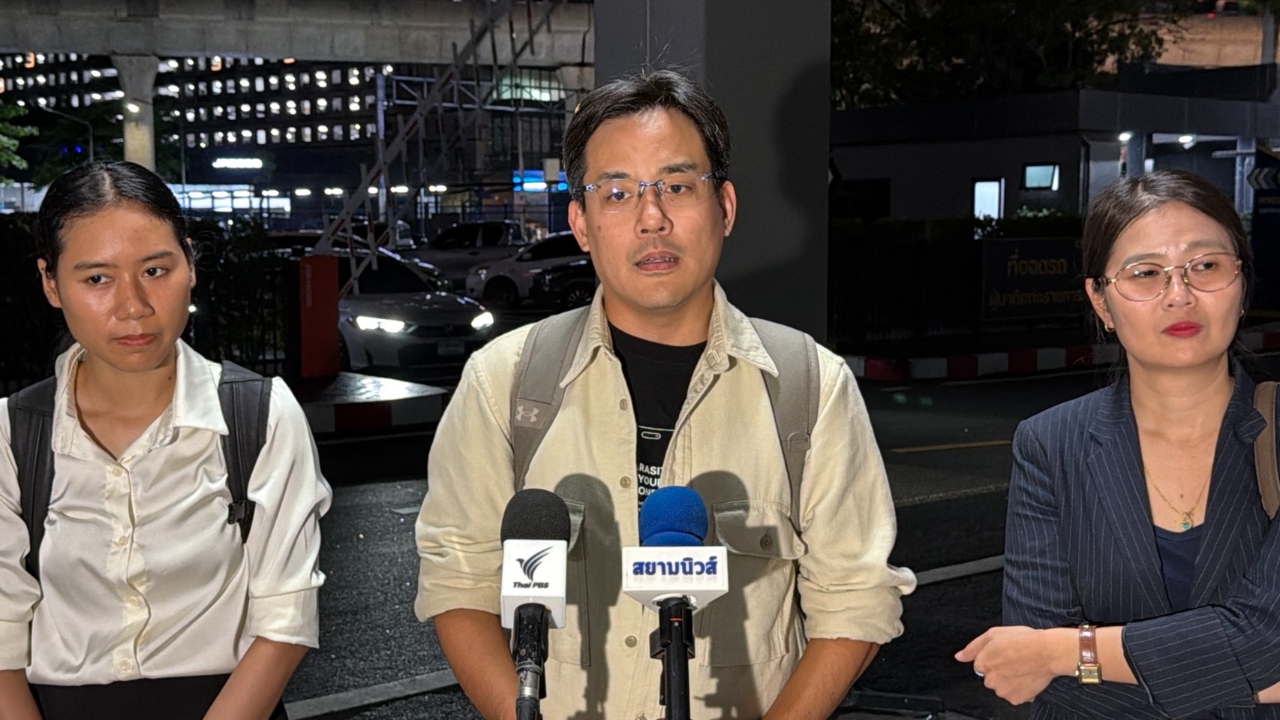
The Crime Suppression Division summoned “Yingcheep iLaw” to probe the issue of leaked documents in the Senate corruption case. He remained tight-lipped, refused to respond to intelligence leads, harshly criticized the investigative team for rushing and barring his lawyer, and called it a “political game,” vowing to continue exposing corruption.
At 18:40 on 9 November 2026 at the Crime Suppression Division headquarters, Mr. Yingcheep Atchayanon, known as “Pao,” project manager of Internet Law for People's Rights (iLaw), along with his lawyer and team, arrived to meet investigators following a summons as a witness amid suspicions about irregularities in the investigation.
Mr. Yingcheep affirmed his integrity and said he presented information based on facts for the public good. However, regarding who delivered the documents to him, he chose to invoke his right to remain silent during the investigation stage to fully protect his sources.
“We have all the documents prepared, but when asked who delivered them, my firm answer is ‘no comment.’ That is a legal right we are exercising,” said Mr. Yingcheep.
He also revealed concerns about the officials’ conduct, which appeared rushed and suspiciously infringed on rights. The officials insisted he enter the interrogation room alone, refusing to allow his lawyer or trusted persons to attend. Mr. Yingcheep called this seriously irregular since even suspects have the right to have their lawyers present, yet he came as a witness assisting officers and was denied fundamental rights.
The summons process was suspiciously expedited: the first summons was sent to his home on 26 October, requiring him to report by 28 October, allowing only two days to prepare. He had to request a postponement to the evening of the current day.
Mr. Yingcheep added that if investigators acted straightforwardly and respected rights, the questioning would take no more than 15 minutes. But if officials had hidden agendas or insisted on barring his lawyer, the investigation could be prolonged and drawn out beyond expectations.
At 19:53, Mr. Yingcheep and his lawyer left the interrogation room at the Crime Suppression Division after completing the summons process as a “witness” in the case of leaked confidential documents on Senate election corruption.
After meeting officials, Mr. Yingcheep said that although the interrogation atmosphere was friendly, doubts remained because this was an internal matter of the Department of Special Investigation (DSI), an expert agency. He questioned why they did not investigate internally but instead complained to the Crime Suppression Division to help find the leaker.
He confirmed he met officials purely as an innocent witness. The corruption information concerning the Senate election was important for public knowledge, especially since the Election Commission had decided not to prosecute despite substantial evidence. Regarding DSI’s search for the document source, he was willing to assist with testimony but firmly declined to reveal the source of the documents.
Besides the legal matter, Mr. Yingcheep filed a complaint with Crime Suppression Division investigators, citing unfair and unlawful conduct by officials.
“Even suspects are legally allowed to have lawyers or trusted persons present during interrogation. But as a witness who is innocent and assisting officers, I was denied my lawyer’s presence. They also refused to say whether charges would be filed later. This is coercion of the citizenry. I demand that this practice be revoked,” Mr. Yingcheep stated.
The iLaw manager affirmed that the incident was a political tactic to impose legal burdens to silence them. He insisted iLaw still holds significant information on Senate election corruption and will continue to disclose it publicly. He is closely monitoring court cases filed against the Election Commission at the Supreme Court and the Central Criminal Court for Corruption and Misconduct.
Furthermore, on 10 November, he and civil society will submit an appeal to the Speaker of the Parliament against the rejection of a bill to repeal Revolutionary Command Order No. 41 (the 'Erasing the 6 October Legacy' campaign), which nearly 60,000 citizens signed. They also plan a public demonstration outside the parliament in the evening to affirm the public’s right to propose legislation.