

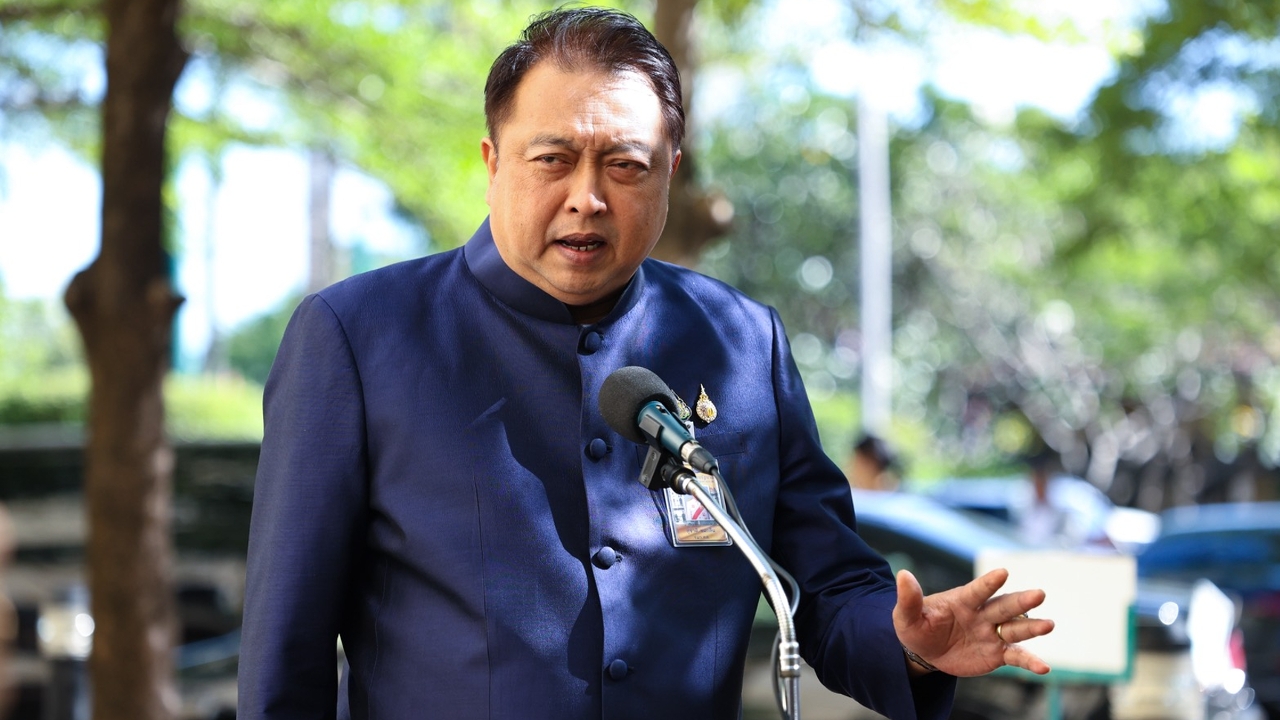
Minister Suchart emphasized that the government is not complacent in addressing pollution problems in the Sai, Kok, and Ruak rivers. A joint meeting with representatives from Myanmar and Shan State is scheduled for the end of this month to reflect the hardships faced by people in both countries before requesting the installation of water quality measuring devices.
At 09:35 on 10 Nov 2026 GMT+7 at the Government House, Minister of Natural Resources and Environment Suchart Chomklin commented on the Sai River in Chiang Rai, where arsenic and heavy metal levels exceeded standards. He stated that this is a cross-border pollution issue involving the Sai, Kok, and Ruak rivers shared with Shan State on Myanmar's side, where mining activities are known to occur. During a recent meeting between Senior General Min Aung Hlaing, President of Myanmar, and the Thai Prime Minister, a Terms of Reference (TOR) agreement was made between the permanent secretaries of Thailand's Ministry of Natural Resources and Environment and Myanmar's environmental ministry. The TOR addresses the problem on two levels: nationally, through cooperation involving the Foreign Ministry and all relevant sectors; and at the end of November, a joint working group meeting on water quality management of border and transboundary rivers will convene with representatives from Myanmar and Shan State. In this meeting, concerns will be expressed regarding the consumption of water and aquatic animals by Myanmar citizens in the area. Water, soil, and other environmental measurements will be conducted to acknowledge the hardships faced by the people. The plan includes providing education and installing monitoring equipment within Myanmar, as this is a cross-border pollution issue.
Minister Suchart said that domestically, the Prime Minister has instructed all related ministries, bureaus, and departments to act. The Department of Fisheries is tasked with checking whether aquatic animals in various rivers are safe for consumption. The Department of Land Development is to test agricultural soil for contamination. The Ministry of Natural Resources and Environment is responsible for water quality monitoring and sharing data with related agencies, such as the Ministry of Public Health, which has deployed teams to educate the public. Following coordination with the Chiang Rai governor, water samples have been tested before being forwarded to the Provincial Waterworks Authority to determine if the water is suitable for producing drinking water. If not, the government and the Provincial Waterworks Authority must find alternative water sources for the people. He stressed that the government is not idle but is addressing the issue systematically.
Minister Suchart added that this upcoming meeting will be the first to finalize the TOR framework. This year, the Pollution Control Department has established seven water quality monitoring stations and is seeking locations to set up laboratories in the area to analyze heavy metal content more quickly without having to send samples to Bangkok.
When asked about securing alternative water sources, Minister Suchart said the Provincial Waterworks Authority is the main agency responsible. If it cannot manage the task, the Ministry of Natural Resources and Environment stands ready to support. He emphasized that this is a national issue involving multiple agencies, including the Ministry of Foreign Affairs and the National Water Resources Office (ONWR). All agencies have received directives from the Prime Minister and must communicate with the public accordingly.
Wang Tonod Canal Reservoir Does Not Affect National Park
Minister Suchart also addressed opposition to the Wang Tonod Canal reservoir project in Chanthaburi Province, describing the communication as unclear and misleading the public. He explained that the Wang Tonod reservoir project dates back to previous governments. The Royal Irrigation Department under the Ministry of Agriculture and Cooperatives recommended constructing four reservoirs, with Wang Tonod being the last one needed. An Environmental and Health Impact Assessment (EHIA) was previously approved but is nearing the end of its five-year review period. The project must be resubmitted to Prime Minister Anutin Charnvirakul and the Minister of Interior for continuation.
Minister Suchart said the Ministry of Natural Resources and Environment has submitted opinions from various agencies, including the Department of National Parks, Wildlife and Plant Conservation, and the Forestry Department, since the project involves using state land. They adhere to the National Environment Board's records, which emphasize balancing the distress of local residents and durian farmers in Chanthaburi who depend on this water source, while ensuring no harm to national park areas or the environment. The forest area affected would be about 4,000–5,000 rai, with residents accepting this. However, if the project encroaches on national park land, the ministry opposes such use unless approved by the National Parks Committee, which Minister Suchart chairs. He has already presented this position to the Cabinet, recommending reducing the project size to avoid impacting pristine forests.
"Do not turn the Wang Tonod reservoir into a hot-button issue; it is a legacy matter. We have already expressed that the reservoir will not be constructed at the previously proposed size. Currently, the Royal Irrigation Department is preparing a model outlining the land area and shape to determine potential impacts. If there is an impact, we reserve the right to approve or deny the project. If residents feel uneasy, we do not have to proceed," Minister Suchart stated.
When asked about discussions with protest groups opposing the project, Minister Suchart described the protests as agitation. He said he has spoken on this topic several times and wants to convey to protest leaders that their public statements must be based on facts. The Wang Tonod reservoir project belongs to the Royal Irrigation Department; the Ministry of Natural Resources and Environment and the current government did not initiate it. He reiterated that the project must not affect national park areas, and the reservoir's design will be reviewed. There may be minor impacts, but a balance must be found between water users, such as durian farmers, and conservationists like himself. He asked for public confidence in this balanced approach.