

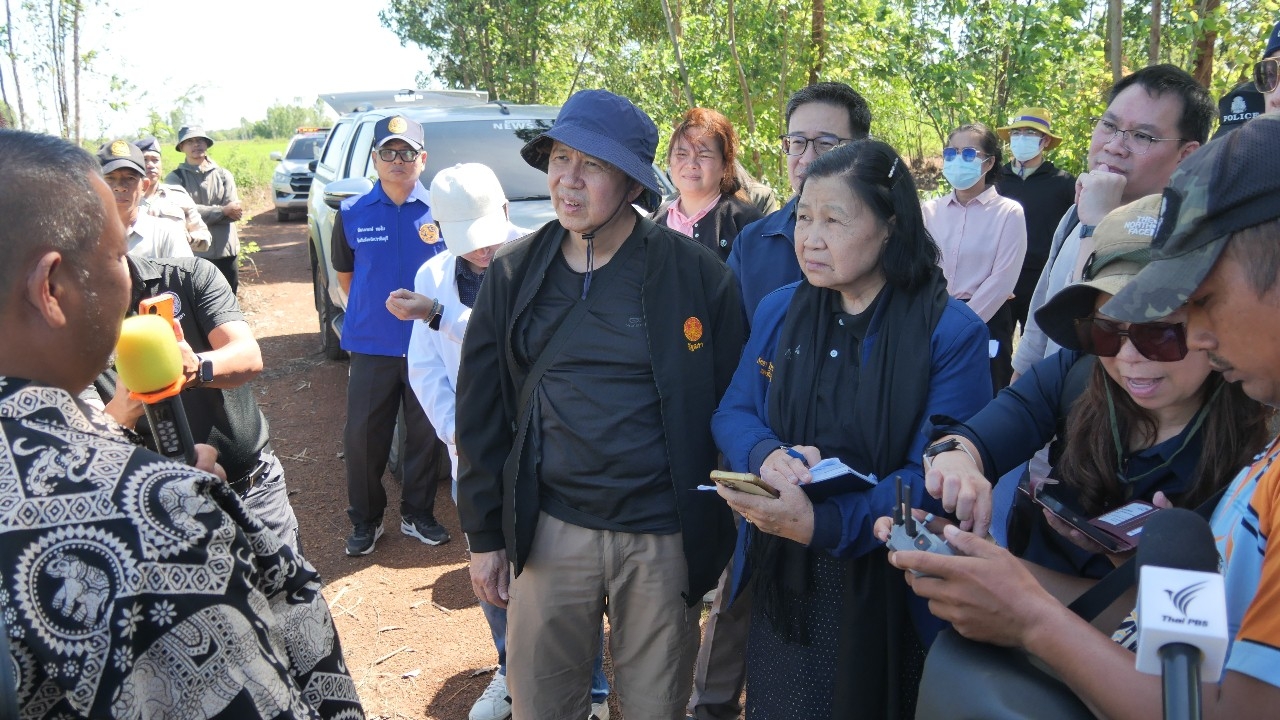
Sunthorn led the Senate to Prachinburi province to expedite pollution risk mapping, while Yotsanan dispatched a research team to rapidly collect samples for in-depth analysis assessing chemical and heavy metal contamination risks in the area.
On 10 Nov 2026, Mr. Sunthorn Pruksapipat, Chairman of the Senate Consumer Protection Subcommittee, accompanied by Senators Kanya Yaiprasan and a delegation including Ms. Prokchon Usub, subcommittee member, and Mr. Pornrak Rakphol, secretary to the Political Development Committee, visited Sri Maha Phot and Kabin Buri districts in Prachinburi province. They studied environmental impacts based on public complaints, inspecting sites of rainbow-colored wastewater discharge, piles of soil and animal waste mixed with crushed electronic waste debris, and collected water samples from Khao Mai Kaeo canal. They also held meetings to hear directly from affected villagers and local agencies. Meanwhile, Mr. Yotsanan Wongsawat, Deputy Prime Minister and Minister of Higher Education, Science, Research and Innovation, assigned the Management Unit for Technology and Innovation for Future Industries (MUTIF) to join researchers and academics in investigating pollution and community impacts on site.
Mr. Sunthorn Pruksapipat, Chairman of the Senate Consumer Protection Subcommittee, stated that chemical contamination and pollution have become widespread issues, causing severe anxiety and drastically affecting the basic quality of life of local residents. Community water supply systems are unusable, forcing villagers to purchase water for consumption. The right to live in a safe environment and access safe food is a fundamental right that the public should not have to endure under such conditions.
Mr. Sunthorn added that the committee is collaborating with academic teams to urgently develop a Risk Map of the affected areas. This map will evaluate safety and clearly classify agricultural plots as either safe for harvest or at risk of toxic residues in soil and water, aiming to protect consumer safety and provide an honest reflection of the situation.
Mr. Sunthorn emphasized that structural solutions require governmental executive power. The committee will act to raise awareness of these issues to the policy level, as the current situation has reached a food security crisis. They are preparing policy proposals to review the Food Act and urban planning laws that have allowed polluting industrial plants to be established near communities and agricultural areas.
Additionally, the field visits have seen positive signs with local agencies, such as subdistrict administrative organizations and relevant bodies, sending representatives to participate. However, sustainable solutions require integrated cooperation among multiple ministries, including the Ministry of Industry and the Ministry of Natural Resources and Environment. The committee will continue to gather feedback from affected residents to compile facts and urgently promote concrete remediation measures.
Dr. Chinawut Pipatphanukul, Deputy Director of MUTIF under the Ministry of Higher Education, Science, Research and Innovation, said that Deputy Prime Minister and Minister Yotsanan Wongsawat sent a team of researchers and experts to Prachinburi to support the Senate Consumer Protection Subcommittee and the Political Development Committee. They collected soil and water samples from affected sites for laboratory testing and advanced analysis to clarify chemical and heavy metal contamination and to develop systematic environmental restoration plans.
This mission aligns with the urgent task of applying scientific knowledge and capabilities to assist the public by identifying types of chemical contamination in the samples, assessing their hazards and environmental and health impacts, the severity of affected areas, and the extent of spread. Laboratory analysis is expected to take about two weeks to precisely determine chemical components and severity levels.
A key feature of this investigation is sending some samples for deep chemical status analysis using synchrotron light research technology at a public research institute. This allows measurement of oxidation states to identify transformation patterns of heavy metals and accurately estimate the duration of chemical accumulation in the real environment.
The scientific analysis results will not only reveal contamination severity but also guide targeted management and containment strategies, such as developing suitable adsorbent materials like activated carbon designed to absorb specific heavy metals. This will serve as a crucial tool for chemical disaster management and sustainable restoration of safety for local residents.

