

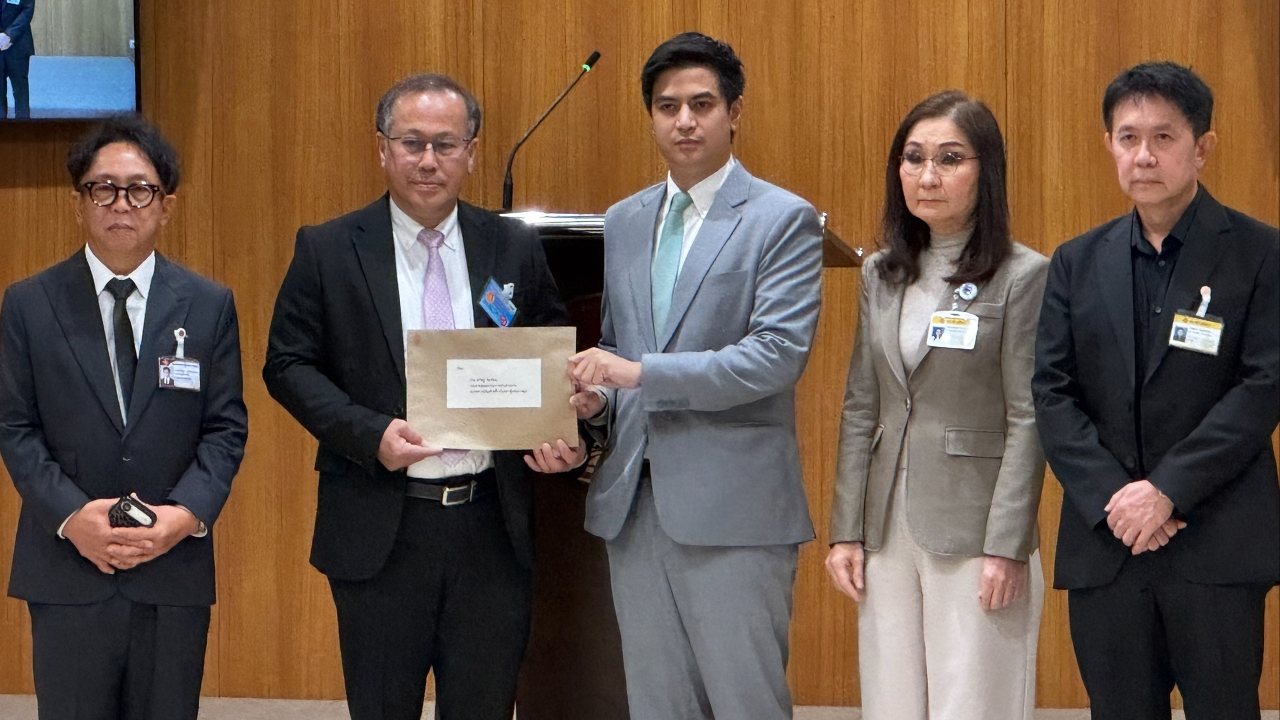
Dr. Tul submitted to the opposition and Senate whips, urging Sopon to stop delaying the complaint to the National Anti-Corruption Commission (NACC) against Sak Siam for stock concealment. After 159 days of delay, he set a 7-day deadline and warned of decisive measures if no response is received.
On 11 Nov 2026 GMT+7, Dr. Tul Sittisamwong submitted a letter to Parit Watcharasindhu, opposition whip and senator, urging the parliamentary speaker to expedite his duties. The NACC committee investigating Sak Siam Chidchob’s stock concealment case has taken over five months, yet the speaker has not acted on the complaint, citing it is under a screening committee he appointed with no set timeline. Dr. Tul wants the opposition whip to follow up and push the speaker to complete the process swiftly, ideally by the end of November, warning that failure to do so would be neglect of duty.
Parit said since the complaint under Article 236 was filed requesting the speaker to forward the case to the Supreme Court for an independent inquiry into the NACC’s handling of Sak Siam’s stock concealment case, 159 days (over five months) have passed with no reply. The opposition has yet to receive answers on two key questions: "When will you decide?" and "How will you decide?"
Parit added that earlier in 2026, a senator filed a complaint regarding a gold bribery case, and it took just 41 days from filing to establishing an independent inquiry. He questioned why this case has taken as long as 159 days.
Parit emphasized the parliamentary speaker’s role is not to judge whether the NACC is right or wrong but, if there is reasonable suspicion, to immediately forward the case to the Supreme Court president. The evidence submitted is substantial, highlighting procedural flaws, decisions conflicting severely with the Constitutional Court rulings, and neglect of key allegations such as conflicts of interest under NACC Act Section 126.
"The opposition sets a 7-day deadline for the speaker to provide a clear public response on when the complaint will be sent to the Supreme Court president and what the stance will be. If the deadline passes without an answer, the opposition and senators will take decisive measures," Parit stated.
Democrat Party deputy leader Satit Wongnongtoey said such unusual delays recall previous parliamentary sessions when complaints from the People’s Party were stalled until the parliament was dissolved. The Democrats had submitted a complaint to the NACC in May about Sak Siam’s conflict of interest, but the NACC has yet to respond. Party leader even had to personally inquire at the NACC and found no action taken. If neglect continues, the party plans to pursue strict legal measures.
Meanwhile, senator Nantana Nantawaropas questioned the parliamentary speaker’s performance, noting that after eight months there has been no effective role in oversight or checks and balances. This raises public suspicion about whether this is a "reciprocal regime" mechanism, since senators select independent agencies that then audit the executive, while the Constitutional Court adjudicates conflicts, linking these processes in a system that the public doubts for transparency.
When asked about the measures, Parit said the opposition will discuss next steps in the upcoming whip meeting, hoping the speaker will clarify before the deadline.
Asked what measures could be taken since the government holds the parliamentary majority, Parit stressed this is unrelated to majority or minority status. Under the constitution, one-fifth of MPs (around 140) can jointly submit a request to the speaker to forward a case to the Supreme Court. Therefore, as the opposition, they must fully use parliamentary mechanisms to oversee both the government and the speaker, who is from the ruling party.
Parit added the opposition is pushing a key long-term mechanism by proposing a constitutional amendment to Article 236 to remove the speaker’s power to dismiss such complaints and require automatic referral to the Supreme Court president. This would make it the court’s inquiry panel’s duty to verify whether there is merit to the allegations.
So far, there is no clear sign of a joint parliamentary session to consider this amendment, although the People’s Party submitted it after the election, meaning it has been pending for eight months since March. The opposition expects that besides the speaker answering within one week about the complaint’s timeline and handling, there should be clarity on when the joint session will convene to address this long-delayed constitutional amendment.