

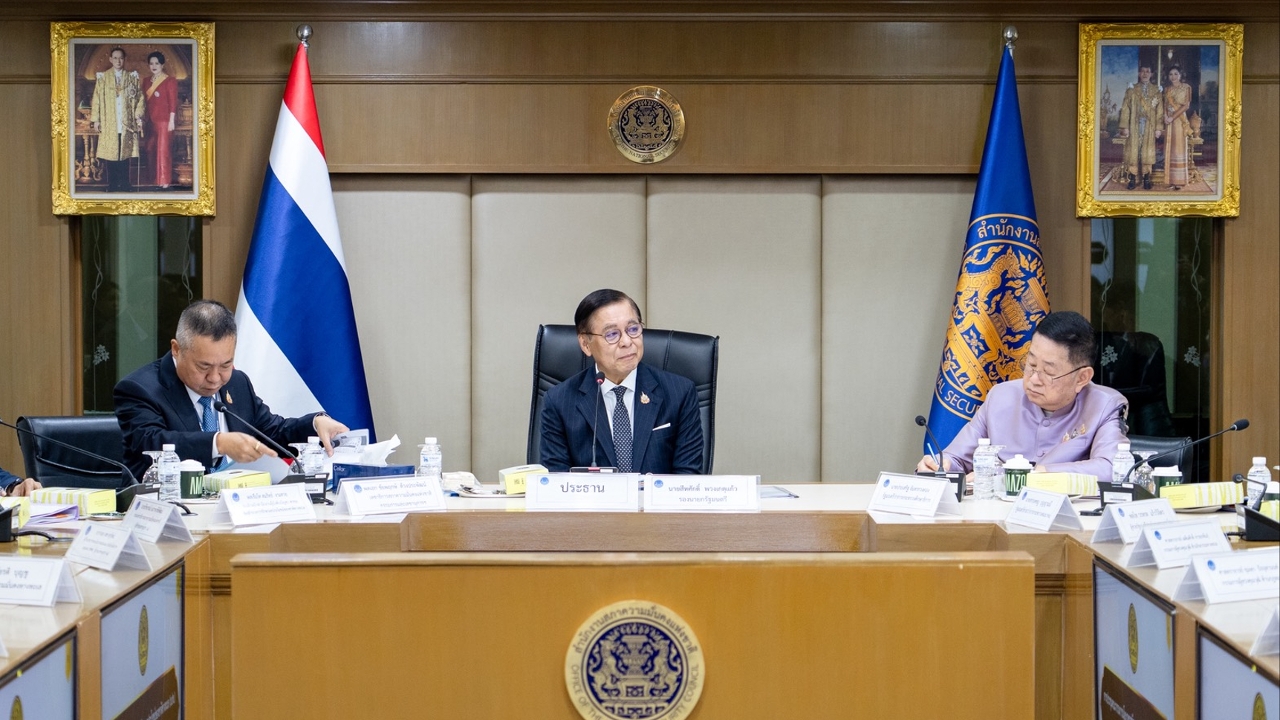
Sihasak led discussions of the National Committee on Maritime National Interest Protection to monitor and evaluate the strategy for safeguarding maritime interests, develop laws and regulations, enhance capacity, and prepare ahead of the first Conference of the Parties (COP1) in early 2027.
At 09:00 on 11 Nov 2026 at the Wijitrawatkan meeting room of the National Security Council (NSC) Office, Government House, Deputy Prime Minister and Foreign Minister Sihasak Puangketkaew chaired the first 2026 meeting of the National Committee on Maritime National Interest Protection (NCMNIP). Attendees included Education Minister Prasert Chanruangthong, Deputy Transport Minister Sanphet Boonyamanee, NSC Secretary-General General Chaiyaruek Duangprapat, Deputy Head of the Maritime National Interest Protection Command Center (MNIPCC) Rear Admiral Samrit Ngamsuay, and representatives from relevant agencies.
The meeting acknowledged five key areas of work in protecting maritime national interests: 1. Overall progress of the National Maritime Security Plan (2023–2027) meeting its targets; 2. Assessment of maritime security issues requiring vigilance and proposals for risk responses by the NSC, National Intelligence Agency, and Navy Intelligence Department, including great power strategic competition, hybrid threats, and risks to critical undersea communication infrastructure; 3. Activities of the Advisory and Knowledge Management Subcommittee for Maritime National Interests (AKMSMNI) serving as an intellectual resource providing academic advice and recommendations, chaired by Phedimsak Jaryaphan.
AKMSMNI was chaired by Phedimsak Jaryaphan.
4. Operations of the Maritime National Interest Protection Command Center (MNIPCC) and its executive committee during the 2026 fiscal year, chaired by the Navy Commander in his role as Deputy Director for Maritime National Interest Protection, including future operational directions; and 5. The selection of expert committee members for NCMNIP in three areas: maritime activities, legal affairs, and naval military.
During the NCMNIP meeting, participants reviewed and commented on the draft framework of the National Maritime Security Plan (2028–2032), which is based on the principle of Comprehensive Security, covering security, economic, social, and marine environmental dimensions, alongside emphasizing the enhancement of the nation’s Sea Power and Sea Governance. The plan also recognizes the importance of maritime national interests and the involvement of government agencies and network partners.
Additionally, the meeting approved draft measures to fulfill obligations under the UN Convention on the Law of the Sea (UNCLOS) regarding conservation and sustainable use of marine biodiversity beyond national jurisdiction (BBNJ), including marine genetic resources (MGRs) and fair benefit sharing. The NSC, Ministry of Foreign Affairs, and Department of Marine and Coastal Resources are collaborating to prepare Thailand for ratification and formal membership. Preparations cover three main areas: developing domestic laws and regulations, supervising and building capacity of relevant sectors, and promoting cooperation and advancing Thailand’s interests on the international stage. This will enable Thailand to safeguard maritime national interests by participating in setting emerging rules and standards, especially at the first Conference of the Parties (COP1) scheduled for early 2027.

