

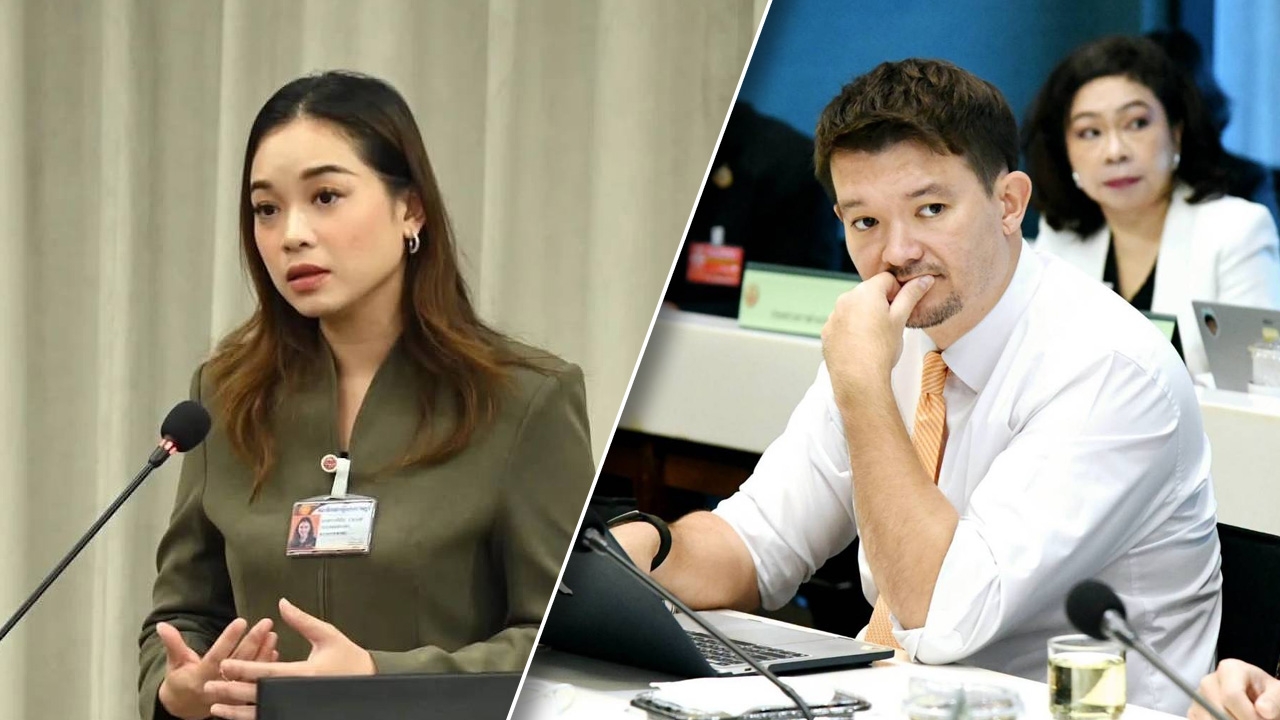
People's Party MPs Phasarin and Phattharaphong criticized Speaker Sophon for being biased by excluding opposition members from participating in the AIPA meeting, sending only government representatives. They further blamed the slow work for Thailand not having a resolution at the meeting, losing the chance to address scammers and toxic water issues in the country.
On 11 Nov 2026, Ms. Phasarin Ramwong, a Bangkok MP from the People's Party, and Mr. Phattharaphong Leelaphat, a Chiang Mai MP from the same party, commented on Speaker of the House Mr. Sophon Sarum’s use of his authority to select Thai parliamentary representatives for the 47th ASEAN Inter-Parliamentary Assembly (AIPA) General Assembly from 16-22 Nov 2026 in the Philippines, without including any opposition party members.
Ms. Phasarin stated that by tradition, the Thai parliamentary delegation includes members from the government, opposition, and the Senate. However, the Speaker’s choice to send only government members and his close allies reflects inappropriate use of power and causes Thailand to lose the opportunity to raise important public issues at the regional cooperation forum.
The Speaker Sophon's past actions have already faced accusations for attempting to limit the role and authority of the parliamentary committee chair overseeing executive oversight. Now, this exclusion extends to barring opposition members from international work, despite all parliamentarians representing the Thai people and deserving to collaborate in protecting national interests regardless of political affiliation.
Ms. Phasarin added that in last year's AIPA meeting, opposition MP Rangsiman Rome played a key role in clarifying and countering claims by Cambodian representatives about border conflicts, demonstrating how opposition participation concretely supports Thailand’s parliamentary functions internationally. Excluding opposition members from this year’s delegation thus limits the personnel and perspectives Thailand can use to defend its interests.
This year's AIPA meeting is themed “Parliament Securing a Peaceful, Prosperous, and People-Centered ASEAN,” directly addressing issues faced by people in the region such as online scams, cross-border toxic dust, river pollution, human trafficking, and violence against children — all requiring legislative cooperation across countries to find solutions.
Ms. Phasarin further said that besides excluding the opposition, the Speaker’s delayed work in drafting and submitting a resolution on behalf of Thailand—a key method to bring public issues to AIPA’s attention—led to no Thai resolution being submitted this year. This caused Thailand to lose the chance to set regional cooperation agendas despite urgent problems needing resolution.
Meanwhile, Mr. Phattharaphong said he does not doubt the abilities of the selected delegates but questions the Speaker’s role in coordinating and enabling Thai parliament to fully use international cooperation mechanisms, especially since Thailand failed to submit any resolution at the 47th AIPA despite citizens suffering greatly from toxic dust and river pollution crossing borders.
Normally, the Thai parliament forms a National AIPA Executive Committee to determine strategies and prepare proposals. However, this year no such committee was convened as the Speaker did not organize joint parliamentary meetings. This concentrated authority in the Speaker and ultimately led to Thailand lacking any resolutions or proposals to present public issues at the ASEAN parliamentary forum.
Mr. Phattharaphong continued, questioning why the Speaker allowed Thailand to lose this opportunity, noting that cross-border problems cannot be solved by one country alone. Although submitting a resolution to AIPA does not guarantee immediate solutions, it is a crucial mechanism to build consensus and prompt member legislatures to prioritize issues impacting Thai people. Neglecting this mechanism wastes chances to foster cooperation unnecessarily.
The Speaker’s role should be based on impartiality and prioritizing national interests, not wielding power to limit political opponents. The exclusion of the opposition harms not only parliamentary harmony but also deprives Thai citizens of representatives advocating their concerns internationally, especially at a time when Thailand urgently needs regional cooperation to address problems directly affecting public health and lives.