

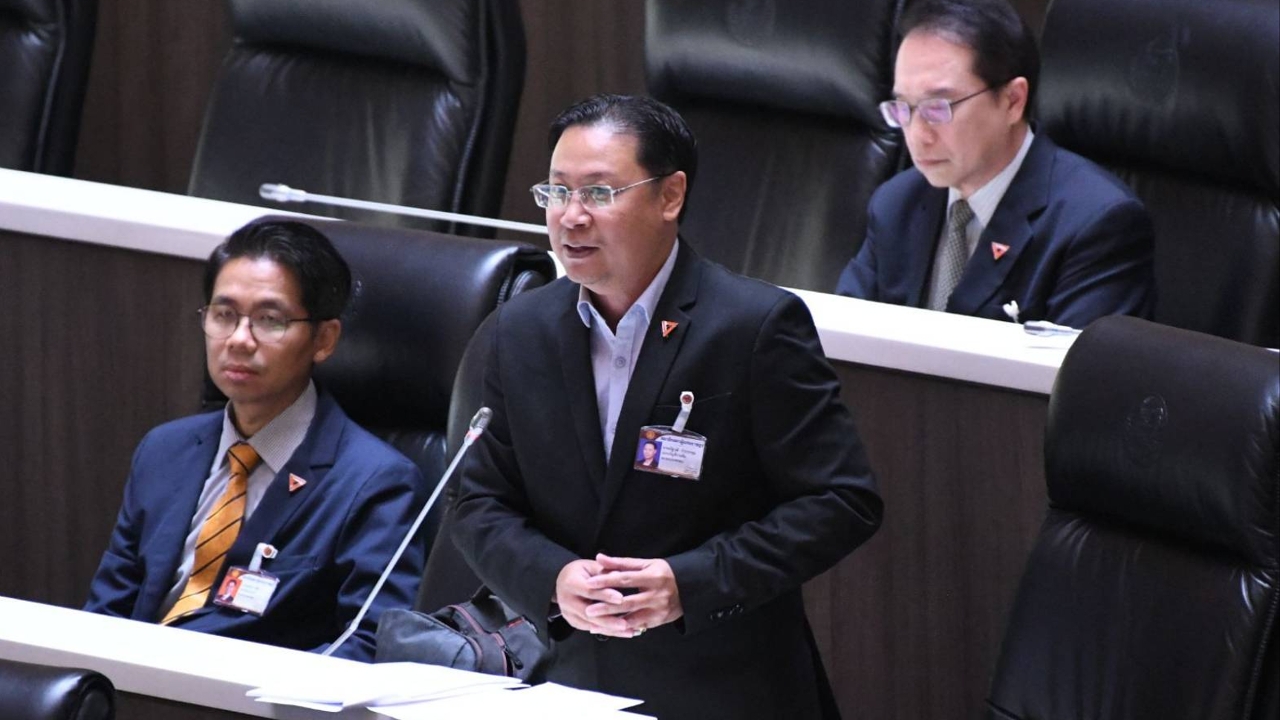
The People's Party has proposed amendments to the House of Representatives meeting rules to improve the effectiveness of parliamentary questions, including pushing for a monthly 'Prime Minister live question session.' It aims to enhance parliamentary oversight and accountability.
On 11 Nov 2026 GMT+7, during a House of Representatives meeting, three draft amendments to the House meeting rules were considered. The People's Party presented all three drafts through party-list MPs Natthawut Buapathum, Parit Watcharasindhu, and Pakornwut Udompipatsakul, who jointly explained the principles and rationale behind the proposed rule changes.
Natthawut explained that his proposed amendments cover 12 key principles, addressing areas including the operations of the opposition party coordination committee, pre-agenda consultations, the preparation and publication of meeting reports, criteria for urgent motions, voting procedures and transparency of results, electronic meetings, and processes for approving key positions and the prime minister.
Previously, the former Move Forward Party and the People's Party advocated for a parliament that is swift, meaningful, strong, transparent, modern, just, equal, connected with the people, and internationally aligned. Although the current proposals may not cover all goals, they improve existing rules to better support MPs in fulfilling their duties.
Natthawut further emphasized a key point in his draft: establishing clear criteria to define which motions qualify as urgent. He proposes that the House Speaker set these criteria with joint approval from government and opposition whips to reduce ambiguity in discretion. Additionally, he suggests improving the electronic publication of meeting and committee reports and voting records to enable data analysis, and opening channels for submitting amendments electronically.
He also proposes expanding electronic committee meetings under appropriate guidelines and adding rules for reviewing candidates for key positions, including allowing the formation of committees to vet backgrounds. Furthermore, he recommends a process for prime ministerial selection where nominees can clearly present their vision and answer MPs' questions.
Parit proposed draft amendments focusing on improving the question-and-answer mechanism. He noted that parliamentary questions are crucial for government oversight, yet current limitations exist, especially regarding the prime minister and ministers often not attending to answer questions, which deprives the public of explanations from the executive.
Statistics show that during the current parliamentary session, ministers have attended to answer live questions from opposition MPs about 70% of the time. However, this figure may not fully reflect underlying issues, since opposition members sometimes change topics or the minister to be questioned upon learning that the relevant minister cannot attend, to avoid wasting their question slot. Notably, since this parliament began, the prime minister has not personally answered any live questions even once.
Parit continued that the People's Party proposes four amendments:
1. Allowing the House Speaker to increase the number of live questions in the following week to compensate when ministers fail to attend, instead of rigidly limiting to three questions per meeting session.
2. Removing limits on the number of question rounds to allow concise two-way exchanges, with only total time limits: 30 minutes for live questions (15 minutes per side) and 20 minutes for general and specific questions (10 minutes per side).
3. Enabling MPs to submit general and specific questions online to reduce travel burdens and waiting times for document submission and lottery draws at the House.
4. Introducing a new category of question: a live question session with the prime minister, held four times per parliamentary session, averaging once a month, requiring the prime minister to personally answer questions about national policies and issues.
Parit cited the example of the United Kingdom's weekly prime minister's question sessions, noting that the last 11 UK prime ministers attended between 88% and 100% of these sessions. The need to prepare to answer opposition questions also motivates governments to address problems before parliamentary scrutiny. These amendments aim not solely to benefit the opposition but to establish a standard of government accountability to parliament and responsiveness to the public.
Meanwhile, Pakornwut proposed four amendments, two of which align with Natthawut's proposals: maintaining the validity of bills on the agenda even if some sponsors lose their membership leaving the number below constitutional requirements, and improving the process for submitting amendments. He focused on two additional unique points.
Pakornwut proposed amending Rule 159 to guarantee the right of MPs who initiate live questions orally to ask or debate their prepared topics within 15 minutes even if the prime minister or ministers do not attend or postpone answering. Currently, when ministers do not attend, the sponsoring party may lose their question slot without receiving an answer, especially smaller parties who might have only one chance for a live question per session. While the Speaker may allow some debate, this right should be clearly codified so MPs can reflect urgent public issues to the executive even without ministerial responses.
Another proposal is to amend rules concerning motions that the House resolves to send to the Cabinet or relevant agencies for action, requiring these bodies to report back on implementation. Such reports would be treated like committee observations, mandating agencies to provide progress updates to the House within specified procedures, replacing the current voluntary cooperation system.
Pakornwut highlighted past cases where urgent motions sent to the Cabinet did not receive feedback, including motions on Middle East crisis impacts sent on 8 Apr 2026 GMT+7, PM 2.5 pollution issues sent on 22 Apr 2026 GMT+7, and railway safety standards after accidents sent on 27 May 2026 GMT+7.
These issues arise because current rules lack a defined follow-up process for motions sent directly to the Cabinet, unlike committee observations which require agencies to report back within 60 days. Pakornwut therefore suggests clear criteria to ensure parliamentary debates and resolutions lead to effective problem-solving follow-up.