

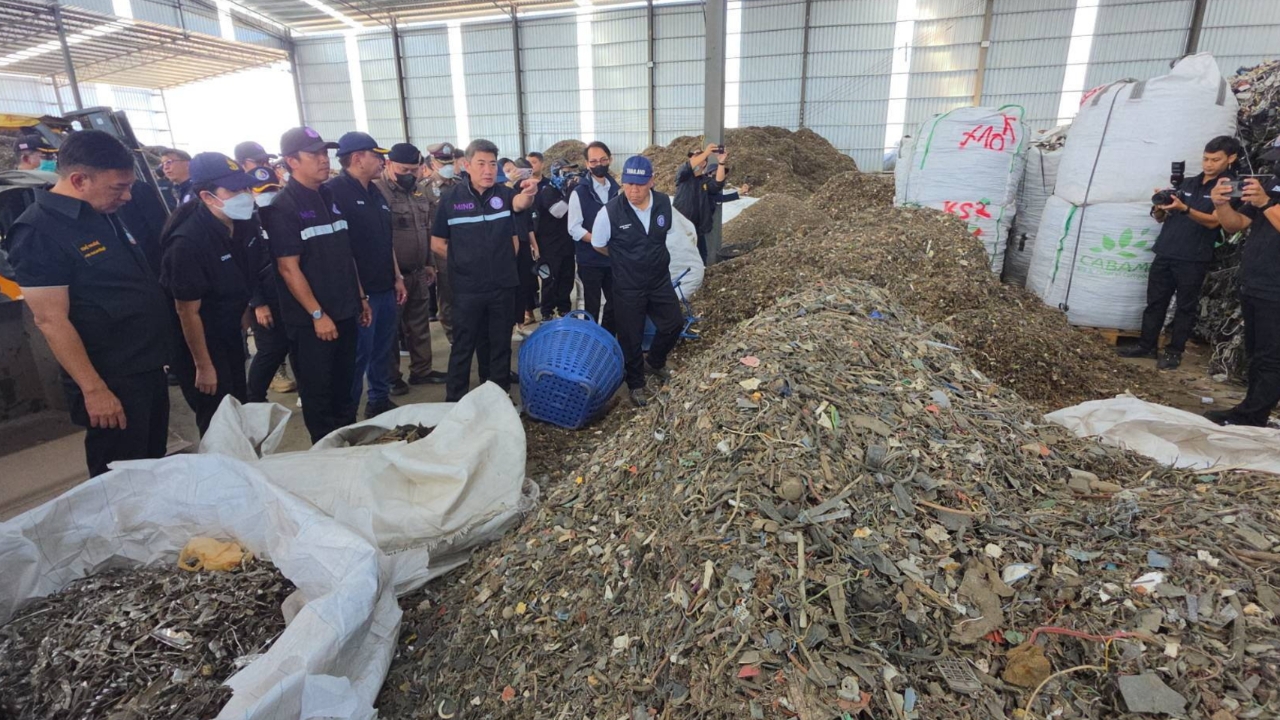
The government is moving forward with a comprehensive approach to electronic waste management, inspecting 752 factories and finding 375 in violation of the law. It has intercepted 89 containers of illegal imports, accelerated control over scrap metals, and increased penalties, aiming to submit proposals to the Cabinet in December 2026.

On 12 Nov 2026 GMT+7, Ms. Lalida Pertwiwatthana, Deputy Spokesperson of the Prime Minister's Office, announced that under Prime Minister Anutin Charnvirakul's leadership, the government is systematically elevating its approach to tackling electronic waste and hazardous waste. At the first 2026 meeting of the Electronic Waste Problem Solving Committee, chaired by Deputy Prime Minister and Minister of Commerce Supachai Sutthampan, the meeting approved a three-pronged mechanism: enforcement and suppression, import-export controls, and legal reforms. These measures target problems from the point of import, factory operations, to illegal dumping and waste disposal, including urgent controls on scrap metals and risky products, aiming to propose the measures to the Cabinet by December 2026.
Ms. Lalida explained the three-track approach: Track 1 involves enforcement and suppression, with intensified factory inspections and complaint responses to block illegal imports and prosecute offenders; Track 2 focuses on import-export controls to prevent smuggling of electronic and hazardous waste through high-risk goods; Track 3 addresses legal reforms and penalties to close legal loopholes and enhance long-term enforcement effectiveness. The committee chair emphasized that all measures must be practicable and enforceable, not merely strict rules without effective application.
Regarding proactive enforcement, the Ministry of Industry deployed 50 integrated teams from the Department of Industrial Works and Provincial Industry Offices to inspect factories, covering inspections numbers 105 and 106 for a total of 752 factories out of a registry of 3,049. They found 375 factories non-compliant with the Factory Act and issued 470 administrative orders, mostly requiring corrections of identified defects rather than full closures. However, eight factories were ordered to cease operations for improvements, and one had its license revoked due to serious violations of a suspension order.
The Ministry of Industry affirmed it will strictly monitor compliance within set deadlines without granting unwarranted extensions. Factories failing to comply by the deadline will face suspension orders, and continued violations of these orders will lead to license revocation following legal procedures. The ministry will clearly categorize violations and enforcement results to enable the public to track law enforcement outcomes transparently.
The Customs Department reported intercepting 89 containers weighing approximately 1.9 million kilograms of illegally imported goods from 1 Oct to 9 Nov 2026. This was achieved through integrated inspections with the Department of Industrial Works and the Pollution Control Department to prevent false declarations, smuggling of electronic waste mixed with scrap metals, and tariff code manipulation to evade inspections.
Simultaneously, the Pollution Control Department, together with the Ministry of Natural Resources and Environment's special task force, investigated seven pollution complaints in the Eastern region, covering illegal waste dumping, warehouse inspections revealing electronic waste materials and equipment, and unlicensed factories. The agencies coordinated to order business suspensions, seize machinery, and file complaints as appropriate. Cases involving large quantities of seized items are being referred to the Department of Special Investigation for rigorous prosecution.
Ms. Lalida added that regarding import-export control measures, the meeting acknowledged proposals to regulate imports of scrap iron, aluminum, and copper, considering contamination standards, certificates from exporting countries, importer qualifications, and joint inspections by Customs, Industrial Works, and Pollution Control. There was also a proposal to ban exports of certain scrap metals to reserve raw materials for domestic industries. The details and exceptions will be carefully studied to suit practical usage.
The meeting approved a working group co-chaired by the Customs Department Director-General and the Department of Foreign Trade Director-General to expedite drafting detailed measures. These will be submitted to the Electronic Waste Problem Solving Committee by the fourth week of November 2026, before proceeding through the National Environment Board and Cabinet. The plan targets December 2026 for final Cabinet consideration, balancing prevention of tariff evasion, inspection readiness, and the recycling industry's raw material needs.
For expanded enforcement efforts, the meeting directed increased inspections of unlicensed and unregistered factories and businesses, not limited to licensed ones. The Ministry of Interior was tasked to coordinate with provincial governors, district chiefs, subdistrict heads, village heads, and local administrative organizations to monitor and report illegal factories and unauthorized industrial waste dumping and landfilling sites, following Prime Ministerial directives.
Accumulated data from 2025–2026 identified over 40 illegal dumping and landfilling sites for industrial waste and electronic waste across Rayong, Chonburi, Chachoengsao, and Prachinburi provinces, with more than 100,000 tons of waste accumulated. Many sites are clustered near provincial borders and overlapping areas with Sa Kaeo province, necessitating integrated inspections and law enforcement. Officials found negligent or derelict in duty will be investigated, and legal and disciplinary actions applied fairly and thoroughly.
Regarding legal reforms, the meeting endorsed a legal working group to study civil, criminal, and administrative measures, and review penalties to align with the severity of impacts. Proposals will be linked to ongoing industrial waste management legislation drafts that emphasize polluters bearing costs and establishing a fund for rehabilitation and compensation for affected communities and the environment.
The meeting also agreed to continue using the Ministry of Natural Resources and Environment's existing complaint inspection system to reduce operational redundancies. Relevant agencies were assigned to discuss procedures for investigating official negligence, integrating incident reporting data, and mechanisms for prosecution alongside immigration law enforcement against foreign offenders, ensuring clear legal authority and processes.
Ms. Lalida concluded, “The government is committed to seriously addressing electronic and hazardous waste issues, not stopping at detection or orders but following up to ensure corrections, prosecuting offenders, and preventing repeated illegal imports or dumping. This three-pronged approach enables comprehensive management from origin to disposal and strengthens laws to prevent Thailand from becoming a hazardous waste dumping ground, thereby protecting public health and the environment sustainably.”
The Electronic Waste Problem Solving Committee will monitor relevant agencies’ progress and report to the Prime Minister every 15 days to ensure continuous and tangible results in resolving the problem.