

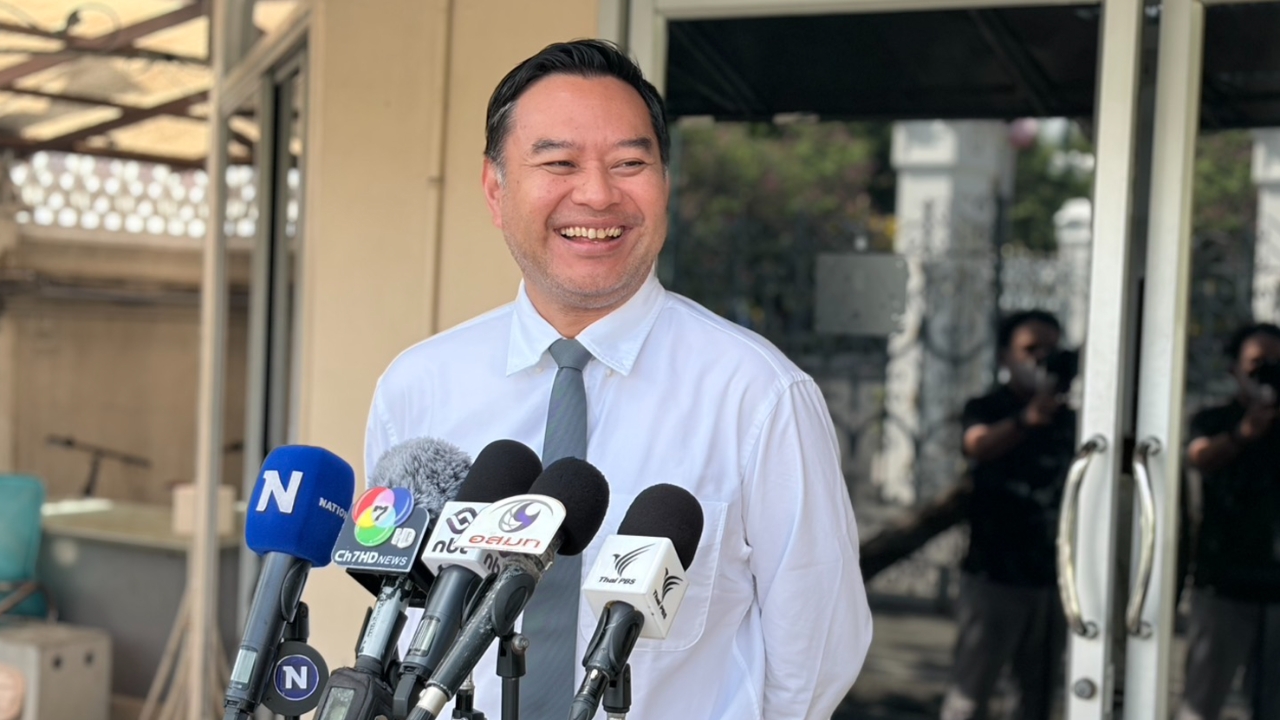
The government spokesperson revealed that Thailand is about to sign an MOU with China to create a laboratory for testing toxins in rivers. Deputy Prime Minister Sihasak is flying to Myanmar to resolve pollution and border conflict issues, with expectations of positive results.
At 10:00 a.m. on 12 November 2026 at the Government House, Mr. Ekaphop Pianpiset, spokesperson for the Prime Minister’s Office, announced that during the official visit of the Prime Minister of the People's Republic of China, an MOU will be signed to support an environmental toxin testing laboratory with Mae Fah Luang University to address water problems in Chiang Rai Province. One of the nine joint items is cooperation and support to establish the lab to tackle environmental issues in Chiang Rai and northern areas. The provincial governor and team have continuously inspected and consulted on site. Meanwhile, the Pollution Control Department has checked water quality and communicated with Myanmar. Thai side found problems but Myanmar side has not yet conducted testing or informed local people. It is believed that if residents on both sides share information, they can work together to resolve the issue.
Mr. Ekaphop said that regarding foreign affairs, the Kok and Sai Rivers originate in Myanmar. The Thai government has already taken action: when water problems were found, Chiang Rai Province moved its water production source from the Kok River to the Lao River, with budget approval secured. There is also a plan to connect the Sai River to nearby areas. The Ministry of Foreign Affairs has initiated ASEAN countries to start discussions with Myanmar about resolving border conflicts affecting Thailand and about toxins in the rivers.
Mr. Ekaphop added that today (12 Nov), Deputy Prime Minister and Foreign Minister Sihasak Puangketkaew has traveled to Myanmar with military leaders and the Ministry of Natural Resources and Environment to discuss these issues, with expectations of positive outcomes.
When asked if Myanmar would help solve the problem since mining occurs in Shan State, Mr. Ekaphop said that international cooperation requires collaboration on many levels, both local and regional. The best approach is to contact the central government first as coordinator, since the Ministry of Foreign Affairs cannot directly negotiate with Shan State. Additionally, cooperation will involve the People's Republic of China through the Mekong-Lancang cooperation framework, employing all parties to participate.
Asked if there is a set timeframe for Myanmar to resolve the problem, Mr. Ekaphop said they must wait for Deputy Prime Minister Sihasak’s return because today’s discussions are crucial. The issue will also be raised at the ASEAN summit next week in the Philippines, focusing on environmental cooperation covering smoke haze, transboundary pollution, water pollution, and marine issues.
When asked whether the 13 November talks with the Chinese Prime Minister would successfully resolve water issues, Mr. Ekaphop said cooperation is increasingly clear, with Myanmar and ASEAN more engaged and Thailand stepping up efforts. China, as a country with investors benefiting from extracted minerals, also plays a part. Signing the MOU shows China recognizes the importance and is committed to helping fully. During the Chinese Prime Minister’s visit to Thailand, multiple topics including the environment will be discussed.